
A Day Trip to Chobe National Park
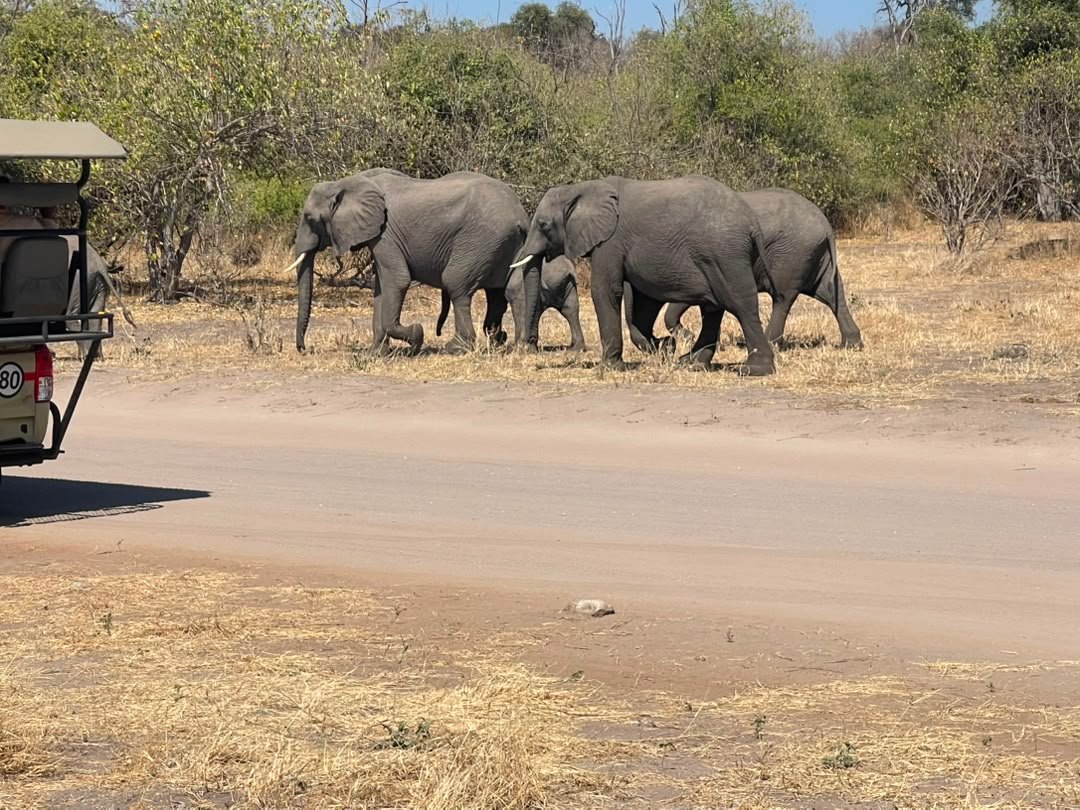
A Day Trip to Chobe National Park is one of the most rewarding short safari experiences in Southern Africa, giving travelers the opportunity to cross into Botswana and experience one of the continent’s great wildlife destinations without needing to add several extra nights to their itinerary. Chobe National Park covers approximately 11,700 square kilometres of northern Botswana and protects a remarkably varied landscape of river frontage, floodplains, woodland, seasonal marshes and open wildlife country. The Chobe River forms a defining part of the park’s northern boundary and plays an enormous role in supporting the area’s wildlife, particularly during the drier months when animals gather around permanent water.
What makes a Chobe day trip particularly attractive is the amount of safari experience that can be fitted into one well-planned day. Rather than spending the entire excursion inside a safari vehicle, a typical day combines wildlife viewing from the Chobe River with a 4×4 game drive inside Chobe National Park. This gives visitors two completely different perspectives of the same ecosystem. From the river, travelers may watch elephants approaching the water, hippos resting in channels, crocodiles along the banks and antelope feeding on the floodplains. From the safari vehicle, the experience moves deeper into the riverfront habitat in search of elephants, buffaloes, giraffes, zebras, antelopes and predators. Boat cruises and 4×4 wildlife drives are both established safari activities in the Chobe region.
For travelers staying around Victoria Falls in Zimbabwe or Livingstone in Zambia, this is also one of the easiest ways to add Botswana to a wider Southern African holiday. Instead of choosing between the spectacle of Victoria Falls and a traditional wildlife safari, visitors can comfortably build both destinations into the same journey. Kasane, the tourism gateway to Chobe National Park, sits on the Chobe River and is specifically positioned as an access point for travelers moving between Chobe, Victoria Falls and Livingstone.
A well-organized Chobe National Park day trip normally begins early in the morning and continues through the afternoon, with international border formalities, a river safari, lunch and a game drive incorporated into the schedule. Although it is only a day excursion, it should not be viewed simply as a quick sightseeing tour. Chobe’s rich riverfront ecosystem means that travelers can experience genuine African wilderness, large concentrations of wildlife and some of Botswana’s most memorable safari scenery before returning to their Victoria Falls or Livingstone hotel the same evening.
Why Take a Day Trip to Chobe National Park?
There are many excellent safari destinations around Victoria Falls and the wider Zambezi region, but Chobe occupies a special position because of the combination of its wildlife density, permanent river, elephant viewing and convenient cross-border location. It is particularly suitable for travelers who have limited time but still want a meaningful Botswana safari rather than simply visiting another attraction.
A day in Chobe also introduces a completely different landscape from Victoria Falls. Around the falls, the experience is dominated by the Zambezi River plunging dramatically into the Batoka Gorge. At Chobe, water creates a broader and quieter landscape of channels, islands, floodplains and riverbanks used continuously by wildlife. Combining the two destinations therefore creates much greater variety within a relatively short journey.
Exceptional Wildlife Viewing
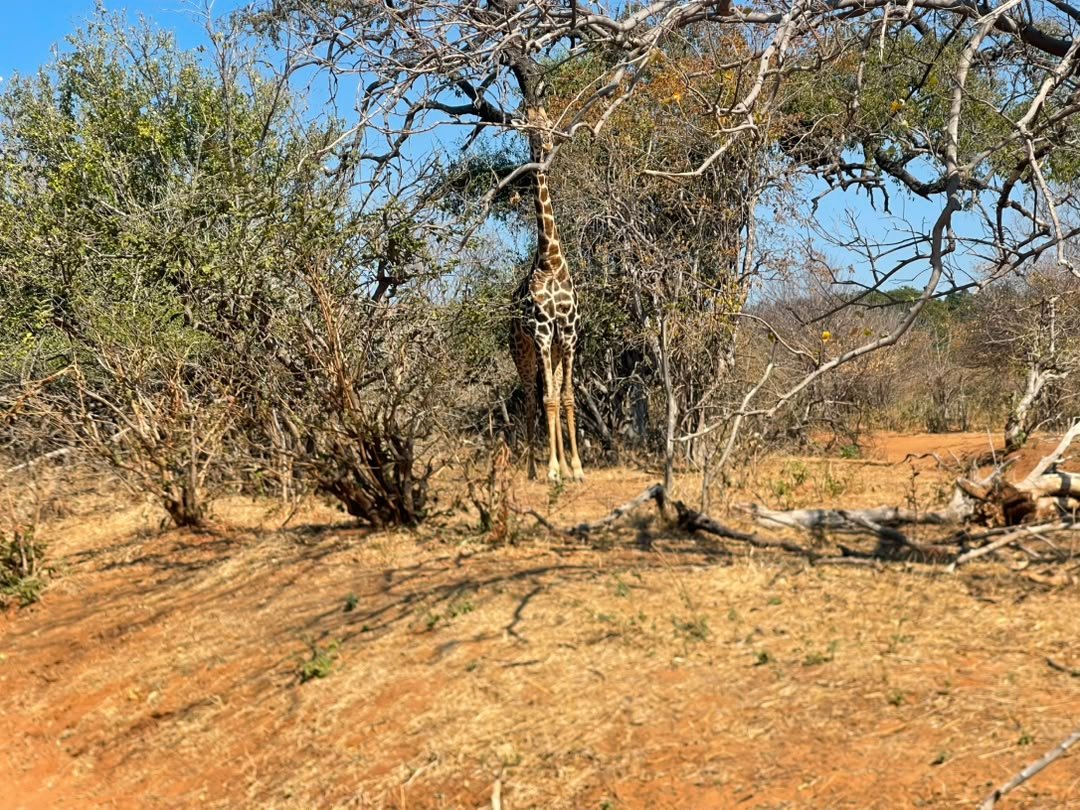
One of the strongest reasons to choose a Day Trip to Chobe National Park is the remarkable diversity of wildlife that can be encountered around the Chobe Riverfront. Botswana Tourism describes Chobe as a park with exceptionally prolific wildlife, while its combination of floodplains, swamps and woodland creates habitat for an impressive range of mammals and birds.
Wildlife viewing during a Chobe day safari can include African elephants, Cape buffaloes, giraffes, zebras, impalas, greater kudu, warthogs, baboons and numerous other antelope species. Along the river itself, visitors frequently search for hippos and Nile crocodiles, while the wetland environment supports an extraordinary variety of waterbirds and raptors. Predators such as lions and leopards also occur within the park, although, as with every authentic safari, individual wildlife sightings can never be guaranteed.
The riverfront makes Chobe particularly productive because travelers are not dependent on a single method of wildlife viewing. Animals hidden behind vegetation from the road may be much easier to observe from the river, while species moving through woodland away from the water may be encountered during the game drive. Using both boat and vehicle therefore creates a broader safari experience than relying on either activity alone.
The scenery also changes throughout the year. During drier periods, permanent water becomes increasingly important and wildlife often concentrates near the Chobe River. During greener months, the park becomes lush and vibrant, with seasonal birdlife, young animals and dramatic skies adding another character to the safari. This means Chobe is not simply a destination with one short “good season”; different months offer different visual and wildlife experiences.
Famous Chobe Elephant Herds
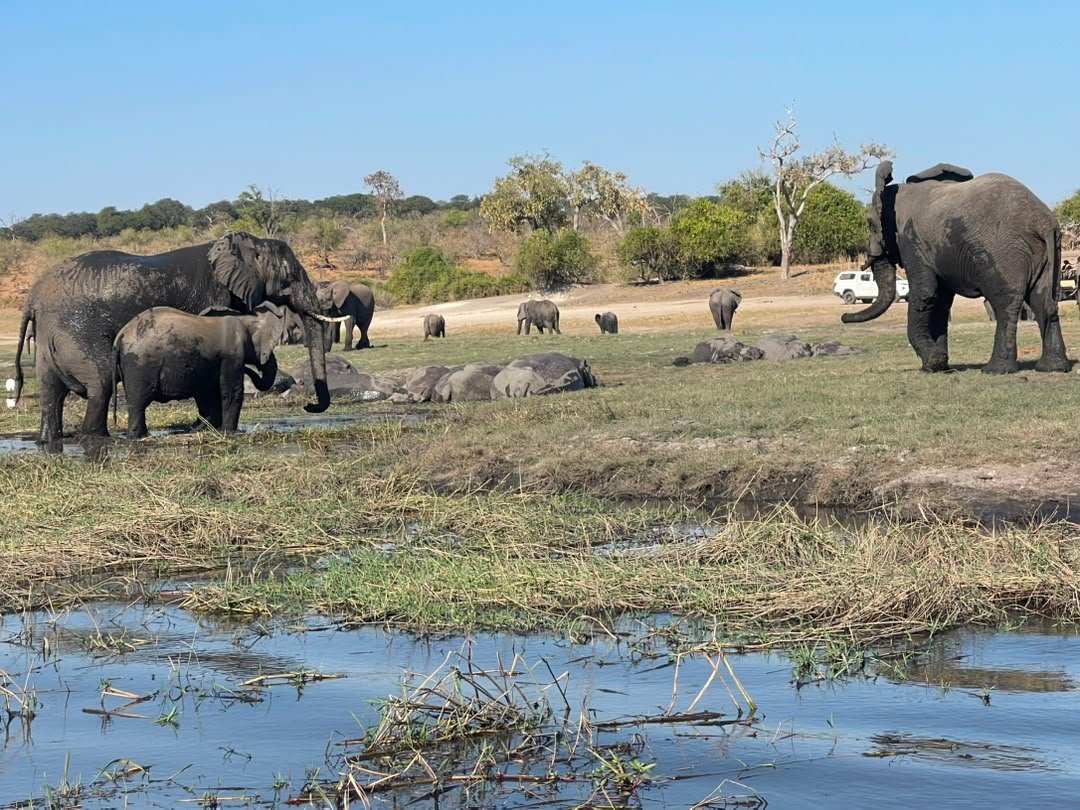
Chobe’s elephants are among the park’s greatest attractions, making a day trip to Chobe National Park especially rewarding for wildlife lovers. Botswana’s official tourism information identifies Chobe National Park as particularly famous for its exceptional elephant herds, and the northern Chobe ecosystem is widely regarded as one of Africa’s most important elephant landscapes.
The Chobe River is especially important to elephants because it provides dependable water within an otherwise seasonally dry environment. During the dry season, visitors may encounter family groups moving through woodland toward the river, elephants drinking at the water’s edge, youngsters playing in the shallows, or entire herds spreading across open floodplains.
Experiencing elephants from the river provides a completely different perspective from seeing them through the windows of a safari vehicle. During a day trip to Chobe National Park, a boat safari can offer wide, unobstructed views across the floodplain, making it possible to watch natural elephant behavior unfold over longer periods. A herd may gradually emerge from the woodland, walk toward the water, drink, spray themselves with mud, interact socially, and eventually move back into the surrounding landscape.
During the game-drive portion of the day, the encounter becomes more intimate with the terrestrial environment. Elephants can appear beside woodland tracks, move quietly through mopane vegetation, or cross the road ahead of the safari vehicle. The contrast between these land-based encounters and the broad river views is one reason Chobe works so well as a one-day safari destination.
Travelers planning a day trip to Chobe National Park should nevertheless remember that Chobe is a wilderness area rather than a zoo. Wildlife moves freely according to water, food, weather, and natural behavior. The strength of the destination lies not in guaranteeing a particular sighting but in placing visitors inside one of Southern Africa’s most important wildlife ecosystems, where every game drive and boat safari can bring a different and memorable experience.
Combine a Game Drive and Boat Safari in One Day
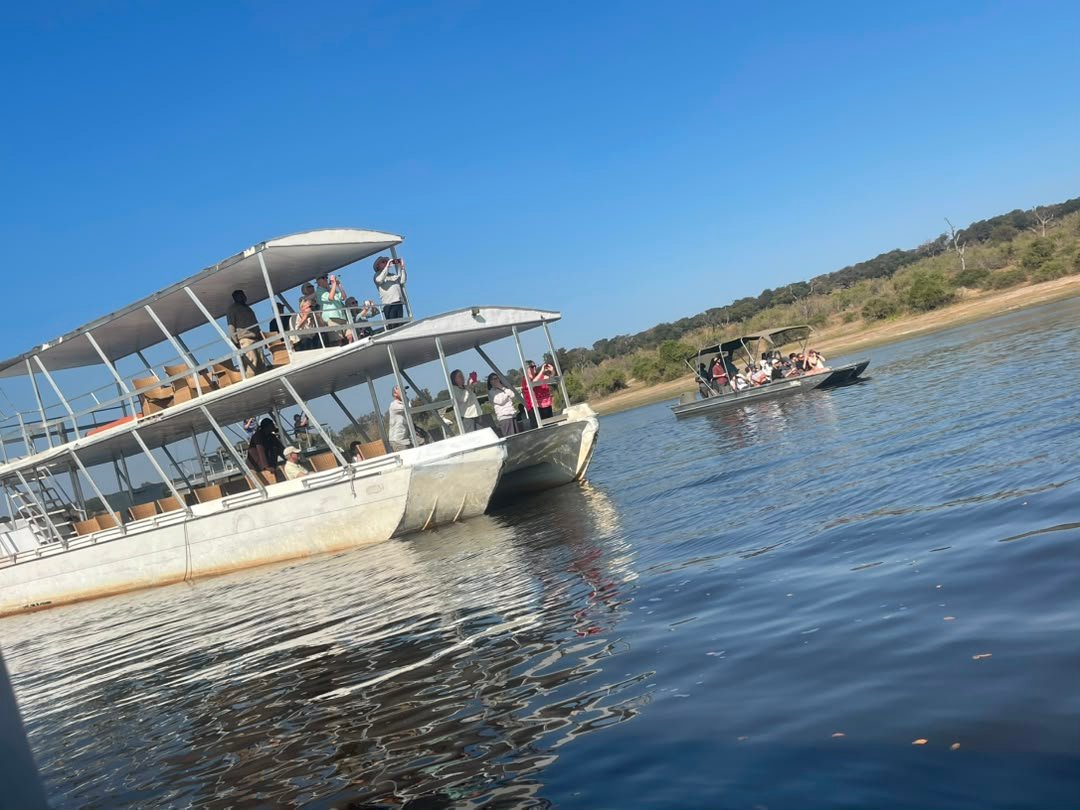
Another major advantage of a Chobe National Park day trip is the ability to experience two distinct safari styles without having to spend several days in Botswana. A typical full-day excursion combines a Chobe River boat safari and an open-vehicle game drive, giving travelers both water-based and land-based wildlife viewing. This combination is a standard feature of Chobe day excursions from the Victoria Falls region.
The boat safari explores the Chobe River and its surrounding floodplains. From the water, travelers can look across open islands and riverbanks rather than through dense roadside vegetation. Hippos, crocodiles, waterbirds and animals coming to drink become the focus, while elephants near or entering the water can create some of the day’s most memorable encounters.
The game drive provides the second half of the experience. Open safari vehicles enter the park’s road network, particularly around the productive Chobe Riverfront, allowing guides to search woodland, open areas and river-edge habitat for mammals that may not be visible from the boat.
This combination also benefits photographers. River safaris can produce low-angle views across the water and opportunities to photograph reflections, elephants against open floodplains and birds close to river level. Game drives provide a different perspective for photographing larger mammals, predators and animals moving through woodland.
The result is a safari that feels much more substantial than its one-day duration might suggest. By the time travelers return to Victoria Falls or Livingstone, they may have crossed an international border, visited Botswana, explored the Chobe River, enjoyed a safari lunch and completed a traditional African game drive—all within a single day.
Easy Access from Victoria Falls and Livingstone
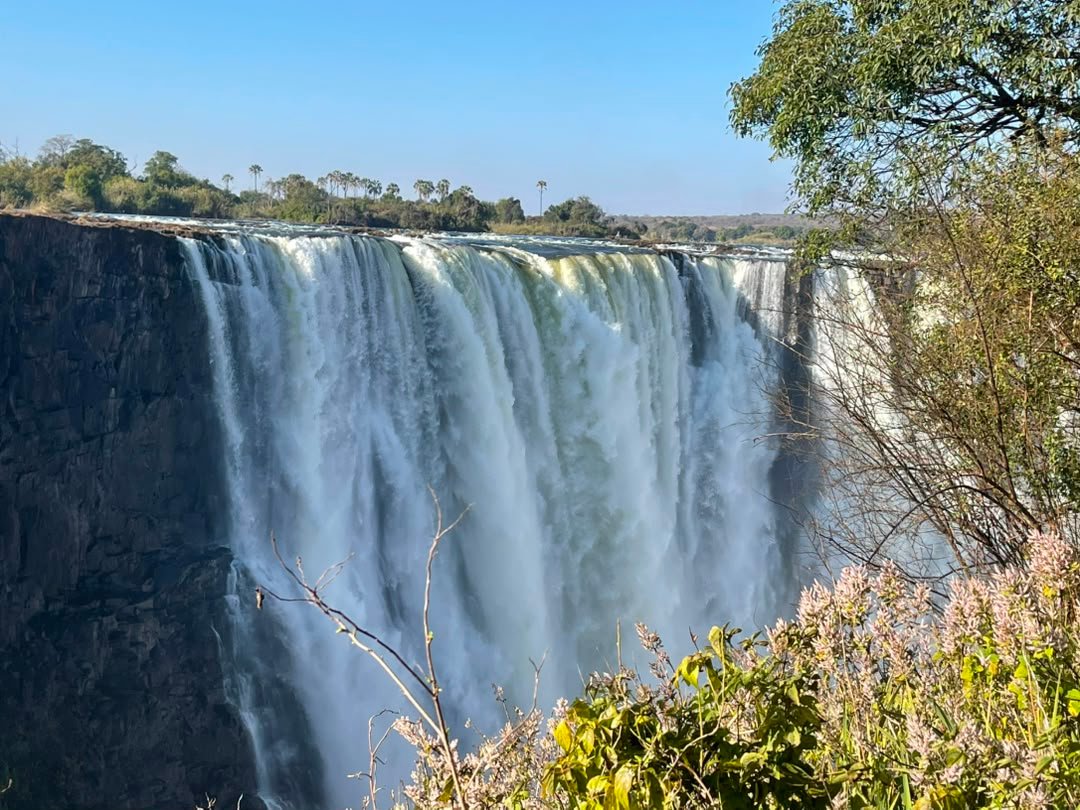
Chobe National Park’s position is another reason it has become such a natural extension to a Victoria Falls holiday. Kasane is the gateway town to Chobe National Park, located along the Chobe River and strategically positioned for travel between Botswana, Zambia, Zimbabwe and Namibia. Botswana Tourism specifically describes Kasane as an important access point for both Victoria Falls in Zimbabwe and Livingstone in Zambia.
From Victoria Falls, Zimbabwe, the road journey to Kasane is roughly 84 kilometres, although the overall transfer time varies according to border procedures, traffic and the day’s logistics. This relatively short distance means travelers can leave Victoria Falls early in the morning, cross into Botswana, complete their Chobe safari activities and return to Zimbabwe later the same day.
Travelers staying in Livingstone, Zambia enjoy similarly convenient access. The road distance toward Kasane is approximately 82 kilometres, again making a same-day safari practical when transfers and border formalities are well coordinated.
This geographical relationship is one of the great advantages of traveling in the Victoria Falls–Chobe region. A visitor can stand beside one of the world’s great waterfalls in Zimbabwe or Zambia and, the following morning, be watching elephants beside the Chobe River in Botswana.
For travelers with limited time, that combination is difficult to match.
Where is Chobe National Park?
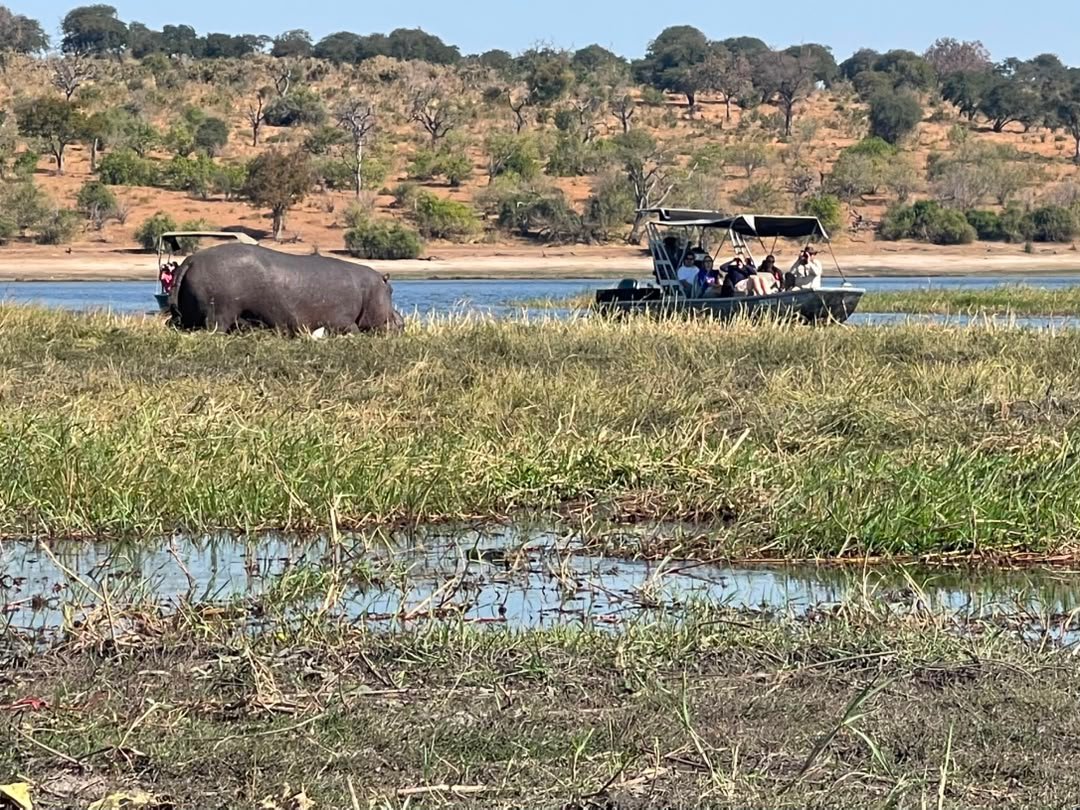
Chobe National Park is located in northern Botswana, close to the country’s borders with Namibia, Zambia and Zimbabwe. The park covers approximately 11,700 square kilometres, incorporating floodplains, woodland, marshes and riverine habitat. The Chobe River defines much of its northern landscape, while different ecological regions extend deeper into the park.
For most travelers taking a one-day safari, however, the most important area is the Chobe Riverfront near Kasane. This northeastern section of the park is the most practical area to reach on a day excursion because of its proximity to Kasane, the river and international border connections.
The location also places Chobe within the wider Kavango-Zambezi region, an enormous cross-border conservation landscape linking Angola, Botswana, Namibia, Zambia and Zimbabwe. Zambia Tourism describes the KAZA region as being centred around the Caprivi Strip, Chobe River and Victoria Falls area.
This helps explain why the region works so well for multi-country travel. Victoria Falls, Livingstone, Kasane and Chobe are not isolated destinations requiring separate long-distance journeys; they form part of the same broader tourism and conservation corridor.
Location of Chobe National Park in Botswana
Chobe National Park lies in the far north of Botswana, with Kasane serving as its principal tourism gateway. The town stretches along the Chobe River and offers accommodation, safari operators, boat departure points and logistical services for visitors entering the national park. Botswana Tourism describes Kasane as the gateway to Chobe and an important departure point for travelers connecting with Victoria Falls, Livingstone and Namibia.
Although Chobe National Park is extensive, most day visitors do not attempt to explore its remote interior. Areas such as Savuti and Linyanti are better suited to longer Botswana safaris because reaching them requires considerably more time.
A day trip therefore concentrates primarily on the Chobe Riverfront, where the combination of permanent water, floodplain and woodland supports excellent wildlife viewing while remaining conveniently accessible from Kasane.
This is an important distinction when describing a Chobe day trip. Visitors are not trying to “cover” the entire 11,700-square-kilometre national park in a few hours. Instead, they focus on one of its most wildlife-rich and accessible ecosystems.
Distance from Victoria Falls to Chobe National Park
Victoria Falls in Zimbabwe is approximately 84 kilometres by road from Kasane, the gateway to the Chobe Riverfront. In practical safari planning, travelers should think in terms of roughly 1½ to 2 hours of transfer time each way, depending especially on border procedures rather than simply the driving distance.
Most organized excursions begin with an early hotel pickup in Victoria Falls. The road travels west toward the Botswana border, after which immigration formalities are completed before continuing toward Kasane and the Chobe safari area.
The relatively short transfer is what makes the trip so attractive. Travelers do not need to take a domestic flight or spend most of the day on a long road journey. Instead, a substantial portion of the day can be devoted to activities inside the Chobe ecosystem.
For visitors building a Southern Africa itinerary, this makes Victoria Falls and Chobe National Park one of the region’s most natural destination combinations—the dramatic waterfall experience of the Zambezi followed by classic Botswana wildlife viewing.
Distance from Livingstone to Chobe National Park
Livingstone in southern Zambia is also conveniently positioned for a Chobe day safari. The road journey toward Kasane is approximately 82 kilometres, making the excursion feasible as a full-day international safari from Zambia.
Travelers are normally collected early from their Livingstone accommodation and transferred toward Kazungula. After completing the appropriate Zambia and Botswana border procedures, the safari continues toward Kasane and the Chobe Riverfront.
Livingstone is therefore an excellent base for travelers who want to combine several contrasting experiences within the same itinerary: Victoria Falls, activities on or around the Zambezi River, and a Botswana wildlife safari.
The ability to leave a hotel in Zambia in the morning, spend much of the day exploring Botswana’s Chobe ecosystem and return to Livingstone later that evening makes the excursion particularly valuable for travelers whose Southern African itinerary is already tightly scheduled.
Kazungula Border Crossing
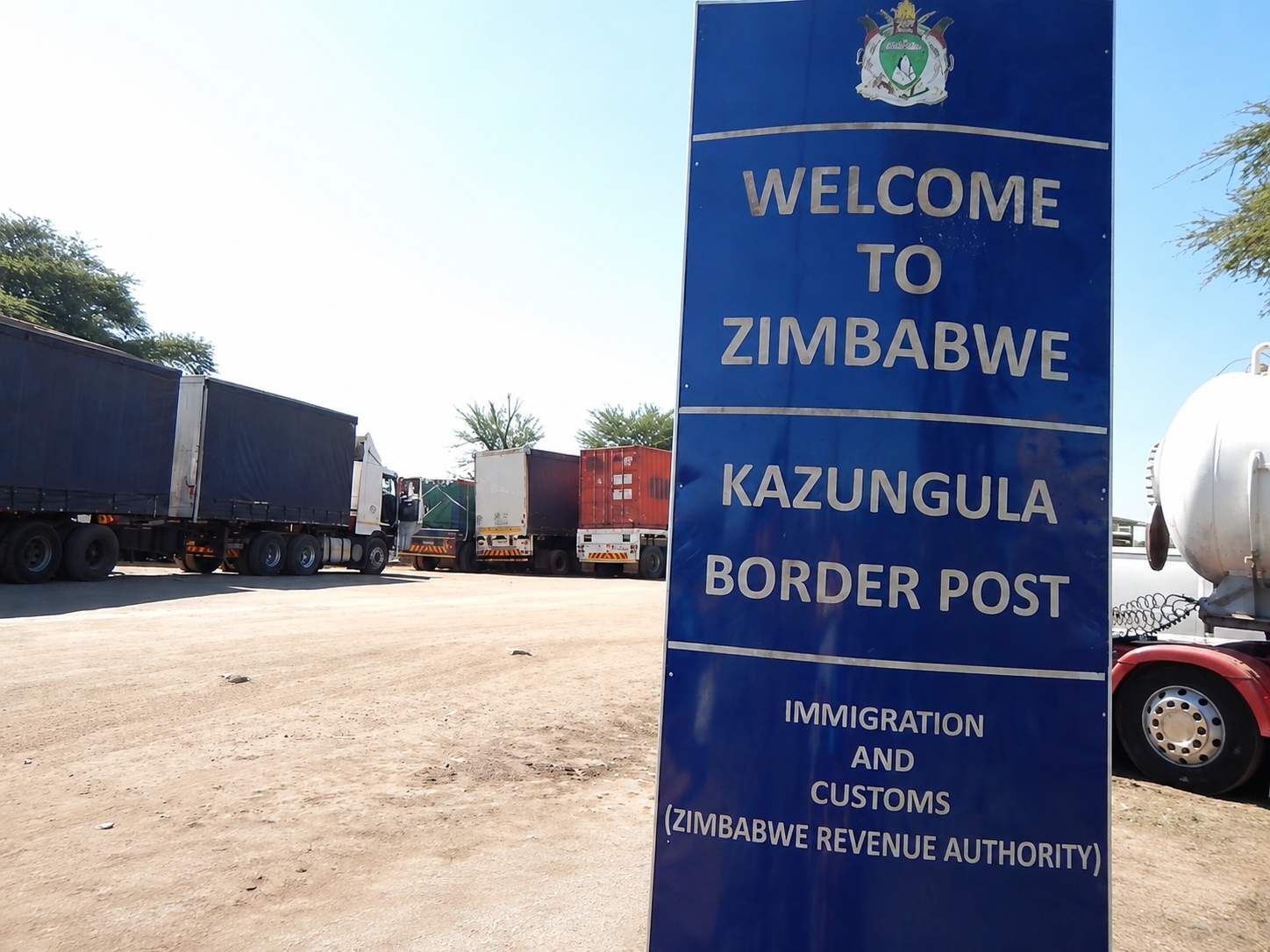
The Kazungula area is one of the most important transport links in this part of Southern Africa, connecting the tourism corridor around Botswana, Zambia and Zimbabwe. For visitors traveling from Livingstone, the Kazungula route provides access between Zambia and Botswana, while travelers coming from the Zimbabwe side use the relevant Botswana–Zimbabwe border route before continuing toward Kasane.
Border procedures form an important part of planning a Chobe day trip because visitors are entering another country and, in many cases, returning to their original country later the same day. Travelers should therefore carry their original passport and confirm Botswana entry requirements as well as the re-entry conditions for Zambia or Zimbabwe that apply to their nationality.
For eligible travelers, the KAZA UniVisa can make a combined Zambia–Zimbabwe itinerary more convenient and also covers qualifying day trips into Botswana through the Kazungula border for visits to Kasane or Chobe National Park. Zambia Tourism advises travelers to verify eligibility and current visa requirements because immigration conditions can change.
Travelers should not treat the border crossing as an inconvenience but rather as part of what makes the experience unusual. A Chobe day trip allows visitors to experience the interconnected nature of the Victoria Falls region, where some of Southern Africa’s most important tourism destinations sit remarkably close to one another across international borders.
A professionally organized Day Trip to Chobe National Park should coordinate transfers on both sides of the border, allow sufficient time for immigration formalities and structure the day so that border procedures do not unnecessarily reduce safari time. With these logistics properly arranged, the journey from Victoria Falls or Livingstone into Botswana becomes a smooth transition from one iconic Southern African destination to another.
Chobe National Park Day Trip at a Glance
A Chobe National Park Day Trip is designed to give travelers a complete Botswana safari experience within a single day, combining comfortable cross-border transfers, wildlife viewing on the Chobe River, a traditional 4×4 game drive and time for lunch between activities. It is particularly popular with travelers staying in Victoria Falls, Zimbabwe, or Livingstone, Zambia, because both destinations are close enough to Botswana for visitors to leave early in the morning, spend several hours exploring the Chobe ecosystem and return to their hotel that evening.
Although the experience takes place in one day, it should be considered a full safari excursion rather than a short sightseeing trip. The day usually starts early so that travelers can complete border formalities and reach the Chobe area while wildlife activity is still high. Most itineraries divide the safari between a river-based experience and a land-based game drive, allowing guests to explore two sides of Chobe’s wildlife environment.
| Trip Detail | Typical Chobe Day Trip Arrangement |
|---|---|
| Starting Point | Victoria Falls, Zimbabwe; Livingstone, Zambia; or Kasane, Botswana |
| Departure Time | Usually approximately 06:30–07:30 depending on hotel location and border logistics |
| Duration | Approximately 10–12 hours from Victoria Falls or Livingstone; shorter when starting in Kasane |
| Destination | Chobe National Park and the Chobe Riverfront, Botswana |
| Main Activities | Chobe River boat safari and 4×4 game drive |
| Meals | Lunch is normally included; bottled drinking water is generally provided during the safari |
| Transport | Road transfer plus open-sided or open-roof 4×4 safari vehicle and motorized safari boat |
| Border Crossing | Botswana immigration plus departure/re-entry formalities for Zimbabwe or Zambia where applicable |
| Return Time | Commonly between approximately 17:30 and 19:00 depending on starting point and border conditions |
Exact times can vary according to season, border traffic, wildlife activity, pickup location and the operating schedule on the day.
Starting Point
A Chobe National Park day trip can begin from Victoria Falls in Zimbabwe, Livingstone in Zambia or Kasane in Botswana, although Victoria Falls and Livingstone are the most popular starting points for international visitors adding Botswana to a Victoria Falls holiday.
Travelers staying in Victoria Falls are normally collected directly from their hotel or lodge early in the morning. The journey continues toward the Botswana border, where guests complete immigration formalities before meeting the Botswana safari team for the onward transfer toward Kasane and the Chobe Riverfront. Because Victoria Falls and Chobe are located relatively close to each other within the wider Kavango-Zambezi region, the combination allows travelers to experience two very different natural attractions without requiring another overnight stay.
Guests beginning from Livingstone follow a similar schedule, traveling toward the Kazungula area before entering Botswana. Livingstone is especially convenient for travelers already exploring the Zambian side of Victoria Falls who want to add a classic wildlife safari to their itinerary.
Starting directly from Kasane is the easiest option because travelers are already beside Chobe National Park. It eliminates the international border crossing at the beginning and end of the excursion, allowing more flexibility in departure times and potentially more time for wildlife viewing.
For private safaris, pickup arrangements can often be adapted to the guest’s hotel, group size and onward travel plans. However, an early start remains strongly recommended because mornings are generally cooler and provide valuable wildlife-viewing time before the heat of the middle of the day.
Departure Time
Most Chobe National Park day trips from Victoria Falls or Livingstone begin between approximately 06:30 and 07:30. The early departure is important because the itinerary must accommodate road transfers, immigration procedures and two major safari activities before returning across the border in the late afternoon.
Guests are normally advised to have breakfast before departure or arrange an early breakfast with their hotel. In some cases, lodges can prepare a breakfast box for travelers leaving before the property’s normal breakfast hours.
The road transfer is not simply dead travel time. As the journey approaches Botswana, the scenery begins to change from the Victoria Falls tourism zone toward increasingly wild woodland and conservation landscapes. Wildlife can occasionally be encountered even outside the national park boundaries, although sightings along public roads should never be expected or treated as guaranteed.
An efficient morning transfer is important because one of the advantages of a Chobe day trip is maximizing actual safari time. Experienced operators therefore coordinate vehicles and guides so that travelers can move through the border process and continue toward Kasane with as little unnecessary waiting as possible.
Guests starting directly from Kasane may have greater flexibility, with safari activities beginning later or being arranged around preferred boat and game-drive times.
Duration
A full Chobe National Park Day Trip from Victoria Falls or Livingstone normally occupies most of the day, with travelers commonly away from their accommodation for approximately 10 to 12 hours.
The length should not be interpreted as continuous driving. Only a portion of the day is spent transferring between destinations. Much of the excursion is devoted to wildlife viewing, with several hours divided between the Chobe River and the national park’s road network.
A typical day may include an early transfer to Botswana, morning safari activity, lunch, an afternoon wildlife activity and the return journey. Depending on the operator, the boat cruise may take place in the morning and the game drive in the afternoon, or the sequence may be reversed.
This flexibility is useful because Chobe is a natural environment. River conditions, wildlife movements, park activity and operational considerations may influence the order that produces the best experience on a particular day.
Travelers should therefore keep the entire day available rather than planning another major activity immediately after the expected return time. Border procedures and road conditions can occasionally create delays, particularly during busy travel periods.
Destination
The principal destination is the Chobe Riverfront section of Chobe National Park in northern Botswana, accessed through the safari town of Kasane.
Although Chobe National Park extends across a very large area, a day safari naturally concentrates on the northeastern riverfront rather than distant sections such as Savuti. This is not a limitation. The Chobe Riverfront is one of the park’s most productive wildlife areas and is particularly well suited to short safaris because permanent water attracts large numbers of animals.
The landscape includes the broad Chobe River, seasonal floodplains, islands, woodland and open riverbanks. These different habitats support both terrestrial and aquatic wildlife, which is why combining a river cruise and game drive works so effectively.
From the river, visitors may observe animals approaching the water and moving across open floodplains. Once inside the park by vehicle, the experience shifts toward woodland tracks and terrestrial wildlife.
The destination is therefore more accurately described as the Chobe River ecosystem and Chobe Riverfront safari area, rather than simply a quick drive through Botswana’s national park.
Activities
The highlight of the Chobe day trip is the combination of two major safari activities: a Chobe River boat safari and an open-vehicle game drive inside Chobe National Park.
Chobe River Boat Safari
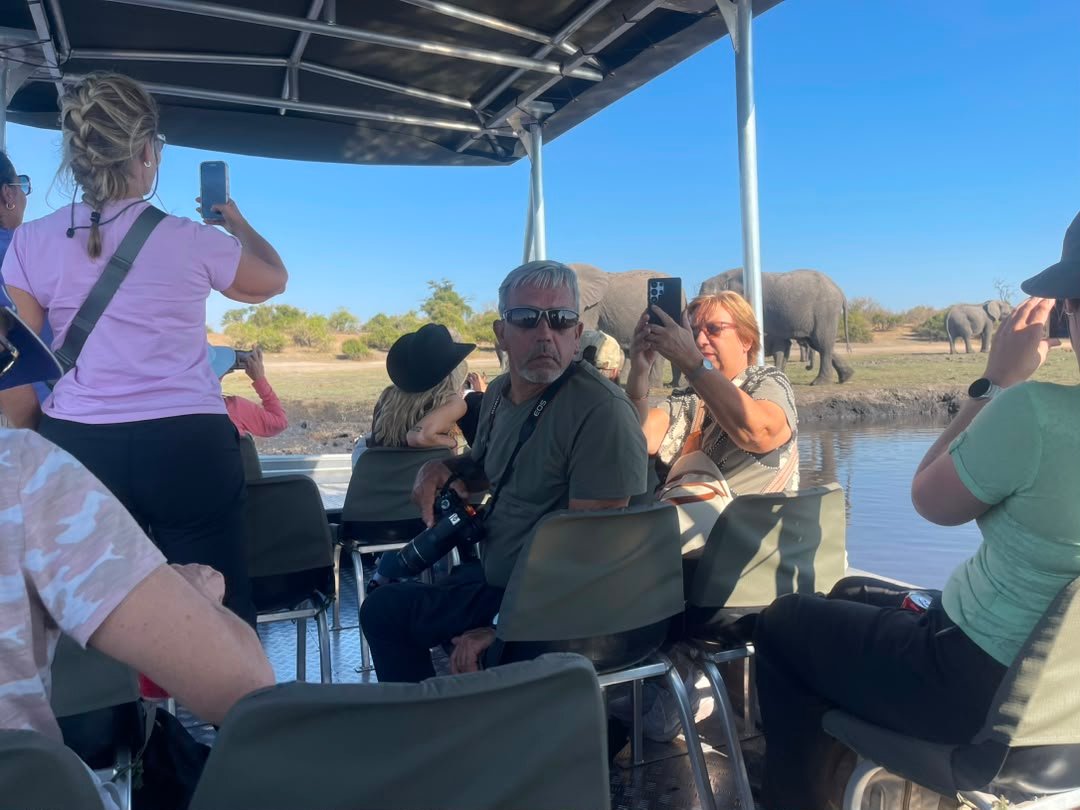
The river safari generally lasts several hours and explores the channels and wildlife-rich banks of the Chobe River. Boats allow guests to approach the ecosystem from a perspective that cannot be experienced from a safari vehicle.
Elephants may be seen drinking along the banks, feeding on floodplain vegetation or occasionally crossing channels. Hippos are frequently associated with the river environment, while Nile crocodiles may rest along exposed banks. Buffaloes, antelopes and other animals can also appear near the water.
Birdlife is another major attraction. Fish eagles, kingfishers, herons, storks and numerous wetland species make the river safari particularly rewarding for photographers and bird enthusiasts.
Because boats travel at a relatively relaxed pace, guests often have more time to observe animal behavior rather than simply moving between sightings.
Chobe National Park Game Drive
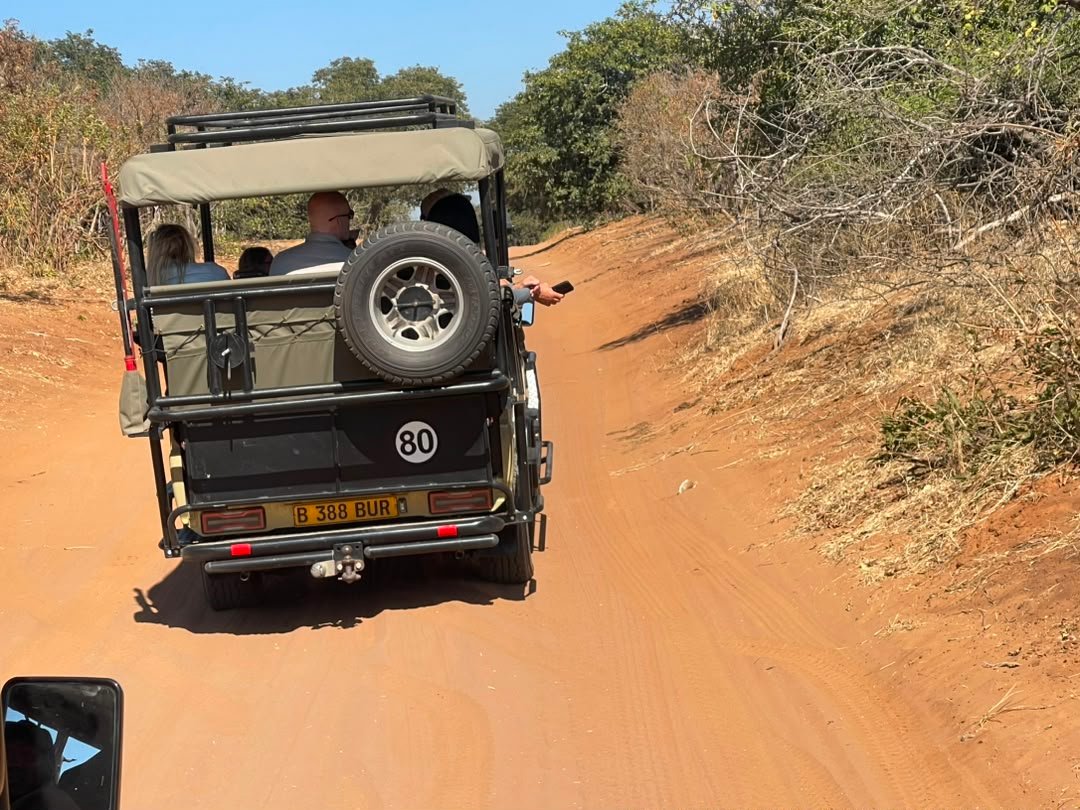
The second major component is a 4×4 safari game drive, usually concentrated around the Chobe Riverfront.
Open safari vehicles provide elevated views and allow guides to search for wildlife moving through woodland, open plains and river-edge habitat. Possible sightings include elephants, buffaloes, giraffes, zebras, impalas, kudus, baboons, warthogs and numerous smaller species.
Predators such as lions and leopards are also present, although sightings depend entirely on natural wildlife movements. Rather than promising individual species, a responsible safari should emphasize the richness of the ecosystem and the unpredictability that makes genuine wildlife encounters exciting.
Together, the game drive and boat safari mean that travelers are not repeatedly seeing the same landscape from the same viewpoint. The two activities complement each other and create a surprisingly complete safari experience within one day.
Meals
Lunch is normally included during a full-day Chobe excursion and is usually served in or around Kasane between the morning and afternoon safari activities.
The lunch break provides more than simply a meal. After several hours of early travel and wildlife viewing, it offers guests time to rest, use washroom facilities, refresh themselves and prepare for the second half of the safari.
Depending on the package, lunch may be served at a safari lodge, hotel, restaurant or designated dining venue overlooking or close to the Chobe River.
Meals typically include a selection of local and international dishes, although the exact menu depends on the selected operator and property.
Travelers with vegetarian, vegan, gluten-free, allergy-related or other dietary requirements should provide this information when booking so that suitable arrangements can be made in advance.
Bottled drinking water is commonly provided during transfers and safari activities. Guests may also wish to carry additional water, particularly during the hotter months.
Breakfast and dinner are normally taken at the traveler’s own accommodation unless a particular package specifically states otherwise.
Transport
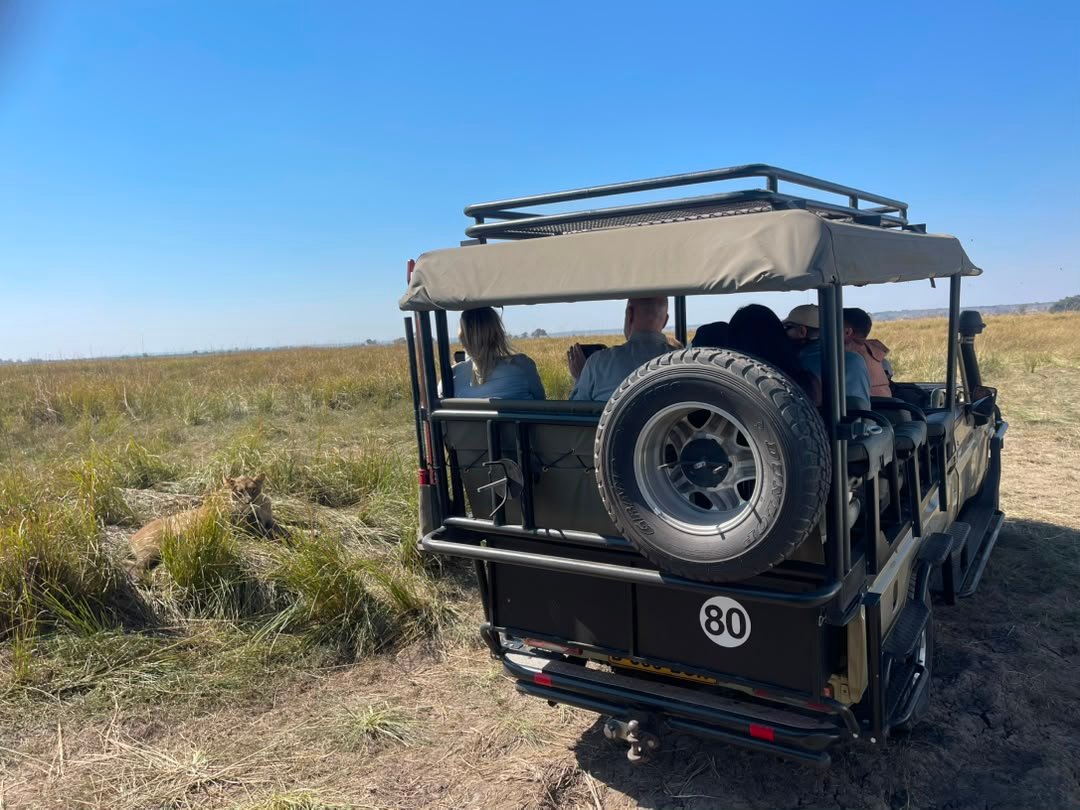
A Chobe National Park day trip normally involves three different forms of transport, each suited to a particular part of the experience.
The first is a comfortable road-transfer vehicle used between the guest’s hotel and the international border. On arrival at the Botswana side, travelers may change vehicles and continue with the local Botswana safari team.
Inside Chobe National Park, guests usually travel in a purpose-built 4×4 safari vehicle. These vehicles are designed for wildlife viewing and normally feature raised seating together with open sides or large viewing areas that improve visibility and photography opportunities.
The river portion is completed aboard a motorized safari boat designed for wildlife viewing on the Chobe River. Boats vary in size depending on whether travelers are joining a shared excursion or taking a private safari.
This combination is part of the appeal of the trip. Instead of spending ten hours sitting in one vehicle, guests experience road travel, a safari vehicle and a boat within the same excursion.
Private Chobe day trips may provide greater flexibility over departure times, vehicle use and the pace of wildlife viewing, while shared departures can be an economical option for travelers comfortable joining other safari guests.
Border Crossing
Travelers beginning in Victoria Falls or Livingstone should remember that a Chobe day trip is an international excursion. Botswana is a separate country, meaning passports and immigration procedures are required even when visitors return to their original hotel the same evening.
Guests traveling from Victoria Falls, Zimbabwe, cross from Zimbabwe into Botswana before continuing toward Kasane. At the end of the safari, they complete the appropriate Botswana exit procedures and re-enter Zimbabwe.
Travelers beginning in Livingstone, Zambia, travel through the Kazungula area and complete Zambia and Botswana immigration formalities in both directions.
Every traveler should carry their original passport, rather than a photocopy, and ensure that it meets the entry requirements applicable to their nationality.
Visa requirements differ according to citizenship and personal travel circumstances. Travelers should therefore confirm whether they require visas for Botswana as well as appropriate permission to re-enter Zimbabwe or Zambia after completing the Chobe excursion.
Those traveling through several countries in the Victoria Falls region should pay particular attention to whether they hold a single-entry, double-entry, multiple-entry or relevant regional visa arrangement.
Families traveling with children should also check whether additional documentation is required for minors before arriving at the border.
Because immigration rules may change, passport and visa requirements should always be confirmed before travel rather than relying solely on older online information.
A professionally arranged day trip should allow realistic time for these procedures and coordinate transfers on both sides of the border so guests do not have to arrange separate transportation themselves.
Return Time
After the afternoon safari activity, guests begin the return journey toward their original starting point.
Travelers staying in Victoria Falls or Livingstone commonly arrive back at their hotels during the early evening, often somewhere around 17:30 to 19:00, although the actual time depends on safari scheduling, traffic, border procedures and hotel location.
The return should therefore be treated as approximate rather than guaranteed to the minute.
Travelers who have an important flight, airport transfer, dinner reservation or other fixed commitment that evening should advise their safari operator before booking. Where possible, additional time should be built into the itinerary rather than relying on an extremely tight connection.
Guests staying in Kasane naturally have a much shorter return journey because they do not need to complete an international border crossing.
For travelers returning to Victoria Falls or Livingstone, the evening journey provides a fitting conclusion to a very full day. Within approximately one daylight period, visitors may have crossed into Botswana, cruised the Chobe River, watched elephants and hippos from the water, explored Chobe National Park by 4×4, enjoyed lunch in Kasane and returned to another country before nightfall.
Typical Chobe Day Trip Schedule
The exact sequence differs between operators, but a well-designed Chobe National Park Day Trip itinerary may follow a schedule similar to the following:
06:30–07:30 – Hotel Pick-Up
Guests are collected from their accommodation in Victoria Falls or Livingstone and begin the road transfer toward Botswana.
08:00–09:00 – Border Formalities and Transfer to Kasane
Complete immigration procedures before meeting the Botswana safari team and continuing into the Chobe area.
09:00–12:00 – First Safari Activity
Enjoy either a Chobe River boat safari or game drive depending on the day’s operating schedule.
12:00–13:30 – Lunch Break
Relax over lunch in Kasane or at a lodge near the Chobe River.
13:30–16:00 – Second Safari Activity
Complete the complementary game drive or boat cruise, exploring another part of the Chobe ecosystem.
16:00–17:00 – Depart Botswana
Begin the transfer back toward the border and complete Botswana exit procedures.
17:30–19:00 – Return to Hotel
Arrive back in Victoria Falls or Livingstone after a full day of safari experiences.
This schedule should be viewed as a planning guide rather than a rigid timetable. Wildlife safaris work best when there is enough flexibility to accommodate animal sightings, river conditions, border traffic and the natural rhythm of the day.
Chobe Day Trip in One Sentence
A Chobe National Park Day Trip gives travelers the opportunity to leave Victoria Falls or Livingstone in the morning, cross into Botswana, experience both a Chobe River boat safari and 4×4 wildlife drive, enjoy lunch near the river and return to their hotel the same evening—making it one of the most rewarding full-day wildlife excursions in the Victoria Falls region.
Detailed Chobe National Park Day Trip Itinerary
A Chobe National Park Day Trip is carefully designed to fit two very different safari experiences into one rewarding day: wildlife viewing from the Chobe River and a traditional 4×4 game drive through the Chobe Riverfront. Kasane is the principal gateway to Chobe National Park and is conveniently positioned for travelers coming from both Victoria Falls in Zimbabwe and Livingstone in Zambia. Botswana Tourism specifically identifies Kasane as the gateway to Chobe and an important access point for these neighboring destinations.
The itinerary below follows the popular format of a morning Chobe River boat safari followed by an afternoon game drive, although the sequence may occasionally be reversed depending on operational arrangements, river conditions, park schedules or the safari operator. Both activities are well-established ways of exploring Chobe, and Botswana Tourism-listed properties in the area commonly offer both 4×4 game viewing and boat cruises on the Chobe River.
Early Morning Pick-Up from Victoria Falls or Livingstone
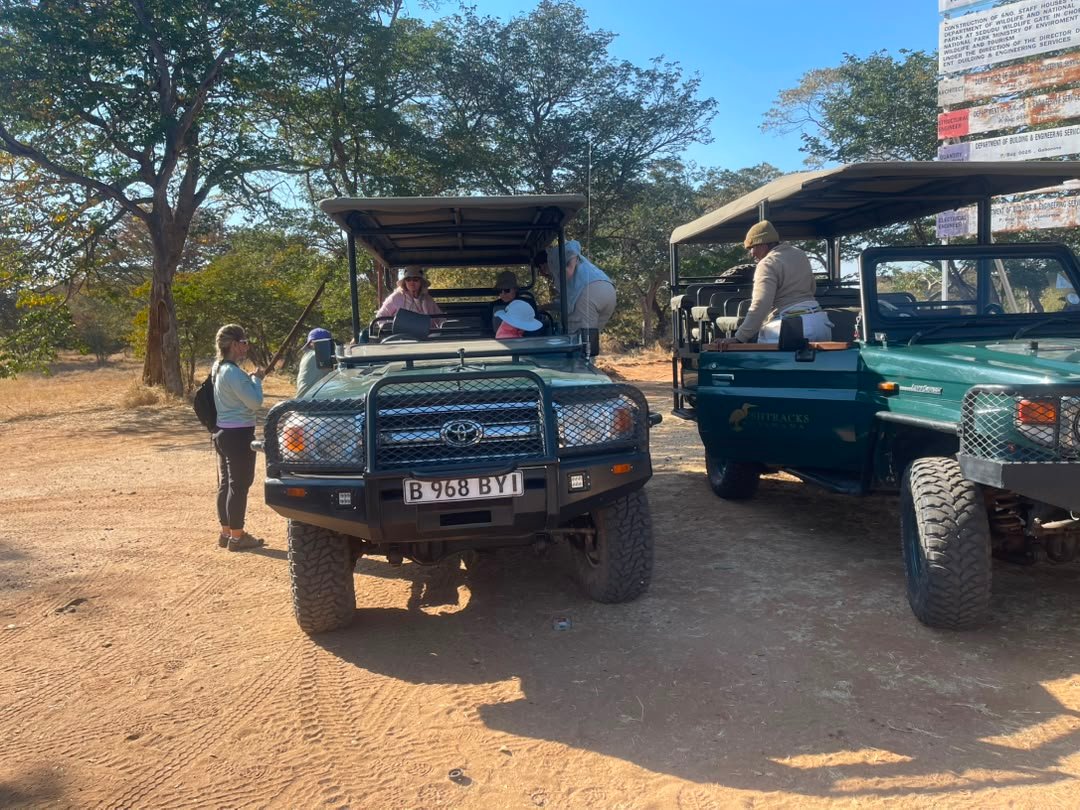
Your Chobe National Park Day Trip begins early in the morning, usually with collection from your hotel, lodge or another agreed meeting point in Victoria Falls, Zimbabwe, or Livingstone, Zambia. An early departure is essential because this is an international full-day excursion involving road transfers, immigration procedures, a river safari, lunch and an afternoon game drive before returning across the border.
The morning begins quietly as you leave the Victoria Falls or Livingstone tourism area and travel toward Botswana. This first part of the journey creates a gradual transition from the atmosphere surrounding Victoria Falls into the broader conservation landscapes of northern Botswana. Guests traveling privately can normally enjoy a relaxed transfer with their driver while receiving an introduction to the day’s route, expected border procedures and the experiences awaiting them in Chobe.
Travelers should ideally arrange an early breakfast at their hotel before departure. When departure falls before normal breakfast hours, many accommodations can prepare a packed breakfast when requested in advance. It is also advisable to carry your passport, camera, sunglasses, sunscreen, hat and any personal medication in a small day bag that remains easily accessible throughout the journey.
Clothing should be comfortable and practical. Morning temperatures can feel considerably cooler in an open safari vehicle, particularly during Southern Africa’s cooler dry-season months, while midday conditions may become warm or hot. Dressing in light layers makes it easier to adapt as temperatures change.
This early start is worthwhile. Rather than using half the day merely reaching the destination, travelers are positioned to enter Botswana early enough to enjoy substantial time within the Chobe ecosystem.
For guests beginning in Victoria Falls, the excursion creates one of the most attractive multi-country combinations in Southern Africa: seeing Victoria Falls in Zimbabwe and then experiencing Botswana’s wildlife within the same holiday.
For travelers based in Livingstone, the concept is equally rewarding. You can wake up near Victoria Falls in Zambia, cross into Botswana, spend the day exploring Chobe and return to the same Livingstone hotel in the evening. Kasane’s location is precisely what makes these combinations practical.
Transfer to the Botswana Border
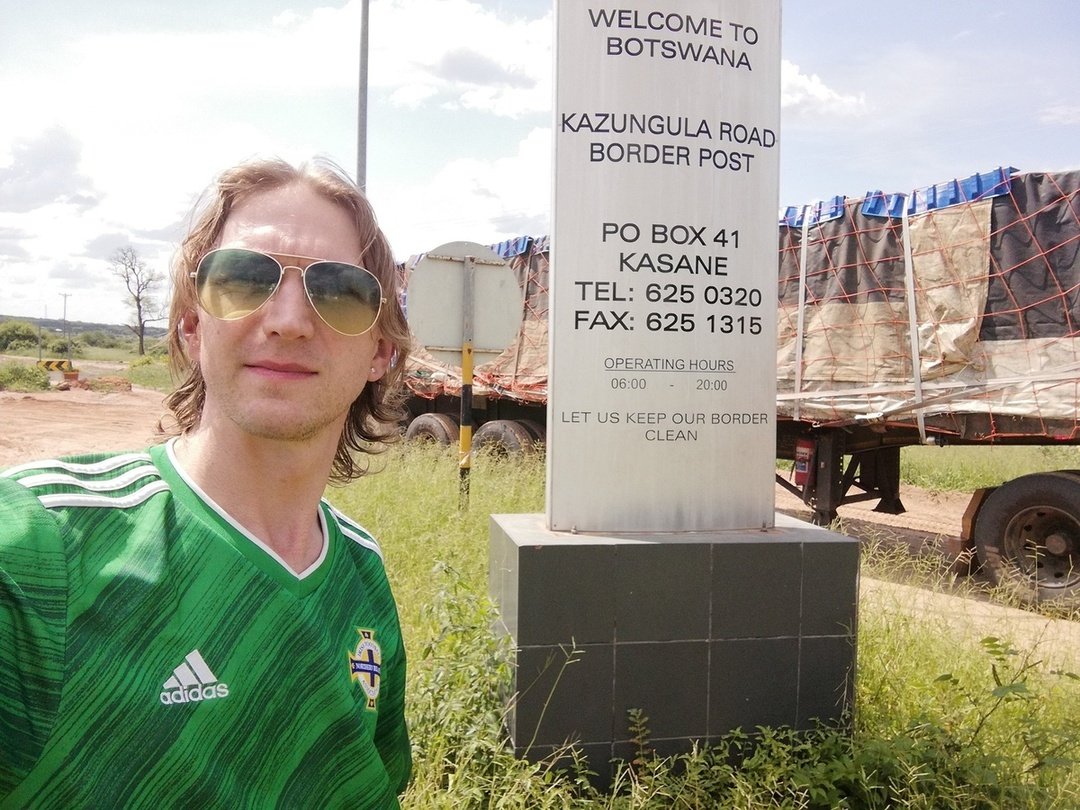
After leaving Victoria Falls or Livingstone, the road journey continues toward the relevant Botswana border crossing.
Travelers departing from the Zimbabwean side travel toward the Botswana–Zimbabwe border before continuing to Kasane. Those beginning in Livingstone travel toward the Kazungula area, where Zambia and Botswana are connected across the Zambezi River corridor.
Although the transfer is relatively short compared with many African safari routes, it forms an interesting part of the experience because the day involves traveling through a region where several Southern African countries meet within a remarkably compact geographical area. Kasane itself is strategically positioned near Zimbabwe, Zambia and Namibia and serves as the principal tourism center for northern Chobe.
The scenery gradually becomes less urban as the vehicle moves away from Victoria Falls or Livingstone. Depending on the season, travelers may pass dry woodland, greener roadside vegetation or broad sections of bush characteristic of this part of Southern Africa.
Guests occasionally become excited when they see wildlife along the route, but animals outside the national park should be regarded as a bonus rather than an expected part of the excursion. The real wildlife experience begins once the group reaches the Chobe ecosystem.
Your driver will normally explain what to expect at immigration before arrival. Keeping passports and necessary documentation ready helps make the process smoother.
Travelers should avoid packing the morning schedule too tightly. Although border crossings are often straightforward, immigration processing times can vary because of traffic, public holidays, group arrivals and other factors. A professionally designed Chobe itinerary therefore includes enough flexibility to protect the main safari activities even when border procedures take slightly longer than expected.
Border Formalities and Transfer to Kasane
On reaching the border, travelers leave the transfer vehicle as required and complete the relevant departure and Botswana entry formalities.
Because this is an international day trip, every traveler should carry an original valid passport and ensure before departure that they meet the entry requirements applicable to their nationality. Visitors returning to Zimbabwe or Zambia later the same day should also make certain that their visa or immigration status allows the necessary re-entry.
For some eligible travelers visiting Zambia and Zimbabwe, the KAZA UniVisa can simplify travel around the Victoria Falls region. Zambia Tourism states that the KAZA UniVisa permits multiple movement between Zambia and Zimbabwe during its validity and also covers qualifying day trips into Botswana through the Kazungula border for destinations such as Kasane and Chobe National Park. Eligibility and immigration rules should nevertheless be confirmed close to the travel date because visa policies can change.
Families traveling with children should check any documentation requirements for minors before starting the trip, while travelers carrying passports from countries requiring advance visas should arrange these well before safari day.
Once immigration formalities have been completed, the journey continues toward Kasane, the bustling safari town located along the Chobe River. Botswana Tourism describes Kasane as the gateway to Chobe National Park, and the town supports the area’s tourism industry with lodges, guesthouses, restaurants, boat operations and safari services.
This is often where guests meet their Botswana-based safari guide and transfer into the vehicle or boat being used for the first activity.
The atmosphere changes noticeably on reaching Kasane. Safari vehicles become a common sight, boats move along the river and signs of the surrounding wilderness are everywhere. Unlike a city that simply happens to be near a national park, Kasane functions very much as part of the wider Chobe safari experience.
From here, the day’s focus shifts away from international travel and completely toward wildlife.
Morning Chobe River Boat Safari
The morning Chobe River boat safari introduces travelers to one of the features that separates Chobe from many traditional African game-drive destinations.
Rather than beginning the safari entirely on dusty tracks, guests board a motorized safari boat and head onto the Chobe River, where islands, channels, floodplains and riverbanks create an entirely different wildlife-viewing environment.
Chobe National Park encompasses approximately 11,700 square kilometres of floodplains, swamps and woodland, and the Chobe River forms an important part of the park’s northern boundary. These contrasting habitats contribute enormously to the area’s wildlife richness.
The safari boat generally moves slowly enough for guests to observe wildlife behavior and photograph animals without constantly rushing between sightings. The guide scans the banks, exposed islands, reeds and channels while explaining the ecology of the river and the relationship between water and the wildlife living around it.
Elephants are one of Chobe’s signature attractions. Depending on season and natural movements, travelers may encounter elephants approaching the river to drink, feeding along the floodplain, splashing themselves with water or mud, or moving in family groups along the bank.
Watching elephants from the water can be especially memorable because the river gives visitors a broad, unobstructed perspective. Instead of looking through woodland from a vehicle, you may see an entire herd gradually moving across an open floodplain.
Hippos are another important part of the river ecosystem. Some may remain largely submerged, while others occasionally appear along the banks. Nile crocodiles can often be searched for around exposed shorelines, and buffaloes, antelopes and other mammals may approach the river to drink or feed.
The Chobe River is also excellent for birdwatching. Even travelers who do not consider themselves dedicated birders often become interested once guides begin pointing out fish eagles, kingfishers, herons, egrets, storks and other water-associated birds.
Photography is particularly rewarding from the boat. The relatively low viewing angle makes it possible to photograph wildlife almost at water level, while reflections, open backgrounds and animals approaching the river can create completely different images from those taken later during the game drive.
One of the most enjoyable aspects of the cruise is that there is no fixed checklist of what must be seen. Wildlife movement changes by hour, weather and season. One morning may be dominated by elephants, while another produces exceptional buffalo, hippo, crocodile or bird encounters.
This unpredictability is exactly what makes an authentic safari exciting.
By combining the morning river cruise with the afternoon drive, visitors gain a far better understanding of Chobe than they would from experiencing only one side of the ecosystem. Botswana Tourism-listed safari establishments in Chobe routinely combine boat cruises with 4×4 game viewing, reflecting how naturally the two activities complement each other.
Lunch in Kasane
After several hours on the Chobe River, guests return toward Kasane for lunch and a short break before beginning the afternoon game drive.
Lunch is usually served at a lodge, hotel or restaurant in or around Kasane. The exact venue depends on the selected safari package, but the pause normally provides sufficient time to enjoy a proper meal rather than simply eating inside the safari vehicle.
The lunch break is deliberately placed between the day’s two principal activities. By this stage, guests have already traveled internationally and spent several hours on the river, so an opportunity to sit comfortably, use washroom facilities, refresh themselves and reorganize cameras or personal items is valuable.
Meals may feature a combination of international and Southern African dishes, with the actual menu depending on the venue. Travelers requiring vegetarian, vegan, gluten-free or other dietary arrangements should communicate these requirements when booking so that suitable options can be organized.
It is equally important to drink enough water. Northern Botswana can become hot, particularly during warmer periods of the year, and several hours of afternoon wildlife viewing in an open vehicle can be dehydrating even when the breeze makes temperatures feel comfortable.
Lunch in Kasane also gives travelers an opportunity to compare their morning sightings and talk with their guide about what they hope to see during the afternoon.
The two safari activities have very different strengths. Perhaps the river cruise has already produced outstanding elephant encounters, in which case the afternoon drive can concentrate more heavily on terrestrial wildlife. Alternatively, the guide may have received information about general wildlife activity within the park and can plan the game drive accordingly.
The break does not need to feel rushed. A well-managed Chobe day trip balances maximizing wildlife time with keeping the experience enjoyable. Safari is considerably more rewarding when guests have enough time to appreciate each stage rather than feeling that they are moving according to an inflexible minute-by-minute schedule.
After lunch, the safari changes character completely.
The boat is exchanged for an open 4×4 safari vehicle, cameras are readied once again, and guests head toward Chobe National Park for the afternoon drive.
Afternoon Game Drive in Chobe National Park
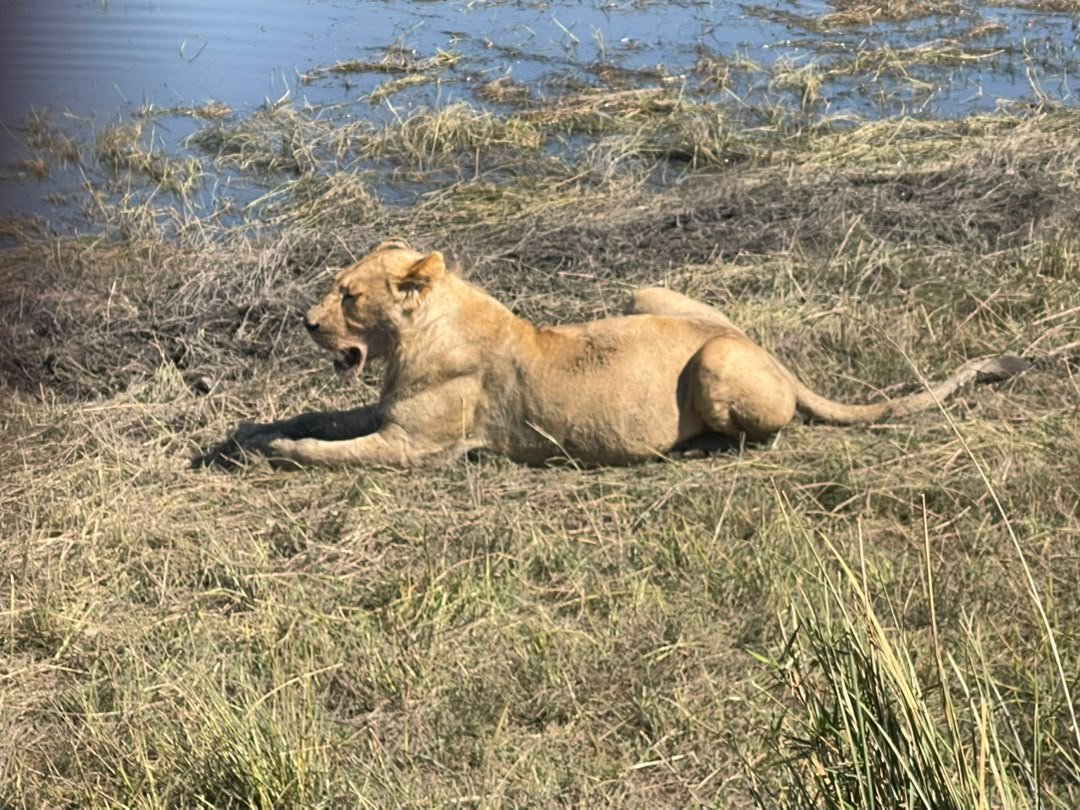
The afternoon game drive in Chobe National Park is the land-based counterpart to the morning river safari and usually becomes one of the biggest highlights of the day.
Chobe National Park was established in 1968 and today protects approximately 11,700 square kilometres incorporating floodplains, swamps and woodland. Day visitors focus primarily on the accessible and wildlife-rich Chobe Riverfront, rather than attempting to reach remote sectors of the much larger park.
Travel is normally in a purpose-built open safari vehicle offering elevated seating and excellent visibility. Once inside the park, the guide begins following tracks through riverine woodland, floodplain edges and bush in search of wildlife.
The experience immediately feels different from the morning cruise.
From the boat, guests observed animals largely from the openness of the water. From the vehicle, they become immersed in the landscape itself: moving through woodland, rounding bends in sandy tracks and watching carefully for movement between trees and bushes.
Possible wildlife includes elephants, buffaloes, giraffes, zebras, impalas, kudus, warthogs, baboons and numerous other mammals. Lions and leopards inhabit Chobe as well, but predator encounters depend on natural movement, timing and luck and should never be guaranteed.
Sometimes the most rewarding observations are not simply sightings of individual animals but interactions.
A herd of elephants may slowly cross the track in front of the vehicle. Giraffes may browse quietly in woodland. Buffaloes might gather near the floodplain, while impalas remain alert to activity around them. Baboons may move noisily through the roadside vegetation while birds react to their presence.
A knowledgeable guide adds enormous value by interpreting tracks, alarm calls, fresh dung, feeding signs and animal behavior rather than simply driving from one animal to the next.
Game viewing can become particularly productive around the riverfront because water influences so much of Chobe’s wildlife movement. Animals may gradually move toward the river as conditions change, creating opportunities to see the same ecosystem from a completely different perspective than during the morning boat cruise.
The afternoon light can also become increasingly attractive for photography as the sun begins to descend. Dust, warm light and the open riverfront landscape can create striking photographic conditions, particularly when animals are positioned against uncluttered backgrounds.
However, the objective should not be to race around the park searching for every species on a checklist.
A better Chobe safari allows enough time to remain with particularly interesting sightings. Watching a family of elephants interact for twenty minutes can be far more memorable than quickly photographing five different animals and immediately moving on.
This approach is one reason private game drives are attractive for photographers, families and travelers with specific wildlife interests. Shared game drives can still provide an excellent safari experience, but private vehicles generally give guests greater control over how long they spend at each sighting.
Toward the end of the afternoon, the guide gradually begins working back toward the park exit and Kasane.
By this point, travelers have experienced Chobe from two complementary perspectives: first from the water and then from the land. Even though the visit lasts only one day, the combination provides a surprisingly rich introduction to northern Botswana’s wildlife.
Return Transfer to Victoria Falls or Livingstone
After completing the afternoon game drive, guests leave the Chobe safari area and begin the return journey to Victoria Falls or Livingstone.
Those staying in Kasane have only a short transfer back to their accommodation, but international day visitors must once again complete border formalities before returning to Zimbabwe or Zambia.
The journey follows the day’s route in reverse, but the atmosphere is usually very different. Cameras are full of photographs, guests are comparing favorite sightings and the intensity of wildlife searching has given way to a relaxed drive back to the hotel.
Travelers returning to Victoria Falls complete Botswana departure procedures and the appropriate Zimbabwe re-entry process before continuing to their accommodation.
Those returning to Livingstone travel back through the Kazungula corridor, completing Botswana and Zambian immigration procedures before continuing toward their hotel. Travelers using an eligible KAZA UniVisa arrangement should still carry all necessary documentation and follow the instructions of border officials.
Return times vary according to safari scheduling, border traffic and the location of the guest’s hotel. For this reason, travelers should avoid arranging a tightly timed international flight or another non-flexible activity immediately after the expected safari return.
The real achievement of the day becomes clear during this final transfer.
In the space of a single day, a traveler can wake beside Victoria Falls, cross an international border into Botswana, cruise the Chobe River, watch elephants along the water, enjoy lunch in Kasane, explore Chobe National Park by 4×4 and return to Zimbabwe or Zambia in time for the evening.
That variety is what makes a Chobe National Park Day Trip from Victoria Falls or Livingstone much more than a convenient side excursion.
It is a genuine multi-country safari experience compressed intelligently into one day.
Typical Chobe National Park Day Trip Timeline
A realistic day may flow approximately as follows, although exact timings should always remain flexible:
06:30–07:30 | Pick-Up from Victoria Falls or Livingstone
Meet your driver at your hotel or lodge and depart for Botswana.
08:00–09:00 | Botswana Border Crossing
Complete departure and Botswana immigration procedures before continuing toward Kasane.
Approximately 09:00–12:00 | Chobe River Boat Safari
Explore the river, channels and floodplains while searching for elephants, hippos, crocodiles, buffaloes, antelopes and birdlife.
Approximately 12:00–13:30 | Lunch in Kasane
Enjoy a relaxed lunch and refreshment break before the afternoon safari.
Approximately 13:30–16:30 | Chobe National Park Game Drive
Enter the Chobe Riverfront in an open 4×4 vehicle and search for elephants, buffaloes, giraffes, zebras, antelopes and predators.
Late Afternoon | Depart Kasane and Complete Border Formalities
Leave Botswana and begin the return journey to Zimbabwe or Zambia.
Approximately 17:30–19:00 | Arrival at Victoria Falls or Livingstone Hotel
Return to your accommodation after a full day in Botswana.
These times are best presented as guidelines rather than guarantees. Border processing, wildlife sightings, season, river conditions and individual safari arrangements can all influence the exact schedule.
What Makes This Chobe Day Trip Special?
The strength of this itinerary lies in how much variety is experienced without making the day feel like little more than transportation.
You are not traveling all the way to Botswana for a two-hour drive through a national park.
You experience two distinct safari environments.
The morning places you on the Chobe River, looking toward wildlife from the water. The afternoon takes you onto the tracks of Chobe National Park, placing you inside the woodland and riverfront landscape. Chobe’s geography—an extensive national park whose northern edge is strongly influenced by the Chobe River—is precisely what makes this combination possible.
Add the international journey, the atmosphere of Kasane and the possibility of experiencing Botswana alongside a Victoria Falls stay, and the result is one of Southern Africa’s most rewarding full-day safari excursions.
For travelers who have only one day available for Botswana, a thoughtfully organized Chobe National Park Day Trip provides an excellent introduction to the country: not simply passing through Chobe, but experiencing the river, wildlife, landscapes and classic open-vehicle safari that make this corner of Botswana so memorable.
Chobe River Boat Safari
A Chobe River Boat Safari is one of the experiences that makes a day trip to Chobe National Park fundamentally different from an ordinary land-based safari. Instead of viewing wildlife only from a 4×4 vehicle, travelers move quietly along the Chobe River, looking back toward the floodplains, islands, reed-lined channels and woodland of northern Botswana. Botswana Tourism specifically recommends a river cruise as a way to experience Chobe’s wildlife from a completely different vantage point, with particularly good opportunities to observe animals such as hippos and crocodiles from the water.
The river is not simply an attractive background to the national park. It is one of the ecological forces shaping wildlife movements along Chobe’s northern frontier. During a boat safari, travelers begin to understand how elephants, buffaloes, antelopes, predators, birds and aquatic species depend on the river and surrounding floodplains.
For a traveler visiting Chobe for only one day, this water-based safari is especially valuable because it reveals wildlife that may be difficult to appreciate from the road. After several hours on the river, the afternoon game drive then introduces the terrestrial side of the same ecosystem, making the two activities highly complementary.
What to Expect on the Chobe River
A typical Chobe River Boat Safari begins from the Kasane riverfront, where guests board a motorized safari boat accompanied by an experienced local guide. Boats vary in design and capacity, ranging from smaller vessels suited to private safaris and photography to larger boats used for shared excursions.
Once the boat leaves the jetty, the pace of the day changes immediately. Instead of following vehicle tracks through bush, the safari unfolds across open water. The boat moves through channels and alongside islands while the guide scans riverbanks, exposed mud, grasses, trees and floodplains for wildlife.
Boat cruises are an established part of the Chobe safari experience, and Botswana Tourism lists them alongside 4×4 game drives as core activities offered around Chobe National Park.
One of the first things travelers notice is the sense of openness. From the river there are often long views across floodplains that are impossible to achieve from a vehicle moving through woodland. An elephant herd can sometimes be observed from the moment it appears in the distance until it reaches the water, allowing guests to watch behavior rather than simply record a quick sighting.
The safari boat normally travels at a controlled speed when wildlife is present. The objective is not to cover the greatest possible distance but to position the boat responsibly for observation while maintaining an appropriate distance from animals.
At times the experience can be wonderfully quiet. The engine may be reduced or switched off while guests watch elephants feeding, hippos surfacing or birds working the shoreline. At other moments the river feels surprisingly active, particularly when several species gather around productive feeding or watering areas.
The scenery itself is an important part of the experience. Depending on season and water level, travelers may see broad grassy islands, shallow channels, exposed banks, submerged vegetation and woodland rising behind the floodplain.
Seasonal changes strongly influence the appearance of the river. During the dry season, the contrast between dry terrestrial landscapes and permanent water becomes particularly striking, while greener periods transform the floodplains and surrounding vegetation.
Travelers should therefore avoid thinking of the boat safari as simply a way to “see elephants from a boat.” It is an opportunity to understand Chobe as a river-dependent ecosystem.
Wildlife Seen Along the River
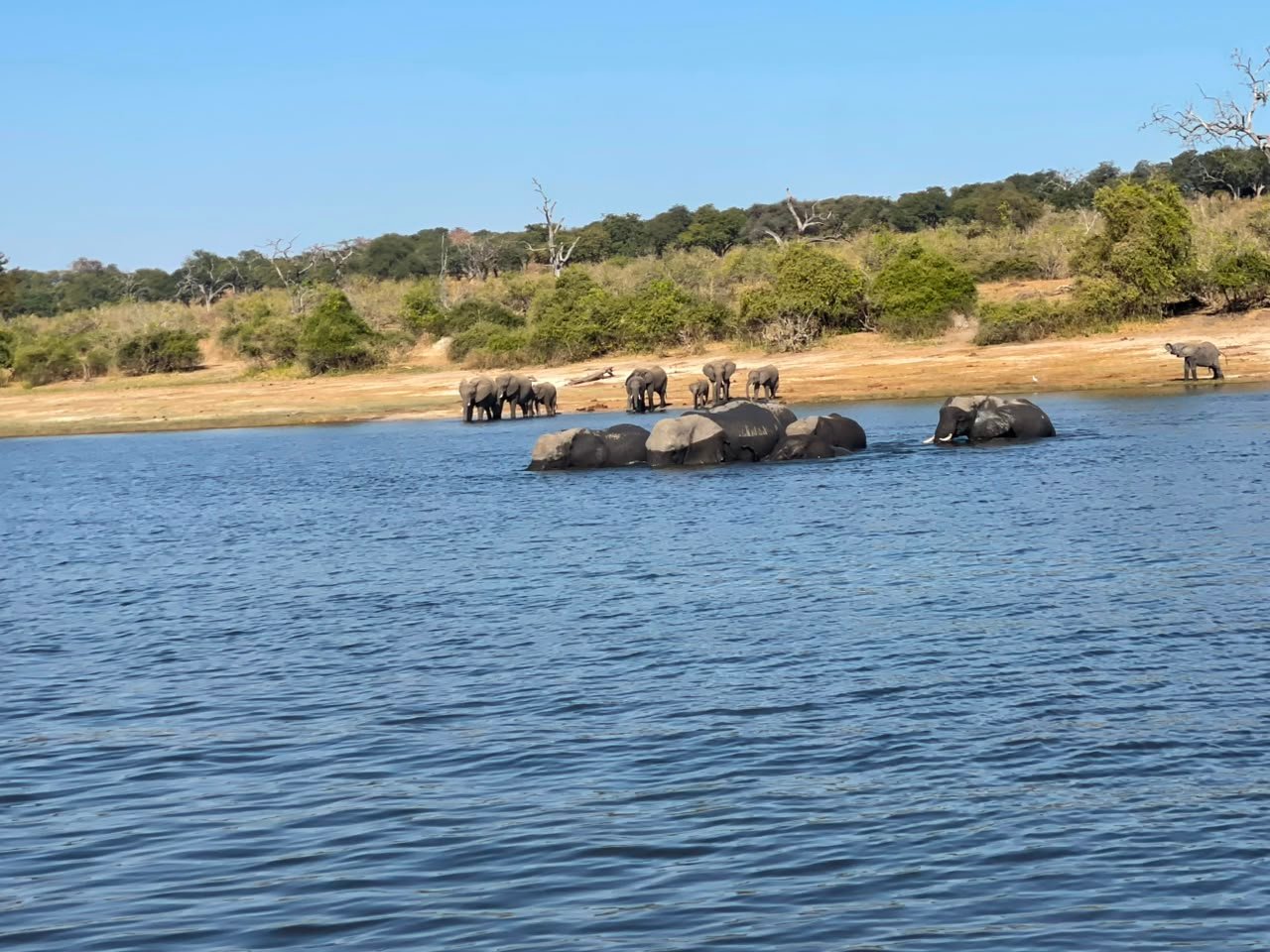
The Chobe River supports an extraordinary range of wildlife, and the diversity of species using the water’s edge is one of the reasons a boat safari is so rewarding. Botswana Tourism highlights the river cruise as an especially useful way to approach wildlife such as hippos and crocodiles, while the Chobe region is also renowned for its elephants and other large mammals.
Elephants Along the Chobe River
For many guests, elephants become the defining sight of the cruise.
Depending on the season and the natural movement of wildlife, elephants may appear singly, in small bachelor groups or in larger family units. Some can be seen descending toward the water to drink, while others feed along the floodplains or use their trunks to spray themselves with water and mud.
Watching elephants from a boat provides a very different experience from encountering them during a game drive. From the river, the landscape often opens around them, allowing travelers to see the relationship between the herd, the shoreline and the wider environment.
Young calves are particularly interesting to observe because their interaction with water can be playful and sometimes clumsy. Adults remain nearby while family members drink, feed and interact.
The experience becomes especially memorable when elephants enter shallow water or move between feeding areas close to the river.
Hippos
The hippopotamus is another characteristic inhabitant of the Chobe River.
During daylight hours, hippos often remain in or close to the water, where their eyes, nostrils and ears may be visible above the surface. A good guide knows where pods regularly occur and approaches cautiously without interfering with their behavior.
Travelers should remember that hippos are powerful wild animals and should never be treated as harmless simply because they appear relaxed in the water.
From a photographic point of view, patience can be rewarded. A hippo may yawn, raise its head, interact with another member of the pod or briefly reveal more of its body while moving through shallow water.
Nile Crocodiles
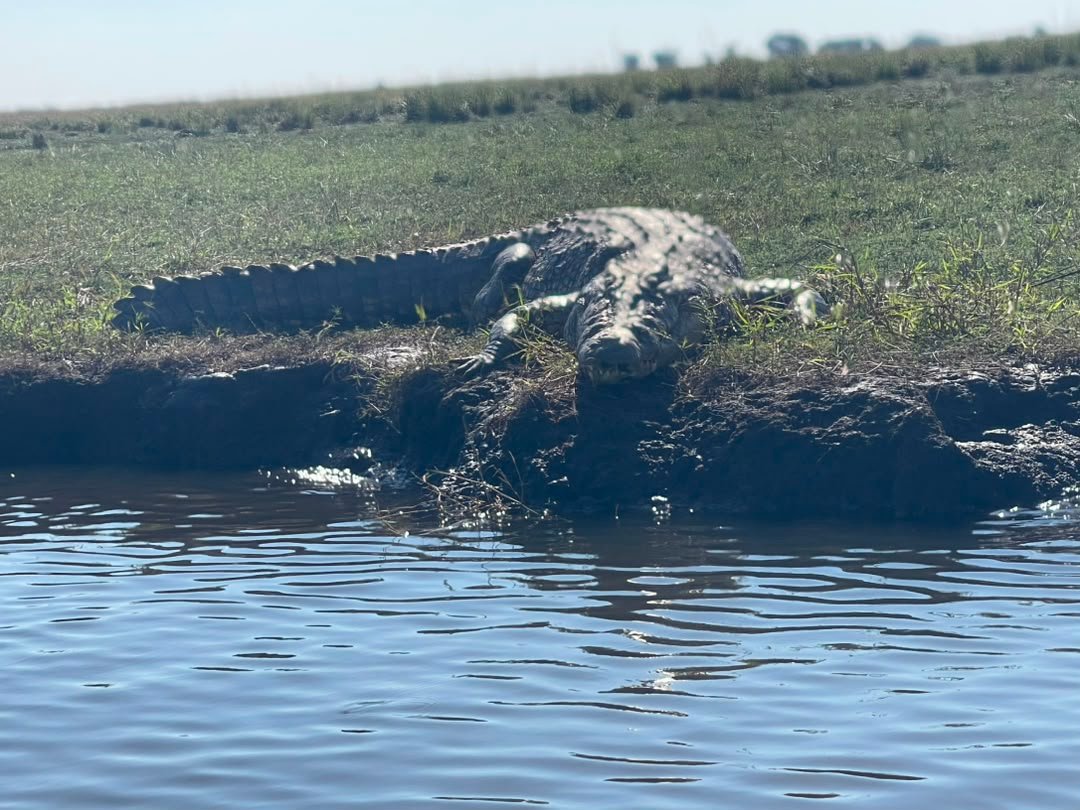
Nile crocodiles are another species associated with the river and one specifically highlighted by Botswana Tourism in relation to Chobe river cruises.
They may be seen resting on exposed banks, partially submerged near the shoreline or moving almost invisibly through the water.
Some crocodiles are remarkably easy to overlook because their coloration blends so effectively with mud, sand and vegetation. Experienced guides help guests identify individuals that might otherwise remain unnoticed.
Their presence also provides an opportunity to discuss the Chobe River’s aquatic food web and the important ecological role of large reptiles.
African Buffalo
Buffaloes may be encountered around the floodplains and riverbanks, particularly when groups move toward water.
From the boat, guests can sometimes watch herds spread across open areas rather than seeing only a few individuals through roadside vegetation. Elephant and buffalo activity around the permanent river is one of the features that makes the Chobe Riverfront so productive for wildlife viewing.
Antelopes and Other Mammals
The edges of the Chobe River may also attract several antelope species and other mammals.
Possible observations can include impalas, kudu and other herbivores using the floodplain and woodland margins. Warthogs, baboons and giraffes may also be encountered in the wider riverfront ecosystem, particularly when the boat route provides views toward terrestrial habitat.
Because wildlife moves naturally, no individual species should ever be guaranteed. A high-quality Chobe safari focuses on interpreting what is present rather than creating an unrealistic checklist.
That uncertainty makes each outing different.
One boat cruise might produce an extraordinary elephant encounter, while another may be memorable for buffaloes, crocodiles, hippos or exceptional bird activity.
Birdlife Along the Chobe River
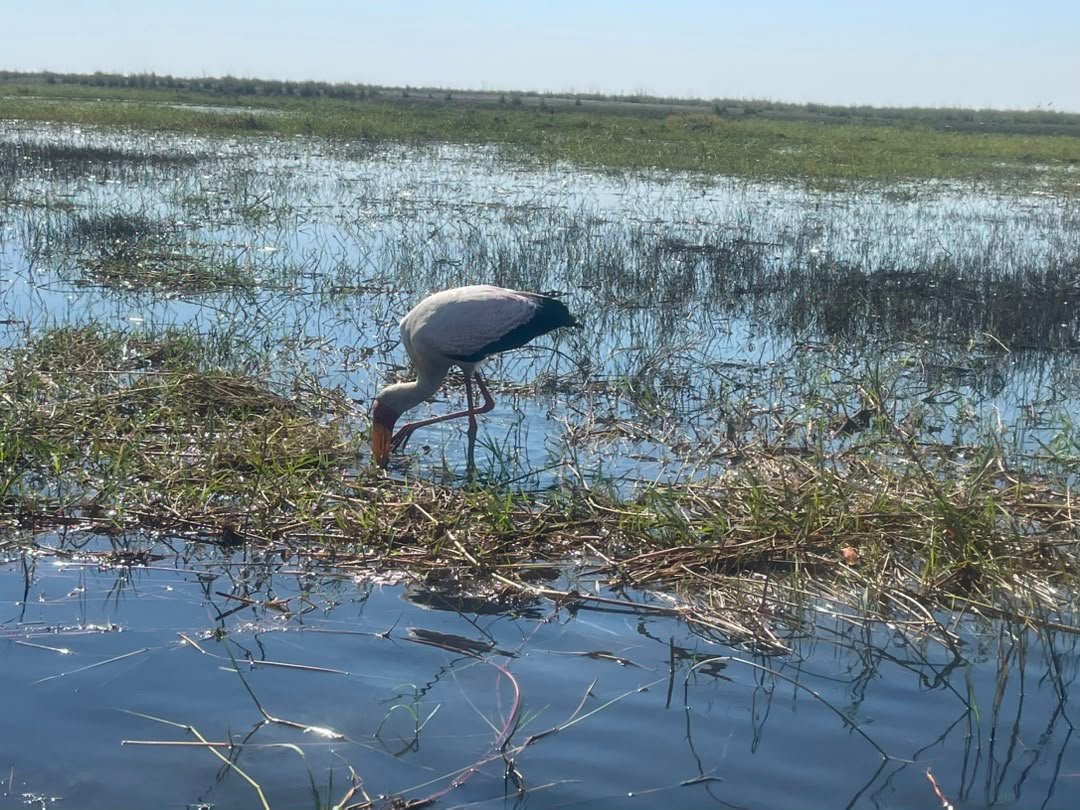
The birdlife of the Chobe River is easily overlooked when travelers first book a safari because most arrive hoping to see elephants, lions and other large mammals. Once on the river, however, birds often become one of the most enjoyable parts of the experience.
The combination of permanent water, wetlands, exposed banks, islands, floodplain grasses and surrounding woodland creates habitat for both aquatic and terrestrial species. Northern Botswana is also important for several bird species, and BirdLife International records notable species occurring in the wider Chobe area.
One of the most recognizable birds travelers may search for is the African fish eagle. Its distinctive silhouette, powerful flight and habit of perching above waterways make it one of Southern Africa’s classic river birds.
Kingfishers are another highlight. Different species occupy slightly different niches along the river, and visitors may see birds hovering above the water, sitting on branches or diving after prey.
Herons and egrets commonly use shallow water and river edges, walking slowly as they search for fish and other small aquatic animals.
Storks may appear around floodplain areas, while cormorants and other waterbirds can be encountered swimming, diving or drying their wings.
Raptors are also worth watching for. A knowledgeable guide will frequently notice birds long before guests do and can explain differences in hunting behavior, habitat use and feeding strategies.
The slower pace of a boat safari makes birding easier than many travelers expect. Instead of trying to identify a small bird while a safari vehicle continues moving, the guide can often position the boat so guests have time to observe it properly.
This is particularly useful for photographers carrying telephoto lenses or travelers using binoculars.
Season also influences the birding experience. Resident species occur throughout the year, while seasonal movements and changing water conditions can alter which birds are most visible in particular habitats.
For serious birders, guests should mention their interest when booking. A private boat with a specialist guide can focus more heavily on identification, behavior and photography rather than spending most of the excursion concentrating only on large mammals.
For non-birders, the Chobe River frequently has the opposite effect: people who begin the cruise saying they are “not really interested in birds” often finish it photographing fish eagles and kingfishers.
Best Photography Opportunities
The Chobe River is one of the strongest photographic elements of a Chobe day trip because the boat places photographers close to water level and often provides clean, uncluttered backgrounds.
From a vehicle, grasses, branches and other safari vehicles may occasionally interfere with a composition. On the river, photographers can often position an animal against water, sky, distant woodland or open floodplain.
Elephants at the Water’s Edge
Perhaps the classic Chobe photograph is an elephant standing beside or inside the river.
Images become particularly interesting when elephants are drinking, spraying water, interacting with calves or moving as a group toward the shoreline.
Rather than immediately photographing continuously, it can be worthwhile to observe behavior first. Elephants often repeat actions, giving photographers time to anticipate where the trunk will move or when another animal may enter the frame.
Reflections
Calm water can create attractive reflections of elephants, buffaloes, birds and vegetation.
Morning conditions may sometimes provide softer light and calmer surfaces, although conditions naturally vary.
Lowering the camera position where safely possible can help emphasize reflections and create a stronger sense of being on the water.
Hippos at Eye Level
Boat safaris can create excellent opportunities to photograph hippos from a lower angle than is normally possible from land.
A telephoto lens allows photographers to frame eyes, ears and facial details while respecting the guide’s positioning and maintaining a safe distance.
Birds in Flight
The river offers particularly good practice for photographing birds in flight.
Fish eagles, kingfishers, herons, storks and other species may cross open stretches of water where the background is relatively clean.
Using a faster shutter speed and continuous autofocus can be useful for moving birds, while photographers interested in slower creative effects may experiment where conditions allow.
Environmental Wildlife Photography
Not every photograph needs to be a tight animal portrait.
Some of the strongest Chobe photographs show animals as part of the wider landscape: a herd of elephants crossing an open floodplain, a lone giraffe beyond the river or buffaloes spread beneath a large African sky.
These environmental photographs communicate the scale of Chobe much better than close portraits alone.
Photography Tips for the Boat
Travelers carrying professional or expensive equipment should use a camera strap and keep equipment protected while boarding or leaving the boat.
A lens in the 100–400 mm range or similar telephoto zoom is highly versatile for wildlife, while a wider lens can be useful for landscapes, large elephant herds and environmental scenes.
A beanbag can sometimes be useful depending on the boat design, although photographers should confirm available supports with the safari operator.
Extra batteries and memory cards are strongly recommended. It is surprisingly easy to take hundreds of photographs during a productive Chobe boat safari.
Most importantly, photographers should occasionally put the camera down.
Watching an elephant family enter the Chobe River with your own eyes is sometimes more memorable than another thousand photographs.
Chobe National Park Game Drive
After seeing the Chobe ecosystem from the river, a Chobe National Park game drive changes perspective completely. Guests leave the boat and enter the national park in a purpose-built 4×4 safari vehicle, exchanging open water for sandy tracks, woodland, floodplain edges and riverfront viewpoints.
Game drives and boat cruises are both central safari activities in the Chobe region. Botswana Tourism-listed safari properties specifically offer the two experiences together, demonstrating how naturally they complement one another.
For day visitors, the game drive normally concentrates on the Chobe Riverfront, rather than attempting to explore distant areas such as Savuti or Linyanti. The riverfront provides excellent wildlife habitat while remaining accessible from Kasane.
Exploring the Chobe Riverfront
The Chobe Riverfront forms the safari heart of most short visits to Chobe National Park.
The area combines riverine habitat, woodland and floodplains, producing a landscape in which wildlife can move between feeding areas, shade and permanent water.
Botswana Tourism describes Chobe National Park as covering approximately 11,700 square kilometres, but a day trip wisely focuses on this northeastern riverfront rather than attempting to cover the entire reserve.
Once the game-drive vehicle enters the park, guests follow a network of tracks that run through woodland and along elevated areas overlooking the river.
One moment the vehicle may be moving beneath trees looking for giraffes or elephants; a short time later it may emerge onto a viewpoint overlooking broad floodplains filled with wildlife.
This variety of habitat is one of the riverfront’s great strengths.
The guide’s role becomes particularly important during the game drive. Safari guiding involves much more than knowing where animals are commonly seen.
Guides continuously interpret tracks, dung, feeding signs, bird alarm calls and the behavior of prey species. Fresh elephant tracks may indicate that a herd passed recently, while impalas staring intensely toward a particular patch of vegetation can sometimes signal the presence of a predator.
The afternoon should therefore not feel like driving randomly around the park.
A good guide is continuously gathering information from the landscape.
Safari vehicles may also communicate information about noteworthy sightings, although responsible operators avoid excessive crowding around animals.
When an important sighting occurs, patience is often more rewarding than quickly moving onward. Sitting quietly beside elephants feeding or watching a pride of lions resting can reveal behavior that travelers miss when they focus only on accumulating species.
Animals You May See
The Chobe Riverfront supports an impressive variety of mammals.
Possible game-drive sightings include African elephants, Cape buffaloes, giraffes, zebras, impalas, greater kudu, warthogs, baboons and other herbivores, while carnivores including lions and leopards are part of the wider ecosystem.
Wildlife viewing remains unpredictable, which is essential to understanding any genuine safari.
Giraffes
Giraffes are particularly striking in the woodland sections of Chobe.
Their height allows them to browse above many other herbivores, and watching them move between trees can produce excellent photographic opportunities.
Groups may occasionally be encountered crossing open areas, where their full height and characteristic gait become especially visible.
Zebras
Zebras may occur in groups around suitable grazing areas.
Their black-and-white patterns are particularly photogenic in warm afternoon light, and they often associate with other herbivores in open habitat.
Impalas
Impalas are among the animals guests may encounter repeatedly, but they deserve more attention than they sometimes receive.
They are elegant, highly alert antelopes and form an important part of the food chain. Their behavior can also help guides detect nearby predators.
Greater Kudu
Greater kudu are among Southern Africa’s most impressive antelopes.
Males are immediately recognizable by their large spiral horns, while both males and females have beautifully marked bodies adapted to woodland environments.
They can disappear remarkably quickly into vegetation despite their size.
Warthogs and Baboons
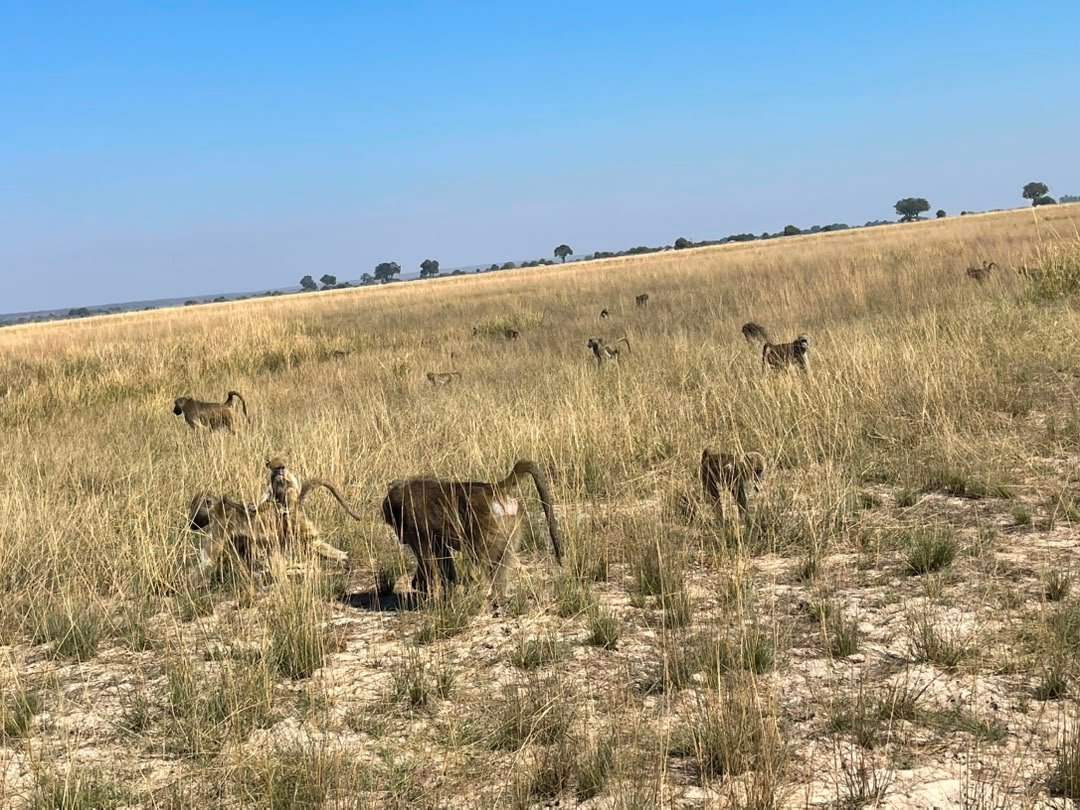
Warthogs are frequently entertaining to watch as they feed close to the ground or run with their tails held upright.
Baboons provide completely different behavior. Their social groups may include adults grooming, youngsters playing and individuals searching for food.
Watching these everyday interactions can be just as interesting as encountering larger mammals.
Buffaloes
Large buffalo bulls or herds may be encountered around the riverfront.
Their relationship with water means the floodplain and river areas can be important habitat, especially as terrestrial water sources become limited.
A herd stretching across the landscape can be one of the more impressive Chobe sightings.
Chobe’s Famous Elephants
Few wildlife species are as closely associated with Chobe National Park as the African elephant.
The park and surrounding northern Botswana landscape are internationally renowned for elephant viewing, and the riverfront provides particularly strong opportunities because the Chobe River represents a major permanent water source.
The Botswana Tourism Organization emphasizes Chobe’s wildlife appeal, while tourism establishments throughout the Chobe region combine game drives and river cruises specifically to take advantage of this productive ecosystem.
During the game drive, elephants may be encountered in completely different circumstances from those seen during the boat safari.
Some herds may be traveling through woodland toward the river.
Others may be feeding among trees, stripping bark, breaking branches or using their trunks to gather vegetation.
Large bulls can sometimes be seen alone or in loose bachelor groups.
Family herds usually consist of related females and younger animals under the leadership and experience of older females.
One of the most memorable encounters occurs when elephants cross the safari track.
The guide stops the vehicle well before the crossing point, allowing the animals to choose their route without obstruction.
Adults may pass first, followed by youngsters moving between larger family members. Calves can occasionally be almost hidden behind the legs of adults.
These moments require patience and respectful guiding.
A safari vehicle should never force elephants off their intended path simply to obtain a closer photograph.
Observing quietly often produces the better encounter.
Elephant behavior also becomes more meaningful when guests understand what they are watching. Ear position, trunk movement, vocalization and the relationship between individuals can provide clues to how relaxed or alert the animals are.
Guides can explain these behaviors and help travelers distinguish between ordinary elephant communication and signs that additional space should be given.
Seeing elephants from both boat and vehicle on the same Chobe day trip is particularly rewarding.
The river cruise shows how strongly elephants depend on water.
The game drive reveals how they move, feed and interact within the surrounding woodland.
Together, these experiences provide a more complete understanding of the animal than either activity alone.
Predators in Chobe National Park
Although elephants dominate Chobe’s reputation, the national park is also predator country.
Lions and leopards occur within Chobe National Park, and the broader northern Botswana ecosystem supports a complex relationship between predators and abundant prey.
Predator sightings, however, should always be presented realistically.
A lion is not waiting beside the road because a safari has been booked.
A leopard does not appear according to an itinerary.
The search itself is part of the experience.
Lions
Lions are the predator many first-time safari travelers hope to encounter.
During the heat of the day they may spend long periods resting, often choosing shade beneath trees or bushes. At other times they may move through open areas, interact within the pride or position themselves near concentrations of prey.
An experienced guide searches for more than the lion itself.
Fresh tracks along the road, distant calls, circling vultures or unusually nervous prey animals can all become part of the process of locating predators.
When lions are found, remaining patient can reveal much more than taking a photograph and immediately leaving.
A resting pride may eventually begin grooming, playing, changing position or interacting socially.
Leopards
Leopards are generally more elusive.
Their spotted coats provide excellent camouflage in woodland and broken shade, meaning one can be surprisingly close without being immediately visible.
Guides therefore pay close attention to trees, dense vegetation and the behavior of other animals.
Leopard encounters can be brief or wonderfully prolonged depending on the individual animal and circumstances.
Their unpredictability makes every sighting special.
African Wild Dogs
African wild dogs occur within the greater northern Botswana and Chobe conservation landscape, although they should never be promoted as a guaranteed sighting on a short riverfront day trip.
They range widely and can cover large distances, which means encounters depend heavily on where packs happen to be moving.
If encountered, their social behavior and cooperative movement can make them one of the most exciting safari sightings in Africa.
Spotted Hyenas and Other Carnivores
Spotted hyenas and smaller carnivores also form part of the ecosystem.
Hyenas are frequently misunderstood as simple scavengers, yet they are highly capable predators with complex social structures.
Smaller carnivores may be considerably harder to notice, particularly during a short daytime safari, but their presence contributes to Chobe’s ecological richness.
Why Combining the Boat Safari and Game Drive Matters
Experiencing the Chobe River Boat Safari and Chobe National Park Game Drive on the same day is not simply a way to include more activities.
It creates a more complete safari.
From the river, you look toward the land.
From the game-drive vehicle, you look back toward the river.
During the boat cruise, elephants, hippos, crocodiles, waterbirds and animals approaching the shoreline become the main focus. During the game drive, the search expands into woodland and terrestrial habitat for giraffes, zebras, antelopes, buffaloes, elephants and predators.
Botswana Tourism promotes both river cruising and game viewing around Chobe, and local safari properties routinely combine the two experiences.
A traveler who spends only a few hours driving around Chobe may leave impressed by its animals.
A traveler who experiences both the river and the land is more likely to understand what makes Chobe special.
The Chobe River is not separate from the national park.
It is one of the reasons the riverfront wildlife experience exists.
That connection between permanent water, seasonal floodplains, woodland, herbivores, predators and birdlife is the real story of a Chobe safari—and it is why a well-designed Chobe National Park Day Trip should include both perspectives whenever possible.
Wildlife to See on a Chobe Day Trip
The wildlife is the main reason a Chobe National Park Day Trip can feel surprisingly substantial despite lasting only one day. The Chobe Riverfront is the most accessible and frequently visited part of the park, and Botswana Tourism specifically highlights it for its large concentrations of African elephants and Cape buffaloes, together with other wildlife attracted to the permanent waters of the Chobe River.
A typical day trip combines a boat safari on the Chobe River with a 4×4 drive through the riverfront section of the national park. This matters because some species are easier to appreciate from the water while others are more likely to be encountered from the game-drive tracks. Botswana Tourism-listed safari operations in the area routinely offer both boat cruises and 4×4 wildlife viewing, reflecting how complementary these two perspectives are.
Travelers should nevertheless approach Chobe with realistic expectations. Elephants and many common herbivores are often easier to encounter than predators, while lions, leopards, wild dogs and other carnivores depend far more on timing, location and natural movement. The more predator-rich Savuti sector lies deeper inside the wider Chobe ecosystem and is not normally reached during a standard day trip from Victoria Falls or Livingstone. Botswana Tourism describes Savuti as particularly known for lion, cheetah and hyena populations.
Elephants
If there is one animal that defines the wildlife experience of Chobe, it is the African elephant. Botswana Tourism identifies Chobe National Park as particularly renowned for its elephant herds, and the riverfront is especially important because the Chobe River provides dependable water through the dry season.
On a Chobe day trip, elephants can potentially be encountered during both the boat cruise and the game drive, giving visitors two very different ways to observe the same species. From the river, family groups may be seen approaching the shoreline to drink, feeding across floodplain vegetation or moving between riverbanks and islands. At certain times, elephants may enter shallow water, spray themselves with water or mud, or allow young calves to follow closely between larger adults.
These river encounters are particularly memorable because the open landscape can reveal an entire herd rather than only a few elephants partially hidden by woodland. A boat may remain at a respectful distance while guests watch a family gradually approach the water, drink and then move away again. The scene often provides far more insight into elephant social behavior than a quick roadside sighting.
During the afternoon game drive, the experience becomes more terrestrial. Elephants may appear among woodland, cross the sandy tracks or browse on trees close to the safari route. Large bulls can sometimes be encountered alone, while breeding herds typically include females, juveniles and calves.
One of the best elephant encounters is often not the closest one. Seeing a large herd spread across the Chobe floodplain with the river behind it reveals the scale of the landscape and the reason elephants are so strongly associated with this part of Botswana.
Responsible guides should always allow elephants to determine the encounter. Vehicles should not obstruct crossing points or push too close for photographs. When elephants are given space, visitors can often observe relaxed feeding, family interaction and movement that are much more rewarding than forced proximity.
For many travelers, seeing elephants first from the Chobe River and later from a safari vehicle becomes the defining memory of a Chobe National Park Day Trip.
Lions
Lions occur in Chobe National Park, although a lion sighting should be treated as an exciting possibility rather than a guarantee during a one-day visit. Chobe’s wider ecosystem supports important predator populations, while Botswana Tourism particularly highlights the more remote Savuti section of the park for its resident predators, including lions.
On a riverfront day trip, guides search for lions by looking not only for the cats themselves but also for the signs they leave behind. Fresh tracks on sandy roads, alarm calls from antelopes, unusual attention from giraffes or baboons, and information from other guides may all help reveal where predators are moving.
During the hotter part of the day, lions frequently conserve energy and may spend extended periods resting in shade. This means that what initially appears to be an inactive sighting can become fascinating when guests remain patient. Pride members may groom one another, cubs may become playful or adults may gradually reposition as temperatures begin to fall.
The riverfront can also create interesting predator-prey dynamics because large numbers of herbivores use the same general ecosystem. Lions may move between woodland and floodplain edges where prey species concentrate, particularly as environmental conditions influence access to food and water.
Photography can be rewarding when lions are encountered in the later afternoon, as softer light can illuminate their coats while the surrounding Chobe landscape gives the image a strong sense of place.
However, visitors should resist measuring the quality of a Chobe safari entirely by whether they see lions. The park’s ecological richness extends far beyond predators, and the unpredictability of finding a lion is part of what makes an authentic sighting so memorable.
Buffaloes
Cape buffaloes are another characteristic species of the Chobe Riverfront, and Botswana Tourism specifically identifies large buffalo herds alongside elephants as a defining feature of this section of the national park.
Buffaloes depend heavily on access to water and suitable grazing, making the Chobe River and its floodplains important habitat. During drier periods, visitors may encounter substantial groups gathering close to the river, while smaller groups and individual bulls can also occur in surrounding woodland.
From the boat, buffaloes can sometimes be seen spread across open floodplain habitat, giving guests a sense of the size of a herd that may not be obvious from a vehicle. These scenes can be particularly impressive when elephants, antelopes and birds are also using the same landscape.
From a safari vehicle, the encounters become more intimate. Large bulls can appear remarkably imposing when seen at relatively close range, particularly individuals carrying thick, heavily developed horn bosses. Guides maintain a safe distance and interpret body posture to ensure animals are not unnecessarily disturbed.
Buffaloes are also ecologically significant because they form part of the prey base for lions. Their presence within Chobe therefore contributes to the complex relationship between large herbivores and predators that defines the national park.
A large herd moving across the floodplain is one of the classic Chobe sights and can rival an elephant encounter in scale.
Hippos and Crocodiles
The Chobe River boat safari is particularly valuable for seeing animals that are strongly associated with the water. Hippos and Nile crocodiles are among the species travelers specifically hope to encounter, and the river environment provides a much more natural perspective for observing them than a conventional land safari.
Hippos spend much of the daylight period in or close to water. From the safari boat, guests may see only eyes, ears and nostrils above the surface before an animal lifts its head or moves through a shallow channel. Some groups may gather together in deeper sections, while others occupy quieter edges of the river.
Although hippos can appear calm, they are powerful wild animals. Guides therefore keep an appropriate distance and avoid positioning boats in ways that could block movement between animals and open water.
Patient observation can reveal fascinating behavior. Hippos may vocalize, interact with neighboring animals, briefly open their mouths or emerge farther from the water when conditions permit. Photography from the boat can be especially effective because the lower viewing angle places the camera closer to the animal’s natural eye level.
Nile crocodiles are another major component of the Chobe River ecosystem. They may be found resting on exposed banks, lying partly submerged at the water’s edge or moving almost invisibly through the river.
Crocodiles can be surprisingly difficult to notice because their coloration blends so effectively with mud and shoreline vegetation. An experienced guide often detects them long before guests do.
The river safari provides an excellent opportunity to appreciate these reptiles in context rather than viewing them simply as isolated animals. Crocodiles, fish, birds, hippos and large mammals approaching the river are all connected through the same aquatic ecosystem.
This is one reason the boat portion of a Chobe day trip should never be considered secondary to the game drive. It introduces an entirely different wildlife world.
Giraffes and Zebras
Giraffes and zebras provide some of the most photogenic terrestrial sightings during a Chobe game drive, particularly where woodland opens onto the floodplain.
Giraffes are frequently associated with the wooded sections of the riverfront, where their height allows them to browse vegetation unavailable to many other herbivores. Despite being among the tallest animals on earth, they can blend surprisingly well into trees when standing still.
Watching giraffes move across open areas creates a very different impression. Their full height becomes obvious, and groups positioned against the floodplain or distant river can produce beautiful environmental photographs.
Guests should also watch giraffes closely when predators may be nearby. Their elevated viewpoint means they sometimes focus intently on movement that humans have not yet detected. Guides frequently observe the behavior of herbivores as part of the process of locating predators.
Zebras are associated more strongly with open grazing areas. Their bold black-and-white pattern makes them instantly recognizable even to first-time safari travelers, but closer observation reveals interesting social behavior within groups.
They may graze alongside other herbivores, rest close together or remain alert while feeding. Young foals can sometimes be seen during the appropriate season, adding another dimension to the safari.
When zebras, giraffes, elephants and antelopes occupy the same open floodplain, the scene begins to resemble the classic image many travelers associate with an African safari.
Antelopes
Antelopes are fundamental to the Chobe ecosystem and deserve much more attention than they often receive. While travelers understandably focus on elephants and predators, the variety of grazing and browsing species contributes enormously to the density and energy of the landscape.
Impala are among the antelopes travelers may encounter regularly around the riverfront. Their abundance sometimes causes visitors to overlook them, but they are elegant animals with highly developed senses and an important role within the predator-prey system.
A herd of impalas suddenly becoming alert can tell an experienced guide that something has changed in the environment. Individuals may stare in one direction, give alarm calls or cluster more tightly if a predator is nearby.
Greater kudu may also be encountered in Chobe’s woodland. Mature males are particularly impressive because of their long spiral horns, while females and younger animals can disappear remarkably quickly among trees because of their markings and cautious behavior.
The Chobe floodplain and river system also provide habitat for antelope associated with wetter environments. The diversity of wetland, woodland and open floodplain habitat is one reason the wider Chobe region supports such varied herbivore communities.
For photographers, antelopes can be especially rewarding in early or late light. Impalas silhouetted against the riverfront, kudu emerging from woodland or groups of grazing herbivores beneath a broad sky can tell the story of Chobe far better than a tight portrait alone.
More importantly, antelopes help visitors understand that safari is about ecosystems rather than individual celebrity species. Predators could not exist without healthy prey populations, and Chobe’s richness depends on the interaction between all levels of its wildlife community.
Leopards and Other Predators
Leopards occur in the Chobe ecosystem, but they are much more elusive than elephants, buffaloes and many herbivores. Their camouflage, solitary behavior and preference for cover mean that even experienced guides can drive past a leopard hidden only a short distance away.
A leopard sighting on a Chobe day trip should therefore be considered a significant bonus.
Guides search trees, riverine vegetation and woodland while also paying attention to alarm calls from monkeys, baboons and antelopes. Fresh tracks can sometimes reveal that a leopard has recently crossed the road even when the animal itself remains hidden.
When a leopard is found, encounters can range from a few seconds to prolonged observation. An individual resting on a branch or walking through relatively open habitat offers an exceptional photographic opportunity, while animals moving through dense vegetation may appear and disappear almost instantly.
Other carnivores form part of the wider Chobe wildlife community. Botswana Tourism notes that Botswana remains an important stronghold for species including African wild dog, cheetah and brown hyena, while the Savuti section of Chobe is especially known for lion, cheetah and hyena populations.
However, this distinction is important for a day-trip page: a standard Chobe day trip generally concentrates on the Chobe Riverfront, not Savuti. Travelers should therefore not be told that cheetahs, wild dogs or hyenas are routine day-trip sightings simply because they exist somewhere within the greater Chobe ecosystem.
African wild dogs can range widely and may occasionally produce extraordinary encounters when packs move through accessible areas, but they should be regarded as unpredictable.
Spotted hyenas may also occur, although daytime encounters depend heavily on luck and location.
Smaller carnivores can be present as well but are easier to overlook during a relatively short daytime safari.
The best approach is to allow predators to remain a genuine safari surprise. Finding a leopard after following alarm calls or discovering lions resting beneath a tree becomes far more exciting when the sighting has not been promised in advance.
Birds of Chobe National Park
Birdlife is one of the strongest but sometimes under-promoted reasons to enjoy a Chobe National Park Day Trip. The combination of the Chobe River, floodplains, islands, exposed banks, reedbeds and surrounding woodland creates habitat for an exceptional variety of waterbirds, raptors and terrestrial species.
The river cruise is especially productive because the boat can move slowly alongside feeding and resting areas. African fish eagles are among the most memorable species associated with large waterways in this part of Southern Africa, while kingfishers, herons, egrets, storks, cormorants and other water-associated birds contribute constant activity along the river.
Kingfishers can be particularly rewarding for photographers. Some species perch quietly before diving, while others may hover briefly above water. Their small size can make them difficult to photograph from a moving safari vehicle, but a boat can often provide more time and a cleaner viewing angle.
Herons and egrets work methodically through shallow water searching for prey. BirdLife records the slaty egret within northern Botswana’s Linyanti–Chobe river system, illustrating the conservation importance of these wetland habitats.
Raptors add another dimension. Guides scan exposed branches and the sky for hunting birds, while vultures can sometimes provide clues to activity deeper within the landscape.
On land, woodland species broaden the day’s birding significantly. One particularly impressive possibility is the southern ground-hornbill, a large terrestrial bird that BirdLife records at relatively strong densities in Botswana’s Okavango and Chobe areas.
The difference between the boat cruise and game drive becomes especially valuable for birders. The river concentrates wetland species, while the terrestrial safari introduces woodland and savannah birds.
Serious birdwatchers should inform their guide at the beginning of the trip. A guide who knows that birding is a priority can spend more time identifying species, explaining behavior and positioning the boat or vehicle for observation rather than focusing almost entirely on large mammals.
For first-time safari travelers, birdlife often becomes an unexpected highlight. The moment an African fish eagle calls over the river, a kingfisher dives beside the boat or a large ground-hornbill walks slowly through the woodland, the Chobe experience becomes about much more than elephants and lions.
How Much Wildlife Can You Realistically See in One Day?
A Chobe day trip can deliver impressive wildlife diversity, particularly because the Chobe Riverfront is one of Botswana’s most accessible big-game areas and because visitors normally explore it from both boat and vehicle. Botswana Tourism specifically describes the riverfront as famous for large elephant and Cape buffalo herds.
However, no responsible safari operator should promise a fixed number of species.
Elephants may dominate one day. Another excursion may produce exceptional buffalo, hippo and birdlife. Some travelers are fortunate enough to encounter lions or leopard; others may spend the same number of hours in the park without seeing a major predator.
That variation does not mean one safari was successful and another was unsuccessful.
What makes Chobe special is the concentration of wildlife around a living river ecosystem. During a single day, guests may watch elephants walking toward the Chobe River, hippos surfacing beside the boat, crocodiles resting along the shoreline, buffaloes feeding across floodplains, giraffes browsing woodland, zebras and antelopes moving through open country, and numerous birds occupying every level of the landscape.
Predators add excitement when they appear, but they are only one layer of the experience.
The richest way to enjoy a Chobe National Park Day Trip is therefore not to arrive with a rigid checklist of eight animals that must be photographed. It is to allow the guide, the river, the season and the wildlife to determine the story of the day.
That is what separates a genuine Chobe safari from simply driving through a park looking for animals.
Chobe Day Trip from Victoria Falls
A Chobe Day Trip from Victoria Falls is one of the easiest ways to combine two of Southern Africa’s outstanding natural experiences within the same holiday: the spectacle of Victoria Falls and the wildlife-rich landscapes of Botswana’s Chobe National Park. Kasane is officially described by Botswana Tourism as the gateway to Chobe National Park and an important access point for nearby Victoria Falls in Zimbabwe and Livingstone in Zambia, which explains why this cross-border safari combination works so naturally.
Instead of relocating to Botswana for several nights, travelers staying in Victoria Falls can leave their hotel early in the morning, travel west toward the Botswana border, complete immigration formalities and spend most of the day exploring the Chobe Riverfront. A well-designed excursion normally combines a Chobe River boat safari, lunch in Kasane and an open-vehicle game drive in Chobe National Park, before returning to Victoria Falls later in the day. Boat cruises and 4×4 game drives are both established Chobe safari activities.
The greatest advantage is variety. Victoria Falls and Chobe are geographically close, yet they offer completely different experiences. Victoria Falls is centered on the Zambezi River, dramatic gorges and waterfall scenery, whereas Chobe introduces visitors to floodplains, woodland, the Chobe River and concentrations of large African wildlife. A traveler can therefore add a genuine Botswana safari without abandoning a Victoria Falls-based itinerary.
Pick-Up and Transfer
The Chobe Day Trip from Victoria Falls normally begins with an early hotel or lodge pick-up. An early departure is the sensible choice because the itinerary must accommodate an international border crossing as well as two safari activities and the return journey.
Travelers should ideally arrange breakfast before leaving their accommodation. Hotels accustomed to safari departures may also be able to prepare an early or packed breakfast, depending on the property. Guests should keep their passport, camera, phone, sunglasses, hat, sunscreen and necessary medication in a small day bag rather than in luggage that is difficult to access.
The road journey leaves the Victoria Falls area and continues west toward Botswana. This is not a long-distance transfer of the kind experienced on many African safaris; the relative proximity of Kasane to Victoria Falls is one of the reasons Botswana Tourism identifies the two destinations as natural regional connections.
The transfer should nevertheless be treated as part of a full-day international excursion rather than a simple drive to a neighboring attraction. Travelers are leaving Zimbabwe, entering Botswana and later returning to Zimbabwe, so passport and visa arrangements matter as much as road travel time.
A good safari operator coordinates the Zimbabwe-side transfer with the Botswana safari operation so guests do not need to negotiate transportation independently at the border. Depending on the excursion arrangement, travelers may change vehicles after immigration and meet their Botswana guide before continuing toward Kasane.
This handover can actually improve the experience. Once on the Botswana side, a locally based Chobe guide takes over the safari portion of the day and can concentrate on interpreting the park, river and wildlife rather than simply providing transport between countries.
During the drive, guests can receive a briefing about the day’s sequence, including whether the boat safari or game drive will operate first. Although many itineraries schedule the river cruise in the morning and game drive after lunch, the exact order can be reversed when operational conditions make that preferable.
The important point is not whether the boat happens at 09:00 or the game drive happens first. What matters is ensuring that both the Chobe River and Chobe National Park are properly experienced, because the combination of land and water is what gives a one-day Chobe safari much of its value.
Victoria Falls–Botswana Border Crossing
Traveling from Victoria Falls to Chobe requires an international crossing between Zimbabwe and Botswana. Zimbabwe’s revenue authority lists a Kazungula Border Post serving this northern border region, while Kasane lies immediately beyond this international tourism corridor on the Botswana side.
Guests should carry their original passport and should verify before travel that they satisfy Botswana’s entry requirements and have the correct visa or immigration permission to return to Zimbabwe later the same day. Requirements differ according to nationality and can change, so they should be checked using official immigration information close to the travel date.
This return requirement is especially important. A traveler may be permitted to leave Zimbabwe for Botswana but still need appropriate authorization to re-enter Zimbabwe in the afternoon. The visa held for the main holiday should therefore be considered when the Chobe excursion is booked.
Travelers who are using the KAZA UniVisa should understand what it actually covers rather than assuming that it replaces every immigration requirement in the region. Zambia’s Department of Immigration states that the KAZA UniVisa facilitates multiple travel between Zambia and Zimbabwe during its validity and also covers qualifying Botswana day trips through the Kazungula borders.
The border process generally involves leaving the transfer vehicle as instructed, presenting travel documents to immigration authorities and completing the required exit and entry procedures. The exact flow can vary, which is why day-trip schedules should include a reasonable buffer rather than being planned to the minute.
Guests should keep important documents easily accessible. Passports should not be buried inside large bags, and travelers should avoid leaving essential documents in one vehicle when transferring to another.
Families traveling with children should verify whether additional documentation is required for minors, while travelers holding passports that require visas in advance should organize those documents before safari day.
Once Botswana immigration procedures are complete, the trip continues toward Kasane, where the emphasis quickly changes from border logistics to safari. Botswana Tourism describes Kasane as the gateway to Chobe National Park, and the town stretches along the Chobe River with accommodation and safari infrastructure serving visitors to the park.
This transition is one of the enjoyable features of the day: within a relatively short period, travelers move from a Victoria Falls hotel in Zimbabwe to a Botswana safari town on the edge of one of Africa’s famous wildlife areas.
Return to Victoria Falls
After the afternoon safari activity, guests leave the Chobe area and begin their return transfer to Victoria Falls.
The Botswana safari vehicle normally brings travelers back toward the border, where they complete Botswana departure formalities and the necessary Zimbabwe re-entry procedures. Once immigration is complete, the Zimbabwe transfer vehicle continues toward Victoria Falls.
The return journey is best left flexible rather than tied to an exact guaranteed arrival time. Wildlife sightings can affect when a game drive finishes, while border processing and road traffic can vary. For that reason, travelers should avoid arranging a flight or another important fixed-time activity immediately after the expected return.
Returning to Victoria Falls after Chobe also highlights just how much has been experienced in a single day. A traveler may have started breakfast in Zimbabwe, crossed into Botswana, explored the Chobe River by boat, watched elephants and hippos near the water, enjoyed lunch in Kasane, searched for wildlife inside Chobe National Park and then returned to the same Victoria Falls hotel in the evening.
This makes the excursion particularly valuable for visitors with only two or three nights around Victoria Falls. They do not necessarily have to sacrifice an additional hotel night to experience Botswana.
The Chobe excursion also works extremely well in a broader Victoria Falls itinerary. One day can be devoted to the falls themselves, another to Chobe, while additional time can be used for a sunset cruise, helicopter flight or other regional activities.
For travelers primarily interested in wildlife, however, spending at least one or more nights in Chobe will naturally provide a deeper safari experience. A day trip is best understood as a high-quality introduction to Chobe, not a replacement for a multi-day Botswana safari.
Chobe Day Trip from Livingstone
A Chobe Day Trip from Livingstone provides Zambian-based travelers with another excellent way to experience Botswana without changing hotels. Livingstone is one of the principal gateways to Victoria Falls, while nearby Kasane serves the same role for Chobe National Park. Botswana Tourism specifically identifies Livingstone as one of the important neighboring destinations connected with Kasane.
The journey is especially convenient because Zambia and Botswana are directly connected through the Kazungula corridor, where modern border infrastructure and the Kazungula Bridge link the two countries. Zambia’s National Assembly has described the completed bridge and modern infrastructure at the Zambia–Botswana border.
This means travelers can wake up in Livingstone, enter Botswana in the morning, complete both a river safari and game drive in Chobe, and return to Zambia later in the day.
Transfer from Livingstone
The day normally begins with an early pick-up from a Livingstone hotel or lodge.
As with the Victoria Falls departure, leaving early protects valuable safari time. There is little advantage in beginning late and then rushing either the river safari or game drive simply to return before evening.
Travelers leave Livingstone and head toward the Kazungula border area, moving from Zambia’s Victoria Falls tourism region toward the point where Zambia and Botswana meet.
Guests should carry their original passports and any visas or immigration documentation required for the outward and return journey. Keeping these documents separate from camera bags or bulky safari equipment makes the border process considerably easier.
The drive also provides an opportunity for the guide to explain the wider geography of the area. Livingstone, Victoria Falls, Kasane and Chobe are part of a closely connected cross-border tourism landscape, which is why travelers can combine waterfalls, river activities and wildlife safaris so efficiently.
On reaching the border, the transfer component ends temporarily while guests complete immigration.
Once the Botswana entry process is finished, travelers continue toward Kasane. The town is Chobe’s principal gateway and sits along the river beside the national park’s tourism infrastructure.
From Kasane, the experience becomes identical in spirit to a Chobe day trip starting elsewhere: one part of the day is spent on the river and another exploring the national park by 4×4.
The difference is simply how the traveler reaches Botswana.
Zambia–Botswana Border Crossing
The Zambia–Botswana crossing at Kazungula is a central part of a Livingstone-to-Chobe day trip.
The Kazungula Bridge provides the modern road connection between Zambia and Botswana, while the associated border infrastructure handles international travelers and commercial movement between the two countries. Zambia’s National Assembly confirmed in 2024 that the bridge had been completed and described the Kazungula Border Post as having modern infrastructure.
For safari travelers, the practical requirement is straightforward: you are entering another country and must complete the applicable immigration procedures.
The passport presented must be valid for travel, and visitors should establish whether their nationality requires advance authorization, visa-on-arrival arrangements or visa-free entry for Botswana. They must also ensure that they can legally re-enter Zambia after completing the safari.
For travelers eligible for the KAZA UniVisa, the arrangement can be particularly useful in this region. Zambia’s Department of Immigration states that the visa is valid for travel between Zambia and Zimbabwe within its conditions and also covers Botswana day trips through the Kazungula borders.
Zambia Tourism likewise explains that the KAZA UniVisa provides a one-day Botswana allowance through Kazungula for travelers visiting destinations such as Kasane or Chobe National Park.
Travelers should still check current eligibility before assuming the visa applies to them. Visa programs can have nationality restrictions, validity rules and conditions that do not apply equally to every passport holder.
A professional safari operator should brief guests on what documents to have ready, but immigration decisions always remain with the relevant border authorities.
Allowing sufficient time for the crossing is important. A relaxed itinerary recognizes that border formalities are part of the journey rather than treating them as an unexpected delay.
After immigration, the contrast is immediate. The administrative part of the morning ends, and within a short onward transfer guests arrive in Kasane and the Chobe safari environment.
Return to Livingstone
Following the afternoon game drive, travelers begin the return journey from Chobe toward Zambia.
The safari vehicle transfers guests back toward Kazungula, where Botswana exit procedures and Zambia re-entry formalities are completed before the final road journey to Livingstone.
As with the morning crossing, travelers should keep passports and documentation accessible and follow the instructions provided by their guide and immigration officials.
Arrival back in Livingstone is generally in the early evening on a standard full-day excursion, but the itinerary should avoid promising an exact minute. Wildlife encounters, park departure times, border processing and road conditions can influence the return.
Travelers with an international flight on the same evening should be particularly careful. Chobe is best enjoyed when the afternoon game drive does not have to be cut short because of a tight airport connection.
For most visitors, returning to Livingstone after a day in Chobe creates an excellent sense of contrast.
The morning began beside the Zambezi and Victoria Falls region.
The middle of the day unfolded on Botswana’s Chobe River.
The afternoon was spent searching for wildlife inside Chobe National Park.
By evening, the traveler is back in Zambia.
Few full-day excursions allow visitors to experience another country so meaningfully without relocating their luggage or changing accommodation.
Chobe Day Trip from Kasane
For travelers already staying in Botswana, a Chobe Day Trip from Kasane is the easiest and most time-efficient way to experience Chobe National Park.
Kasane is not simply a town near the park. Botswana Tourism describes it explicitly as the gateway to Chobe National Park, and accommodation and safari services are concentrated along the Chobe River and surrounding area.
Safari lodges around Kasane routinely offer both game drives and Chobe River boat cruises, confirming how well positioned the town is for accessing the two main experiences used in a Chobe day safari.
For travelers who have the option of sleeping in Kasane rather than making a cross-border day trip, this starting point provides several important advantages.
Advantages of Starting in Kasane
The biggest advantage is simple: there is no international border crossing at the beginning or end of the safari.
Travelers can wake up in Botswana, meet their safari guide and move directly toward the day’s wildlife activities rather than spending part of the morning and afternoon completing immigration procedures.
That saved logistical time can translate into a more relaxed safari.
Instead of constantly thinking about when the group must leave for the border, guests can devote more attention to the Chobe River and national park.
Kasane is also extremely well positioned for the riverfront. Botswana Tourism lists numerous properties in and around the town offering boat cruises and game drives, while Chobe Game Lodge lies inside the park’s riverfront approximately 23 kilometres west of Kasane.
This proximity means the safari experience can begin comparatively quickly after hotel collection.
Another advantage is greater scheduling flexibility.
Travelers coming from Victoria Falls or Livingstone must build their day around border transfers. Guests staying in Kasane can potentially structure activities around preferred wildlife-viewing periods instead.
For example, photographers may place greater emphasis on earlier morning or later afternoon light. Families may prefer a less rushed lunch interval. Dedicated birdwatchers may wish to spend longer on the river, while travelers primarily interested in mammals may prioritize more game-drive time.
Private safaris can be particularly valuable for this reason.
Starting in Kasane is also the better choice for anyone wanting to move beyond a simple day excursion into a broader Botswana itinerary. Kasane has accommodation ranging from guesthouses to safari lodges, and Botswana Tourism describes the town as an important connection point not only for Chobe but also for Victoria Falls, Livingstone and Namibia’s neighboring Caprivi/Zambezi region.
Guests can therefore use Kasane as the beginning of a longer journey into northern Botswana rather than merely entering and leaving the country on the same day.
Another underestimated benefit is the evening.
Cross-border day visitors must begin leaving Chobe with enough time to complete immigration procedures. Guests sleeping in Kasane do not face the same international return journey, giving their itinerary more breathing room.
This does not mean every Kasane safari automatically spends longer inside the park; activity lengths depend on the specific booking. But geographically and logistically, Kasane clearly gives travelers greater flexibility.
Suggested One-Day Safari Schedule
For travelers staying in Kasane, the following is a strong full-day Chobe safari structure. The times are intentionally approximate because safari schedules should remain flexible around season, wildlife conditions and the chosen operator.
06:00–06:30 | Early Morning Hotel Pick-Up
Meet your guide at your Kasane lodge or hotel shortly after sunrise and prepare for the first safari activity.
An early start gives the day a completely different character from a cross-border excursion. There is no international transfer before the wildlife experience begins, so the cooler morning hours can be used more efficiently.
Depending on the chosen arrangement, the safari can begin with either the game drive or river cruise.
For many wildlife-focused travelers, beginning with a morning game drive is an attractive option because terrestrial animals may still be active before temperatures rise.
06:30–09:30 | Morning Chobe National Park Game Drive
Enter the Chobe Riverfront in an open safari vehicle and begin searching woodland, floodplain edges and riverine habitat for wildlife.
Elephants are strongly associated with Chobe, and Botswana Tourism notes that large numbers can gather around the riverfront, particularly during the dry season.
Other possibilities include buffaloes, giraffes, zebras, antelopes and a wide variety of birds. Predators may also be encountered, but sightings should always be treated as natural possibilities rather than guaranteed inclusions.
The advantage of an early drive is not simply the possibility of seeing more animals. Morning light, cooler temperatures and the atmosphere of entering the park at the beginning of the day make this one of the most enjoyable periods to be on safari.
09:30–10:30 | Refreshment Break
Return toward Kasane or a designated stopping point for breakfast, coffee or refreshments.
This break gives guests time to review photographs, recharge themselves and prepare for the next part of the day.
Private itineraries can use this period more flexibly, particularly when an exceptional wildlife sighting causes the morning drive to run longer.
10:30–13:00 | Chobe River Boat Safari
Board a safari boat and explore the Chobe River.
The experience provides an immediate contrast to the game drive. Instead of searching woodland and tracks, guests move through a broad aquatic landscape where elephants, hippos, crocodiles, buffaloes, antelopes and waterbirds may be encountered.
Boat cruises are a recognized part of the Chobe experience and are offered alongside land-based wildlife viewing by safari properties throughout the Kasane area.
From a photography perspective, the boat can provide lower viewing angles and open backgrounds, making it especially rewarding for elephants near the shoreline, hippos, crocodiles and birds.
13:00–14:30 | Lunch in Kasane
Return to Kasane for lunch at a lodge or restaurant.
Rather than treating lunch as a rushed refueling stop, a full-day private safari can use this as a genuine midday rest period.
Northern Botswana can become warm around the middle of the day, and wildlife activity may also slow in the heat. Taking a proper break therefore makes good use of this period.
Guests can recharge camera batteries, organize memory cards and discuss the afternoon plan with their guide.
14:30–17:30 | Afternoon Safari
The afternoon can be structured according to the traveler’s priorities.
One option is a second game drive along the Chobe Riverfront, revisiting the park under different light and searching for animals moving toward the river.
Another is additional river time for guests particularly interested in elephants, birds or photography.
A private safari can also adjust the emphasis according to what was seen in the morning. If the first game drive delivered exceptional elephants but few other large mammals, the guide may explore a different section in the afternoon.
The point is not simply to repeat the morning.
A strong full-day Chobe safari should use the afternoon to add another layer to the experience.
Approximately 17:30–18:00 | Return to Kasane
After the final activity, return to your Kasane accommodation.
Because there is no international border to cross, guests can finish the day much closer to the safari area than visitors returning to Victoria Falls or Livingstone.
This is particularly appealing after a long wildlife day. Instead of another international transfer, travelers can return to their lodge, shower, have dinner and reflect on the day’s sightings beside the Chobe River.
Which Starting Point Is Best for a Chobe Day Trip?
There is no single starting point that is right for every traveler.
Victoria Falls is ideal for guests whose main holiday is based in Zimbabwe and who want to add Botswana without changing accommodation. The combination provides tremendous destination variety and is especially useful when overall travel time is limited.
Livingstone is ideal for travelers staying on the Zambian side of Victoria Falls. The Kazungula corridor provides the direct international connection into Botswana, and eligible KAZA UniVisa holders may find the regional arrangement particularly convenient for a Botswana day trip.
Kasane is the strongest option for maximizing safari time. Because travelers are already in Botswana at the gateway to Chobe National Park, there is no morning or afternoon international border crossing and the schedule can be built more freely around wildlife viewing. Botswana Tourism’s designation of Kasane as the gateway to Chobe reflects precisely this logistical advantage.
The choice therefore depends on the wider itinerary rather than on the quality of Chobe itself.
If you are already staying in Victoria Falls, there is no need to relocate simply for a one-day introduction to Chobe.
If you are staying in Livingstone, Chobe remains an easy and logical Botswana extension.
If wildlife is one of the primary reasons for the trip and time allows, overnighting in Kasane provides the most relaxed Chobe experience and creates the easiest foundation for additional game drives, river cruises or a longer Botswana safari.
Whichever starting point is chosen, the essential experience remains the same: the Chobe River and the Chobe Riverfront should both be included. Experiencing the park from water and land is what transforms a simple cross-border excursion into a genuine Chobe safari.
What is Included in a Chobe National Park Day Trip?
A well-organized Chobe National Park Day Trip is normally sold as a fairly comprehensive safari package, especially when it begins in Victoria Falls or Livingstone. The purpose of the package is to remove most of the logistical work from the traveler: transport is arranged to Botswana, safari activities are coordinated in Kasane, lunch is provided between activities, and the return journey is organized for the same afternoon.
However, inclusions are not identical across every operator, so travelers should always read the quotation carefully rather than assuming that every Chobe day trip covers exactly the same items. For example, Pieland Gorilla Safaris currently lists return transfers, a game drive, boat cruise, Chobe National Park fees and lunch as part of its Chobe day-trip package, while another Livingstone operator includes the boat cruise, game drive, buffet lunch, transfers and drinks during safari activities.
A comprehensive Chobe day trip will typically include the following:
Return Transfers from Victoria Falls or Livingstone
For travelers staying in Victoria Falls, Zimbabwe, or Livingstone, Zambia, round-trip transport between the hotel and the Botswana border is normally included in a complete day-trip package.
Guests are usually collected directly from their hotel or lodge early in the morning and transferred toward the relevant border. After completing immigration procedures, travelers may meet a Botswana-based safari guide and change into another vehicle for the onward journey to Kasane.
The same process is repeated in reverse after the afternoon safari.
This transfer arrangement is particularly valuable because travelers do not have to organize taxis, negotiate transport at an international border or independently coordinate safari activities once they reach Botswana.
Some operators restrict complimentary transfers to hotels within their normal pickup zone. Travelers staying at remote lodges, private residences, camps outside Victoria Falls or Livingstone, or properties far from the standard route may therefore be charged an additional transfer supplement. Pieland Gorilla Safaris, for example, specifically lists transfers outside Victoria Falls as an exclusion from its standard package.
Chobe River Boat Safari
A guided boat safari on the Chobe River is normally one of the principal inclusions.
The cruise usually lasts several hours and gives travelers the opportunity to explore the riverfront from the water. Wildlife possibilities include elephants approaching the river, hippos, Nile crocodiles, buffaloes, antelopes and an impressive variety of birds.
The boat safari should include the services of a knowledgeable guide who can identify wildlife, explain behavior and position the boat responsibly for viewing and photography.
Some packages use larger shared boats, while premium or private tours may provide smaller boats reserved for one party. The latter can be particularly valuable for photographers because the guide can often spend longer at selected sightings.
A standard day trip should clearly state whether the boat safari is shared or private, because this is one of the factors that influences the overall trip price.
Chobe National Park Game Drive
A guided 4×4 game drive through Chobe National Park, normally concentrating on the Chobe Riverfront, is another core inclusion.
Travelers generally use an open safari vehicle with elevated seating, providing better visibility than a conventional road-transfer vehicle.
The drive typically lasts several hours and searches for elephants, buffaloes, giraffes, zebras, antelopes, warthogs, baboons and other wildlife. Lions and leopards may also be encountered, although predator sightings can never be guaranteed.
Current Chobe day-tour programs commonly combine approximately three hours on the river with several hours of game driving, although individual schedules differ. Pieland Gorilla Safaris, for example, describes its excursion as a three-hour river cruise followed by a three-hour game drive with lunch between the activities.
This land-and-water combination is one of the most important things travelers should look for when comparing packages. A cheaper tour that offers only a short game drive may not provide the same overall Chobe experience as a full-day excursion combining both ecosystems.
Professional Safari Guide
The services of an experienced Botswana safari guide should be included during the wildlife activities.
A good guide contributes far more than simply driving the vehicle or operating the boat. Guides interpret animal behavior, recognize tracks and alarm calls, identify birds, understand seasonal wildlife movements and know the sections of the riverfront that have recently been productive.
During predator searches, for example, the guide may use tracks, calls from prey species and information exchanged with other guides to locate animals that an inexperienced visitor would almost certainly miss.
For photographers, knowledgeable guides can also position vehicles and boats according to available light while respecting wildlife and park rules.
Lunch in Kasane
A full Chobe National Park Day Trip normally includes lunch, usually served at a lodge, hotel or restaurant around Kasane between the morning and afternoon safari activities. Multiple current tour programs specifically include a buffet or lodge lunch as part of the day.
Lunch provides a welcome break after the early start and morning safari. Guests can use washroom facilities, reorganize camera equipment, rest and prepare for the afternoon activity.
Depending on the venue, lunch may be buffet style or a set meal and may include a combination of African and international cuisine.
Travelers with vegetarian, vegan, gluten-free, allergy-related or other dietary requirements should communicate this when booking so arrangements can be made in advance.
One important detail to check is drinks during lunch. Some packages include water during the safari but exclude beverages ordered at the restaurant. One current Livingstone day-trip operator, for example, specifically lists lunch drinks as an exclusion while providing water and drinks during the game drive and boat safari.
Chobe National Park Entrance Fees
Many complete packages include Chobe National Park entrance fees, but this is not universal.
Pieland Gorilla Safaris currently lists national park fees within its Chobe day-trip inclusions. Other products, particularly lower-priced Kasane-based activities, may advertise a lower headline price and charge the applicable park fee separately.
This is one of the most important details to examine when comparing prices online.
A tour costing less at first glance is not necessarily cheaper if park fees, transfers or activities are later added separately.
For website content or quotations, it is therefore better to state clearly:
“Chobe National Park entrance fees are included unless otherwise specified in your quotation.”
This prevents uncertainty and makes price comparisons more transparent.
Bottled Drinking Water
Bottled water is normally provided during the safari, particularly during the warmer months when temperatures around Chobe can become very high.
Some operators additionally provide soft drinks, tea, coffee or light refreshments, while others provide water only.
Because Chobe day trips can involve ten hours or more away from the hotel, staying properly hydrated is important.
Border Assistance
For day trips beginning outside Botswana, assistance with the border-crossing process is normally part of the operational service.
The guide cannot override immigration rules, but the safari company should explain where guests need to go, coordinate vehicles on both sides of the border and ensure that travelers meet their Botswana guide after completing formalities.
Organized day trips are particularly convenient because the operators use these crossings regularly and coordinate the vehicle handover between countries. Pieland Gorilla Safaris similarly notes that organized Chobe excursions from Victoria Falls generally involve a transfer to the border followed by meeting a Botswana driver-guide on the other side.
The traveler remains responsible for holding the correct passport and visas.
What is Not Included?
Although a Chobe day trip is generally close to all-inclusive in terms of safari activities, there are several expenses travelers should expect to cover separately.
Visa Fees
Visa and immigration fees are normally not included.
Whether a traveler requires a visa depends on nationality, passport type and the countries involved in the wider itinerary.
Travelers starting from Zimbabwe need to consider both Botswana entry and their ability to re-enter Zimbabwe after the safari. Travelers starting from Zambia must similarly ensure they can return to Zambia.
Some visitors may qualify for regional visa arrangements, but immigration conditions should be verified before travel rather than assumed.
Current operators commonly list visa costs as the guest’s responsibility.
Travel Insurance
Travel insurance is generally not included.
Visitors should arrange appropriate insurance covering medical emergencies, trip interruption, personal belongings and safari activities before traveling.
Alcoholic and Premium Drinks
Water during the safari may be included, but beer, wine, cocktails, spirits and premium beverages are generally purchased separately.
Drinks ordered during lunch may also be excluded depending on the package.
Personal Expenses
Personal purchases such as souvenirs, additional snacks, SIM cards and shopping in Kasane are not normally included.
Gratuities
Tips for guides, drivers, boat crews and service staff are usually left to the traveler’s discretion and are not automatically part of the advertised day-trip price unless stated otherwise.
Additional Activities
Any activity outside the standard boat cruise and game drive should normally be considered an extra.
Examples could include a private photographic boat, specialist birding arrangements, extended game drives, fishing, helicopter flights or additional Victoria Falls activities.
Accommodation
A conventional Chobe day trip does not include overnight accommodation because travelers return to Victoria Falls, Livingstone or their Kasane hotel at the end of the safari.
Anyone wanting sunset wildlife viewing, dawn game drives or more extensive exploration should consider an overnight or multi-day Chobe safari instead.
Chobe National Park Day Trip Cost
The cost of a Chobe National Park Day Trip varies considerably according to starting point, whether the safari is shared or private, group size, included park fees, boat type, transfer arrangements and overall service level.
As of August 2026, current day-tour listings show a fairly broad market. Pieland Gorilla Safaris displays numerous Victoria Falls–Chobe day tours around approximately US$150–US$250 per person , with some promotional products below this range and specialist or private tours substantially above it. Current Livingstone products are commonly advertised around US$190–US$230 per person.
Because rates change, the figures below are best presented as planning estimates rather than permanent fixed prices.
| Safari Type | Indicative 2026 Price | Typical Arrangement |
|---|---|---|
| Shared Chobe Day Trip from Victoria Falls | US$150–US$250 pp | Transfers, shared boat safari, shared game drive, lunch; check park fees |
| Shared Chobe Day Trip from Livingstone | US$180–US$230 pp | Return transfer, boat cruise, game drive and lunch |
| Kasane-Based Shared Day Safari | About US$120–US$200 pp | Boat and game-drive combination; park fees may sometimes be separate |
| Private Chobe Day Trip | About US$240–US$400+ pp | Private vehicle and/or boat, flexible pacing and smaller party |
| Premium/Specialist Private Safari | US$400+ pp | Tailored photography, exclusive transport or high-end private arrangements |
These ranges are indicative only. Current market listings demonstrate significant variation—even among tours that appear similar—so travelers should compare what is actually included, not simply the headline price.
Private Chobe Day Trip Cost
A private Chobe day trip generally costs more because the safari vehicle, guide and sometimes boat are reserved exclusively for one traveling party.
Current 2026 listings illustrate just how widely private pricing can vary. Pieland Gorilla Safaris currently shows some private Chobe excursions in the low-to-mid US$200s per person, while extended and premium private programs can reach roughly US$385 per person or considerably higher.
The actual cost depends heavily on group size.
For example, the cost of a private vehicle divided between six travelers may produce a relatively modest per-person supplement. The same vehicle reserved for one or two travelers can result in a much higher price per guest.
Private tours are particularly worthwhile for:
- Families wanting their own vehicle.
- Couples seeking a more personal safari.
- Professional and enthusiastic photographers.
- Birdwatchers.
- Travelers who prefer slower wildlife observation.
- Groups of friends traveling together.
- Guests wanting additional flexibility over stops and pacing.
The main advantage is not necessarily more wildlife.
It is control over the experience.
On a shared safari, the guide must balance the interests of everyone in the vehicle. One guest may want to photograph elephants for thirty minutes while another wants to continue searching for lions.
On a private safari, the guide can tailor the day much more closely to the group’s interests.
Shared or Group Chobe Day Trip Cost
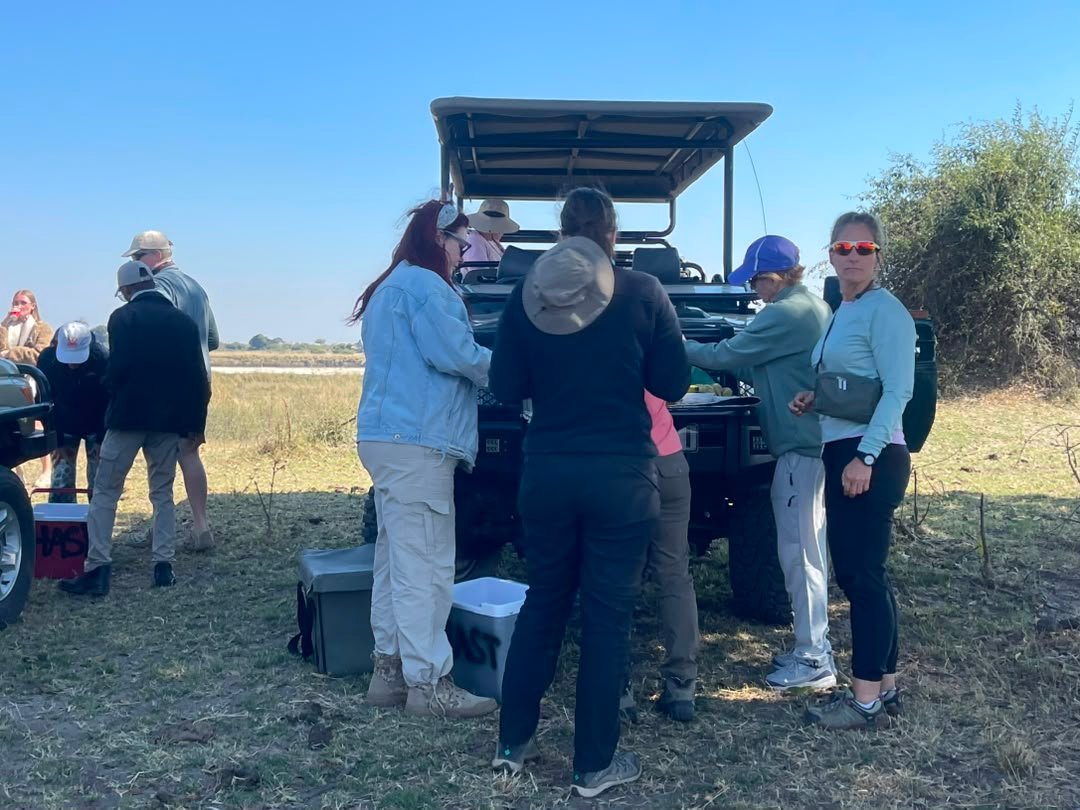
A shared Chobe day trip is the most economical option and works especially well for couples, solo travelers and small parties who do not mind sharing the safari with other guests.
Current 2026 listings show many shared Victoria Falls departures clustered around approximately US$150–US$250 per person, including examples at US$150–160, US$165, US$182, US$200 and above US$210 depending on operator and package.
Livingstone departures currently show a similar market, with several full-day options advertised around US$190–US$230 per person.
Shared trips generally include the same core wildlife experience as private departures:
a Chobe River cruise, game drive, lunch and transfers.
The main differences are group size and flexibility.
A shared vehicle may carry approximately six to twenty guests depending on the operator and vehicle configuration. Travelers should therefore ask about maximum group size when comparing tours.
A smaller shared group can sometimes provide a significantly better safari experience even if the price is slightly higher.
What Determines the Price?
Several factors explain why two apparently similar Chobe day trips can have noticeably different prices.
Starting location has an immediate effect. A traveler already staying in Kasane does not require international transfers, whereas a Victoria Falls or Livingstone guest needs transportation across national borders.
Shared versus private operation is another major factor. Reserving an entire vehicle or boat naturally costs more than dividing operating expenses among several travelers.
Group size matters particularly on private safaris. The fixed cost of a vehicle spread among six guests generally results in a lower per-person rate than the same vehicle carrying two guests.
National park fees must also be considered. Some operators include them in the advertised price, while others charge them separately. Current listings demonstrate both approaches.
Boat type can influence the rate. A shared motorized safari boat is generally cheaper than a private photographic vessel reserved exclusively for one group.
Meal standard matters as well. A basic lunch and a higher-end lodge buffet do not necessarily carry the same operating cost.
Finally, specialist guiding can increase the price. A private photographic safari with a specialist guide and customized positioning may cost considerably more than a conventional shared excursion.
For this reason, travelers should compare Chobe tours according to value rather than simply selecting the cheapest price.
A US$140 trip excluding park fees, transfers and certain refreshments may eventually cost almost as much as a US$180 package covering everything.
Best Time for a Day Trip to Chobe National Park
A Chobe National Park Day Trip can be enjoyed throughout the year, but Chobe changes dramatically between seasons.
For travelers primarily interested in high concentrations of elephants and large mammals around the Chobe Riverfront, May through October is generally the strongest period. Botswana Tourism specifically notes that large herds of elephants and Cape buffalo converge on the Chobe River during the dry winter months.
For travelers interested in lush landscapes, dramatic skies, migratory birds, young animals and fewer visitors, the greener months from approximately November through April can be exceptionally rewarding. Chobe’s wet season is generally strongest from November through March, while April acts as a transition toward the dry season.
There is therefore no single month that is perfect for every traveler.
The best time depends on what you want to photograph and experience.
Dry Season – May to October
The dry season from May to October is generally considered the premier period for wildlife viewing around the Chobe Riverfront.
As temporary water sources across the interior disappear, animals increasingly depend on permanent water. The Chobe River therefore becomes a powerful wildlife magnet.
Botswana Tourism specifically highlights the dry-season convergence of elephant and buffalo herds along the riverbank.
May
May is an excellent transition month.
The rains have normally ended, vegetation begins to dry and animals progressively return toward permanent water. Chobe.com notes that large elephant herds begin appearing along the riverfront while game drives and river cruises become increasingly productive.
Temperatures are generally more comfortable than later in the season, making May particularly attractive for travelers combining Chobe with Victoria Falls.
June and July
June and July bring cooler, dry conditions and increasingly impressive wildlife concentrations.
Elephants become highly visible around the river, while buffaloes and other herbivores gather across the floodplains. These months can provide excellent river-cruise conditions and productive game drives.
Travelers should not underestimate the morning cold.
Open safari vehicles and boats provide little protection from wind, and early starts can feel surprisingly chilly. Warm layers, a fleece and light jacket are highly recommended.
By midday, temperatures are normally considerably more comfortable.
August
By August, Chobe’s dry season is well established.
Vegetation is thinner, water away from the river is increasingly limited and wildlife concentration around the Chobe Riverfront can become excellent.
This creates strong conditions for both boat safaris and game drives.
Demand is also high, so travelers should book well in advance when visiting during the main safari season.
September and October
September and October can produce some of the highest concentrations of wildlife along the riverfront as the dry season approaches its climax.
Animals become increasingly dependent on permanent water, making river cruises particularly productive. Chobe.com notes that wildlife density at the river reaches extremely high levels during these months.
The trade-off is heat.
October can become extremely hot, with afternoon temperatures sometimes exceeding 40°C.
Travelers visiting at this time should wear lightweight clothing, use strong sun protection and drink plenty of water.
For wildlife enthusiasts willing to tolerate the heat, September and October can nevertheless be spectacular.
Green Season – November to April
The green season from approximately November through April presents an entirely different version of Chobe.
The first significant rains normally begin around November, transforming dry brown landscapes into fresh grass and green vegetation.
Temporary water becomes available throughout the wider ecosystem, allowing animals to spread away from the permanent Chobe River. As a result, the spectacular dry-season concentrations along the riverfront generally decrease.
This does not mean Chobe becomes poor for wildlife.
Instead, the safari becomes less about enormous concentrations around water and more about lush scenery, seasonal behavior, birdlife and exploring a rejuvenated ecosystem.
Rain usually falls in showers or thunderstorms rather than continuously throughout every day. However, weather is naturally unpredictable, and visitors should carry lightweight rain protection.
The green season can also provide wonderful photographic conditions.
Dark storm clouds, vivid vegetation, clean air and dramatic shafts of sunlight can produce images that are completely different from the dusty tones of September and October.
Young antelopes may appear during the wetter period, adding another interesting dimension to wildlife viewing. Chobe.com notes that December brings newborn antelope as well as striking green scenery and dramatic cloud formations.
Birdlife becomes particularly impressive.
Migratory species arrive, resident birds become active and many species display breeding plumage.
January and February represent some of the greenest months, while March sees the rains gradually begin to decline.
April is an excellent transition month for travelers who want greener scenery without necessarily experiencing the wettest conditions. Vegetation remains attractive, while surface water begins declining and wildlife gradually starts moving back toward more permanent sources.
Best Months for Wildlife Viewing
For travelers whose primary objective is seeing large concentrations of elephants, buffaloes and other mammals around the Chobe Riverfront, the strongest general window is:
June to October.
May is already very good, but wildlife concentrations usually build as the dry season progresses.
June and July combine productive wildlife viewing with comparatively comfortable daytime temperatures.
August delivers increasingly intense riverfront activity.
September can provide an outstanding balance between wildlife density and manageable weather.
October can produce extraordinary concentrations but also brings the year’s most intense heat.
For many first-time visitors, August and September are particularly strong choices because vegetation has thinned, animals increasingly depend on the river and both boat and vehicle safaris can be extremely rewarding.
However, travelers should remember that wildlife never follows a timetable.
A visitor in January can have an extraordinary lion or elephant encounter, while someone visiting during the theoretical peak season can still experience quieter periods.
Season influences probabilities—not guarantees.
Best Months for Photography and Birding
The best season for photography depends entirely on what type of photographs you want to create.
For classic large-mammal photography, the dry season is difficult to beat.
From approximately June through September, animals gather around the river, vegetation becomes less dense and the dry air can create clear photographic conditions. May also offers particularly attractive conditions as the landscape transitions from green toward dry.
Elephants drinking against the Chobe River, buffaloes spreading across open floodplains, giraffes against dry woodland and predators around concentrated prey can create classic safari images.
Dust in late dry season can also become an artistic advantage.
When backlit by afternoon sunlight, dust kicked up by elephants or buffaloes can create atmospheric golden scenes.
For landscape photography, however, the green season can be even more visually dramatic.
Between approximately December and March, Chobe becomes rich green. Thunderstorms create towering clouds, the air can become exceptionally clear after rain and pools of water produce reflections unavailable during the dry months.
Photographers interested in color, atmosphere and environmental wildlife portraits may actually prefer these months.
For bird photography and serious birdwatching, the green season is particularly rewarding.
Chobe supports more than 450 recorded bird species according to Chobe.com’s destination guide, and wet-season conditions bring additional migrants into the region.
The period from November through March is therefore especially attractive for birders.
Travelers may search for kingfishers, bee-eaters, rollers, storks, herons, fish eagles, raptors and many other species associated with the river, floodplains and surrounding woodland.
September can also be interesting because some migrants begin arriving before the main rains.
Which Month Should You Choose?
For travelers trying to choose one period for their Chobe National Park Day Trip, the decision can be simplified:
May–June: excellent combination of comfortable weather, increasingly strong wildlife and relatively attractive scenery.
July–August: excellent elephant and general wildlife viewing, cool mornings and high safari demand.
September: one of the strongest all-round months for wildlife, photography and river activity.
October: exceptional wildlife concentrations but extremely hot conditions.
November: dramatic seasonal transition, first rains, fresh landscapes and increasing bird activity.
December–February: best suited to travelers who love greenery, dramatic skies, birding, young animals and quieter safari conditions.
March–April: attractive transitional period with green scenery, gradually decreasing rainfall and improving visibility as the dry season approaches.
For a first-time traveler whose highest priority is elephants and classic Chobe wildlife, July through September would normally be among the safest choices.
For a photographer wanting lush landscapes and dramatic skies, December through March deserves serious consideration.
For a dedicated birder, November through March provides some of the richest seasonal diversity.
The important point is that Chobe should not be marketed as a destination that is only worth visiting during three or four months of the year.
The dry season concentrates the wildlife; the green season transforms the landscape.
Both can produce exceptional Chobe day trips—they simply tell different stories.
What to Pack for a Chobe Day Trip
Packing correctly for a Chobe National Park Day Trip can make a surprisingly large difference to the experience. Although travelers are normally away from their hotel for only one day, the excursion can involve an early-morning road transfer, an international border crossing, several hours on the Chobe River, lunch in Kasane and an open-vehicle game drive before returning in the evening. Conditions can therefore change considerably between departure and return.
The best approach is to travel light. A small backpack or soft day bag is normally sufficient. Large suitcases are unnecessary and can become inconvenient when changing vehicles at the border or boarding a safari boat.
Essential Chobe Day Trip Packing List
- Original passport – essential for travelers crossing into Botswana from Zambia or Zimbabwe.
- Correct visa or immigration documentation – including evidence of a KAZA UniVisa where applicable.
- Birth certificate and parental documentation for children where required.
- Camera or smartphone – Chobe offers exceptional wildlife and landscape photography.
- Extra camera batteries and memory cards – long boat cruises and game drives can generate hundreds of photographs.
- Binoculars – especially valuable for birds, distant elephants, antelopes and predators.
- Sunglasses – glare from the Chobe River can be strong.
- Wide-brimmed hat or safari hat – useful on both the boat and open safari vehicle.
- High-SPF sunscreen – much of the day is spent outdoors.
- Light jacket or fleece – particularly important for cool dry-season mornings from approximately June to August.
- Lightweight rain jacket – useful during the November-to-April green season.
- Comfortable closed shoes or supportive sandals – extensive walking is normally not required, but footwear should be secure when entering vehicles and boats.
- Reusable or additional water bottle – even when bottled drinking water is included.
- Personal medication – including anything that may be required during the full day away from the hotel.
- Insect repellent – particularly useful during warmer and wetter months.
- Lip balm and moisturizer – dry air, wind and sun can be surprisingly dehydrating.
- Small amount of cash – useful for gratuities, drinks or personal purchases.
- Phone power bank – valuable if photographs, maps and communication are used throughout the day.
One item travelers should particularly avoid forgetting is the original passport. A photograph or photocopy on a phone should not be regarded as a substitute for the original travel document when crossing an international border.
Professional photographers should also consider equipment carefully. A telephoto zoom such as a 100–400 mm equivalent is extremely useful, while a wider lens can capture the Chobe River, large elephant herds and environmental wildlife scenes. Carrying several heavy lenses, however, may become inconvenient when moving between transfer vehicles, boats and safari vehicles.
Plastic protection or a simple waterproof camera cover can also be useful during the green season. Even outside the rainy months, protecting equipment from dust is sensible during game drives.
The goal is to have everything needed for a 10- to 12-hour safari day without carrying unnecessary luggage.
Passport, Visa and Border Requirements
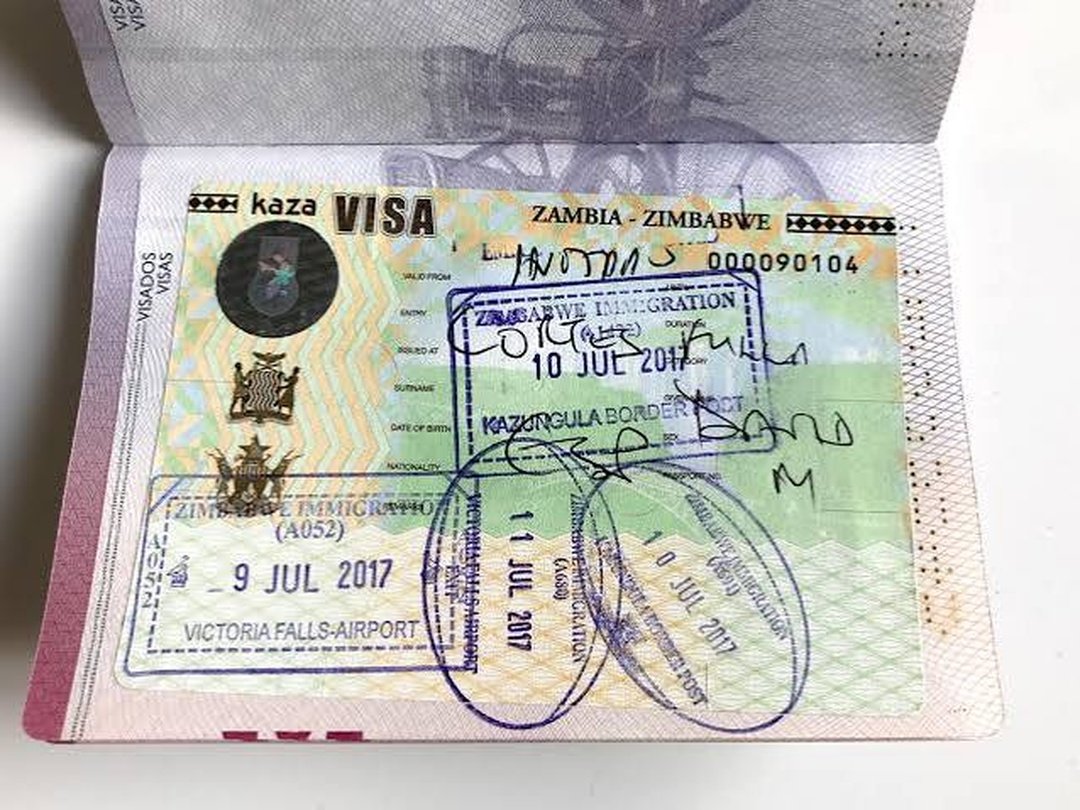
A Chobe day trip from Victoria Falls or Livingstone is an international safari, not simply a visit to a neighboring national park. Travelers staying in Victoria Falls leave Zimbabwe and enter Botswana before returning to Zimbabwe later in the day. Guests beginning in Livingstone leave Zambia, enter Botswana and subsequently re-enter Zambia.
Passport and visa arrangements are therefore among the most important parts of planning the excursion.
Immigration rules vary according to nationality and can change. The information below provides a planning framework, but travelers should verify requirements using the relevant government immigration authorities shortly before travel.
Botswana Entry Requirements
Every traveler entering Botswana for a Chobe day trip should carry a valid original passport.
Botswana’s government states that, in the absence of specific bilateral arrangements, visitors must hold a passport valid for at least six months.
Whether a tourist needs a Botswana visa depends on nationality. Some travelers may enter visa-free, while others must obtain the appropriate visitor authorization. Botswana maintains a visitor-visa process for nationals who require visas, and travelers should confirm their individual category before departure.
Travelers coming from or transiting through countries where yellow fever is endemic should also pay particular attention to vaccination documentation. Botswana’s official health guidance states that travelers arriving from or transiting yellow-fever-endemic countries must carry a valid International Certificate of Vaccination or Prophylaxis for yellow fever, which may be requested at entry.
This point can be particularly relevant for travelers whose wider African itinerary includes East, Central or West African destinations before arriving in Southern Africa.
Families also need to prepare more carefully than adults traveling alone. Botswana government information issued in December 2025 warned travelers that children under 18 should travel with a valid passport and an unabridged birth certificate. Botswana government guidance has also stated that when a minor travels with only one parent, additional parental authorization may be required.
Parents should therefore verify the latest requirements before traveling, particularly when:
one parent is traveling without the other,
the child’s surname differs from that of the accompanying adult,
the child is traveling with grandparents,
or the accompanying adult is not the child’s parent.
Arriving at the border without the correct paperwork can disrupt the entire Chobe day trip.
Zambia Entry Requirements
For a Chobe Day Trip from Livingstone, travelers must consider not only leaving Zambia but also their eligibility to re-enter Zambia later that afternoon.
Zambia’s Department of Immigration states that arriving travelers should have at least six months of passport validity from the date of entry and at least three full blank passport pages.
Visa requirements depend on nationality. Zambia divides visitors into groups that may enter visa-free, obtain visas on arrival or require authorization before travel. Official immigration information maintains separate lists for these categories.
This distinction is important for Chobe day visitors because crossing into Botswana means leaving Zambia. A traveler holding immigration permission that does not allow re-entry should resolve this before beginning the safari.
One particularly useful arrangement for eligible visitors is the KAZA UniVisa.
According to Zambia’s Department of Immigration, the KAZA UniVisa currently costs US$50, allows tourists to travel multiple times between Zambia and Zimbabwe during its validity, is valid for up to 30 days, and also covers Botswana day trips through the Kazungula borders.
This can make it especially convenient for travelers combining:
Victoria Falls in Zambia,
Victoria Falls in Zimbabwe,
and a Chobe day safari in Botswana.
The KAZA UniVisa is not automatically available to every nationality, however. Travelers should check eligibility rather than assuming they can purchase it at the border. Zambia’s immigration authorities provide current eligibility information and state that the visa can be obtained through designated entry points and through the eVisa system under the applicable conditions.
For travelers based in Livingstone, this regional visa arrangement can significantly simplify a holiday involving both sides of Victoria Falls plus Chobe.
Zimbabwe Entry Requirements
Travelers booking a Chobe Day Trip from Victoria Falls, Zimbabwe, should pay particular attention to Zimbabwe re-entry requirements.
The important issue is not simply whether you were legally admitted into Zimbabwe at the beginning of your holiday. Leaving Zimbabwe for Botswana means that you subsequently need the correct immigration permission to enter Zimbabwe again.
Zimbabwe operates nationality-based visa arrangements. Depending on the traveler’s passport, entry may be visa-free or require the appropriate visa authorization. Zimbabwe’s official eVisa platform states that travelers from certain countries may enter without obtaining a visa beforehand, while others can use the eVisa application system according to their eligibility.
Travelers whose nationality requires an eVisa should arrange it within the correct timeframe. Zimbabwe’s official eVisa FAQ currently advises applicants to submit an application at least three weeks before travel.
Visitors should also understand the difference between single-entry, double-entry and multiple-entry permission.
If a traveler enters Zimbabwe using a single-entry visa, leaves for Botswana and then attempts to return to Victoria Falls, that original entry may no longer be sufficient. This is why Chobe should be considered when deciding which visa arrangement to obtain at the beginning of the holiday.
Eligible travelers may find the KAZA UniVisa particularly practical because it supports multiple movement between Zambia and Zimbabwe and covers qualifying Botswana day trips through Kazungula within its conditions.
Because visa categories and eligibility can change, travelers should confirm the latest situation through the official Zimbabwe eVisa and immigration channels before departure rather than relying on older travel blogs.
Important Border Crossing Advice
The border crossing is usually straightforward when documents have been prepared correctly, but it should never be treated as an insignificant part of the safari.
Keep your passport with you throughout the day. Do not leave it inside the hotel safe because the Chobe excursion crosses an international border.
Check passport validity well before traveling. Botswana generally requires six months’ validity, while Zambia requires six months and at least three full blank passport pages.
Confirm both entry and re-entry requirements. Travelers leaving Zimbabwe or Zambia for Botswana need to know that they will be allowed back into their original country later that day.
Check whether your nationality is eligible for visa-free entry, visa on arrival, eVisa or the KAZA UniVisa rather than relying on the rules that apply to another traveler.
Parents should prepare children’s documentation carefully. Botswana’s current government guidance makes documentation for travelers under 18 particularly important.
Carry the original yellow fever vaccination certificate if your recent travel history means Botswana’s yellow fever requirement applies to you.
Avoid booking an international flight immediately after the expected return from Chobe. Border queues can vary and safari activities themselves do not always finish exactly to the minute.
Travelers should also keep valuables, cameras, medication and documents with them when transferring between vehicles at the border.
Most importantly, verify immigration requirements close to the actual travel date. Border and visa policies are government regulations and are more important than information copied from an old safari itinerary or blog.
What to Wear on a Chobe Day Safari
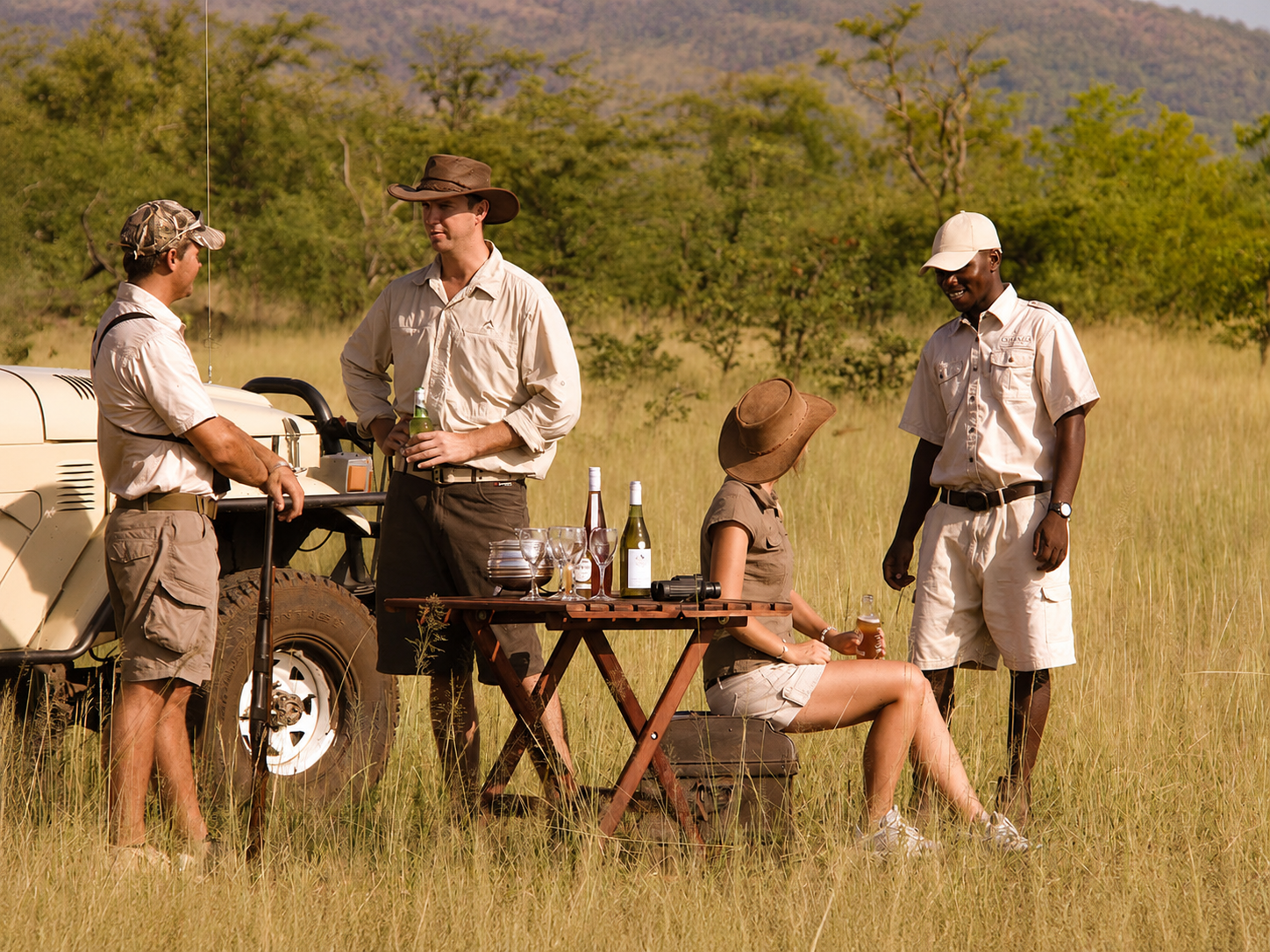
There is no need to buy an elaborate safari wardrobe for a one-day Chobe excursion. Comfortable, practical clothing in light, neutral tones works perfectly well.
Colors such as khaki, beige, olive, brown, grey and other muted shades are practical because they blend naturally with the safari environment and tend not to show dust as quickly as very dark or bright clothing.
A lightweight long-sleeved shirt is particularly useful. Sleeves provide protection from strong sunlight and can also offer some protection against insects without making the traveler excessively warm.
Comfortable lightweight trousers, safari trousers or longer shorts work well depending on season and personal preference.
The biggest mistake many travelers make is assuming that Botswana is hot at every hour of the day.
During the dry-season winter months, especially June, July and August, early mornings can feel surprisingly cold in an open vehicle or on the river. Wind created by the moving vehicle or boat can make conditions feel considerably cooler than the actual air temperature.
Layers are therefore ideal.
A shirt, fleece or sweater and light wind-resistant jacket allow travelers to remove clothing gradually as the day warms.
During September and October, conditions can become very hot. Lightweight breathable clothing, a good hat, sunglasses and sunscreen become particularly important.
During the wetter months from November through approximately March or April, lightweight clothing remains appropriate, but carrying a compact waterproof jacket is wise because showers and thunderstorms are possible.
Footwear does not need to be heavy hiking boots unless they are personally preferred. A Chobe day trip normally involves relatively little walking. Comfortable closed shoes, trainers or secure outdoor footwear are usually sufficient.
Very high heels, slippery sandals and footwear that is difficult to climb in and out of boats or safari vehicles should be avoided.
A hat should fit securely enough that it will not immediately blow away while the safari vehicle or boat is moving.
The best Chobe outfit is ultimately one that allows the traveler to forget about clothing and concentrate on the wildlife.
Is a Chobe Day Trip Suitable for Families?
A Chobe National Park Day Trip can be an excellent family safari, particularly for children who already enjoy animals, nature and boat trips.
The combination of river safari and game drive helps keep the experience varied. Instead of asking children to remain seated in the same vehicle for an entire day, the itinerary changes between road transport, border crossing, boat safari, lunch and game drive.
Children may watch elephants drinking beside the river, search for crocodiles along the banks, count hippos, photograph giraffes and learn to identify birds. These experiences can turn the day into an enjoyable introduction to wildlife conservation rather than simply another sightseeing excursion.
However, parents need to consider the child’s age, patience and ability to cope with a long day.
Chobe Day Trip with Children
For school-age children who are enthusiastic about wildlife, Chobe can be one of the most memorable days of a Southern African family holiday.
The boat safari is particularly family-friendly because children can see animals from an unusual perspective and often remain engaged by the movement of the boat and the constant search for animals along the banks.
Elephants are naturally a highlight, while hippos, crocodiles, giraffes, monkeys, baboons and colorful birds tend to maintain children’s interest.
The game drive requires slightly more patience because there may be periods when the guide is searching for wildlife rather than actively watching an animal.
Parents can make the experience more enjoyable by giving children binoculars, allowing them to keep a wildlife checklist or encouraging them to photograph their favorite sightings.
Very young children require more careful planning.
Individual safari operators may apply their own minimum-age policies for shared vehicles or boats, especially where long game drives are involved. Families traveling with babies, toddlers or very young children should therefore confirm the operator’s age policy before paying for the tour.
A private Chobe safari can be a significantly better option for families with younger children because it provides greater control over the pace of the day.
If a child becomes tired, hungry or needs a break, the family is not affecting unrelated guests sharing the same vehicle.
Parents should also consider the length of the excursion. A Chobe trip from Victoria Falls or Livingstone may occupy ten or more hours once road transfers and border procedures are included.
Children who struggle with long days may therefore enjoy Chobe more when the family stays overnight in Kasane, eliminating the return international transfer.
Documentation is also critical. Botswana government guidance indicates that children under 18 should carry a valid passport and unabridged birth certificate, with additional consent documentation potentially relevant when a child travels with only one parent.
Families should verify the latest rules well in advance rather than waiting until safari morning.
Chobe Safari for Seniors
A Chobe day safari can also be very suitable for senior travelers, because the core activities do not involve strenuous trekking.
Unlike walking safaris or mountain experiences, the wildlife is primarily viewed from a safari boat and 4×4 vehicle.
This makes Chobe accessible to many older travelers who are comfortable sitting for several hours but may not want an activity requiring significant walking.
The main physical considerations are getting into and out of the safari vehicle and boarding the boat.
Open game-drive vehicles can be relatively high off the ground and may require guests to use steps. Travelers with reduced mobility, hip or knee problems, recent surgery or difficulty climbing should tell the safari operator before booking.
The same applies to boats. Boarding arrangements differ according to vessel and water level, so mobility requirements should be discussed in advance rather than on arrival at the jetty.
For seniors, a private safari may again be worth considering.
It allows more control over rest stops, seating arrangements and the pace of the game drive. Guests who need more time entering a vehicle do not feel rushed, while those who prefer shorter wildlife sessions can structure the day accordingly.
Travelers sensitive to heat should take particular care during September and October, when Chobe can become very hot.
Conversely, travelers sensitive to cold should carry adequate layers for early-morning outings during June, July and August.
Medication should remain in the traveler’s day bag throughout the excursion rather than inside luggage left at the hotel.
A senior traveler who is generally comfortable with a full sightseeing day will often find Chobe very manageable, but mobility needs should always be discussed before booking so the correct vehicle, boat and assistance can be arranged.
Private Safari Options
A private Chobe National Park Day Trip is the best option for travelers who value flexibility over the lowest possible price.
Instead of sharing the game-drive vehicle and possibly the boat with unrelated guests, the safari is reserved for one couple, family or private group.
For families, this provides the freedom to adapt the pace around children.
For seniors, it allows easier boarding, additional rest time and more control over seating.
For photographers, it is particularly valuable because the vehicle does not have to leave an excellent sighting simply because another guest wants to continue searching elsewhere.
Birdwatchers can ask the guide to spend longer identifying smaller species rather than concentrating only on elephants and predators.
Couples may simply prefer the privacy and quieter atmosphere.
A private trip can also sometimes adjust the relative amount of time spent on the river and in the national park, depending on operator arrangements and park schedules.
It is important to understand, however, that private does not mean guaranteed wildlife.
Animals move naturally regardless of how much the safari costs.
What private touring buys is control over the pace, interests and style of the safari, not control over nature.
For a family of four or six, the per-person difference between shared and private arrangements may also be smaller than expected because the fixed cost of the vehicle is distributed across several guests.
It is therefore worth requesting both prices before automatically choosing a shared departure.
Chobe Day Trip vs Overnight Chobe Safari
One of the most common decisions travelers face is whether to visit Chobe as a day trip from Victoria Falls or Livingstone or spend at least one night in Kasane or at a lodge around Chobe National Park.
Neither option is automatically better.
The right choice depends on available time, budget and how important wildlife is within the wider holiday.
| Comparison | Chobe Day Trip | Overnight Chobe Safari |
|---|---|---|
| Time Available | Approximately one full day, often 10–12 hours including transfers and borders | Two days or longer, allowing substantially more safari time |
| Wildlife Viewing | Excellent introduction to the Chobe Riverfront with boat and vehicle viewing | More opportunities across different times of day and repeated wildlife searches |
| Activities | Usually one boat safari + one game drive | Multiple game drives, boat cruises and potentially additional specialist activities |
| Early Morning Safari | Limited when traveling from Victoria Falls or Livingstone because the morning begins with a transfer | Easier to begin at or near sunrise |
| Late Afternoon / Sunset | International travelers must leave with enough time to return across the border | Greater flexibility to remain around the safari area later |
| Accommodation | No Botswana accommodation required | One or more nights in Kasane or a Chobe safari lodge |
| Border Crossings | Outbound and return border procedures in the same day from Zambia or Zimbabwe | Border crossing normally spread across different travel days |
| Pace | Full and relatively structured day | More relaxed |
| Cost | Lower overall cost | Higher because accommodation, meals and additional safari activities are required |
| Photography | Very good, especially when boat + game drive are included | Better opportunity to photograph different light conditions and repeat locations |
| Families | Good for children comfortable with a long day | Often better for younger children because the experience can be divided across days |
| Seniors | Suitable for many travelers but can be a long day | More relaxed and usually easier to pace |
| Best For | Visitors with limited time who are primarily staying at Victoria Falls or Livingstone | Wildlife-focused travelers who want a deeper Botswana safari |
Time Available
The major strength of the Chobe day trip is efficiency.
Travelers can remain based in Victoria Falls or Livingstone while adding Botswana to their itinerary without changing hotels.
For a visitor spending three nights at Victoria Falls, this can be extremely valuable.
The disadvantage is that part of the day must be devoted to road transfers and border formalities.
An overnight safari removes some of this pressure.
Once travelers are staying in Kasane or near the park, the safari can begin early without first traveling internationally. The next day can also include another activity before departure.
Wildlife Viewing
A day trip can produce exceptional wildlife viewing, particularly because it usually combines water and land.
However, wildlife is unpredictable.
If lions are inactive during the few hours available on a day safari, there may be no second opportunity to search for them.
An overnight itinerary creates additional wildlife sessions.
A quiet morning can be followed by a productive afternoon. Animals missed during the first drive may be found on the next.
This is particularly useful for travelers hoping to see predators or spend substantial time photographing elephants.
Activities
A standard Chobe day trip normally revolves around two major experiences:
the Chobe River boat safari and the Chobe National Park game drive.
That is sufficient to provide an excellent introduction.
An overnight safari allows the itinerary to breathe.
Travelers can potentially enjoy a sunset boat cruise, morning game drive, afternoon drive or additional river experience depending on the lodge and package selected.
It is therefore more immersive rather than merely containing more activities.
Accommodation
The day trip requires no Botswana accommodation, which keeps logistics and costs relatively simple.
Travelers leave their luggage at their Victoria Falls or Livingstone hotel and return to the same room after the excursion.
An overnight safari requires accommodation in Kasane, inside or near Chobe National Park, or at another suitable property.
This adds cost but can significantly change the atmosphere of the experience.
Instead of leaving Botswana just as the day begins to cool, guests can have dinner near the Chobe River, sleep within the safari region and wake ready for another wildlife activity.
Cost
A day trip will normally be the more affordable option overall because it eliminates the cost of an additional Botswana hotel night, dinner, breakfast and further activities.
The overnight safari costs more but provides additional safari time.
Travelers should therefore compare cost per experience rather than cost per day alone.
Someone who has flown halfway around the world primarily to see African wildlife may find that spending more for an overnight Chobe experience delivers significantly greater value.
A traveler whose main objective is Victoria Falls and who simply wants one excellent safari day may gain little from extending the visit.
Which Option Is Best?
Choose a Chobe Day Trip if you:
are staying mainly in Victoria Falls or Livingstone,
have limited time,
want to visit Botswana without changing hotels,
want both a boat safari and game drive,
are experiencing an African safari for the first time,
or want to keep the overall holiday cost lower.
Choose an Overnight Chobe Safari if you:
consider wildlife one of the main priorities of your Southern African journey,
want sunrise and later-afternoon safari opportunities,
want more than one chance to search for predators,
are a serious wildlife photographer,
prefer a slower pace,
are traveling with younger children who may struggle with a 10- to 12-hour day,
or simply want to experience Chobe as a destination rather than as an excursion.
For travelers who have the time, two nights in Chobe is considerably more immersive than a day trip. It creates opportunities for several wildlife activities without turning the safari into a rushed schedule.
For travelers who do not have that time, the Chobe day trip remains an unusually strong option because the riverfront allows two very different safari experiences to be combined efficiently in a single day.
The most important distinction is therefore not that an overnight safari is “good” and a day trip is “bad.”
A Chobe day trip is about efficiency and variety.
An overnight Chobe safari is about depth, flexibility and additional wildlife time.
Choosing between them should depend on the role Chobe plays in the wider journey. If Botswana is an exciting addition to a Victoria Falls holiday, the day trip can be ideal. If Chobe’s wildlife is one of the main reasons for traveling to Southern Africa, staying overnight is usually the more rewarding choice.
Can You Combine Chobe with Victoria Falls?
Yes. Combining Chobe National Park with Victoria Falls is one of the most practical and rewarding short multi-country safari combinations in Southern Africa. The two destinations provide completely different experiences while sitting close enough together to be included in a two-day, three-day or longer itinerary. Victoria Falls delivers dramatic waterfall scenery and the power of the Zambezi River, while Chobe introduces travelers to Botswana’s wildlife-rich riverfront, open 4×4 game drives and boat safaris among elephants, hippos, crocodiles and abundant birdlife.
The combination works particularly well because Kasane is the main gateway to Chobe National Park and is also an important regional access point for Victoria Falls in Zimbabwe and Livingstone in Zambia. Botswana Tourism specifically describes Kasane as the gateway to Chobe and a departure point for nearby Victoria Falls and Livingstone.
Rather than choosing between sightseeing at Victoria Falls and experiencing a traditional African safari, travelers can enjoy both within the same holiday. One day can be centered on the falls and surrounding Zambezi attractions, while another is devoted to crossing into Botswana for a Chobe River boat safari and game drive.
For travelers with additional time, the combination becomes even better when one night is spent in Kasane or near Chobe National Park. This removes the need to return across the border immediately after the afternoon safari and creates opportunities for early-morning or late-afternoon wildlife viewing.
Victoria Falls itself lies on the Zambezi River between Zambia and Zimbabwe and is famous for its enormous curtain of falling water. Zambia Tourism describes it as one of the world’s great natural spectacles, while Zimbabwe Parks records the waterfall at approximately 108 metres high and 1,708 metres wide.
Chobe offers a completely different environment. The national park covers approximately 11,700 square kilometres, encompassing floodplains, swamps and woodland, with the Chobe River forming an important part of its northern landscape.
This difference is precisely what makes a Victoria Falls and Chobe safari combination so worthwhile.
One destination is about water crashing dramatically into a gorge.
The other is about water sustaining one of Botswana’s richest wildlife ecosystems.
Victoria Falls and Chobe Safari Combination
A Victoria Falls and Chobe Safari can be arranged from either the Zimbabwean or Zambian side of Victoria Falls. Travelers based in Victoria Falls town in Zimbabwe usually travel toward Botswana in the early morning, while guests staying in Livingstone use the Zambia–Botswana route through the Kazungula corridor.
Once in Botswana, visitors continue toward Kasane and the Chobe Riverfront.
The classic combination includes three very different experiences:
Victoria Falls sightseeing, where travelers explore viewpoints overlooking the waterfall and Zambezi Gorge;
a Chobe River boat safari, providing wildlife viewing from water level;
and a Chobe National Park game drive, exploring the riverfront by open 4×4 safari vehicle.
This makes the combination especially attractive for first-time visitors to Southern Africa because it provides an unusually broad range of experiences without requiring multiple internal flights or lengthy transfers between distant destinations.
A traveler may spend one morning walking through rainforest-like vegetation beside Victoria Falls and, less than twenty-four hours later, be watching elephants drinking along the Chobe River.
The contrast is remarkable.
Victoria Falls also offers numerous optional experiences that can be incorporated around the Chobe safari. Depending on season and personal interests, travelers may add a Zambezi sunset cruise, helicopter or microlight flight, cultural experiences, scenic viewpoints or other adventure activities. Zambia Tourism notes that helicopter and microlight flights are among the activities available around Victoria Falls, although some activities are seasonal or water-level dependent.
For travelers with only a few days, however, the itinerary should not become overloaded.
Victoria Falls and Chobe are both destinations that deserve time to be experienced rather than simply photographed and left behind.
A good combination therefore balances sightseeing with unstructured moments.
At Victoria Falls, allow enough time to stop at viewpoints, appreciate changing angles and watch the Zambezi disappearing into the gorge.
At Chobe, allow the safari guide enough flexibility to remain at productive wildlife sightings rather than racing through the park to maintain an unnecessarily rigid timetable.
The Chobe River is particularly important to the combination because it creates an experience that differs from a conventional vehicle-only safari. Tourism establishments around Chobe routinely offer both river cruises and 4×4 game drives, demonstrating how central both activities are to exploring this ecosystem.
For travelers who want the simplest arrangement, the best option is usually:
Victoria Falls as the accommodation base + one full Chobe day trip.
For travelers who want deeper wildlife viewing:
Victoria Falls + one or two nights in Kasane/Chobe.
For travelers continuing through Botswana:
Victoria Falls → Kasane/Chobe → onward Botswana safari, rather than returning to Victoria Falls.
This flexibility means the combination works for honeymooners, families, photographers, seniors, first-time safari travelers and experienced visitors wanting to add Botswana to a broader Southern Africa itinerary.
Suggested 2-Day Victoria Falls and Chobe Trip
A 2-Day Victoria Falls and Chobe Trip is ideal for travelers with limited time who want to experience both destinations without adding unnecessary complexity.
The strongest arrangement is to remain based in Victoria Falls or Livingstone for both nights and use the second day for the full Botswana excursion.
Day 1: Explore Victoria Falls
Begin the morning with a guided or independent visit to Victoria Falls.
Travelers staying on the Zimbabwean side can explore the viewpoints within Victoria Falls National Park, while guests based in Livingstone can experience the falls from the Zambian side. The waterfall forms a natural boundary between Zambia and Zimbabwe.
Allow several hours rather than rushing through the viewpoints.
The appearance of Victoria Falls changes considerably with season and water level. Spray conditions, visibility into the gorge and the amount of exposed rock vary throughout the year, so the experience is never exactly the same from one season to another.
A waterproof jacket or poncho can be extremely useful when spray is heavy, while secure footwear is recommended because paths may become wet and slippery.
After visiting the falls, return to the hotel for lunch and some time to relax.
The afternoon can remain free or be used for an optional Victoria Falls experience.
A Zambezi sunset cruise makes an excellent addition because it provides a relaxed contrast to the following day’s wildlife safari. Travelers can watch the river landscape change as the sun lowers while beginning to appreciate the wider Zambezi ecosystem.
Alternatively, guests interested in aerial perspectives may choose a helicopter flight when conditions allow.
Return to the hotel for dinner and prepare for an early departure the following morning.
Overnight: Victoria Falls, Zimbabwe, or Livingstone, Zambia.
Day 2: Full-Day Chobe National Park Safari
Begin early with collection from your Victoria Falls or Livingstone accommodation.
Travel toward Botswana, complete the relevant immigration formalities and continue toward Kasane, Botswana’s gateway to Chobe National Park.
The Chobe experience should include both major safari environments.
Spend approximately three hours exploring the Chobe River by boat, searching for elephants, hippos, crocodiles, buffaloes, antelopes and river-associated birdlife.
The boat safari provides excellent low-level wildlife viewing and some of the best opportunities to appreciate the relationship between Chobe’s animals and permanent water.
Break for lunch around Kasane before continuing with an afternoon game drive through the Chobe Riverfront.
From the open safari vehicle, search woodland, floodplain edges and riverine habitat for elephants, giraffes, zebras, buffaloes, antelopes and, with luck, predators.
The objective should not be simply to accumulate a species checklist. Allow the guide to interpret tracks, behavior, landscapes and the ecological relationship between the animals and the Chobe River.
After the game drive, leave Botswana and complete the required border procedures before returning to your Victoria Falls or Livingstone hotel in the evening.
Overnight: Victoria Falls or Livingstone, or continue with onward travel if the schedule allows.
Is Two Days Enough?
Two days is short, but it works surprisingly well when planned properly.
The first day concentrates on Victoria Falls itself.
The second concentrates entirely on Chobe National Park.
The key is avoiding unnecessary additions that reduce the quality of the two main experiences.
A two-day itinerary is particularly suitable for travelers passing through Victoria Falls as part of a longer Southern African journey, visitors with limited annual leave or guests connecting Victoria Falls with destinations such as Cape Town, Johannesburg or another safari region.
Suggested 3-Day Victoria Falls and Chobe Safari
A 3-Day Victoria Falls and Chobe Safari allows a considerably richer experience.
Instead of visiting Botswana and immediately returning on the same afternoon, travelers can spend a night around Kasane and experience Chobe during more than one wildlife-viewing period.
This is the stronger option for travelers whose interest in wildlife goes beyond simply adding a safari to their Victoria Falls holiday.
Day 1: Victoria Falls Experience
Begin with a guided visit to Victoria Falls, allowing plenty of time to explore the viewpoints and appreciate the scale of the waterfall.
Victoria Falls National Park protects the Zimbabwean side of the falls, while the Zambian side is accessed from the Livingstone/Mosi-oa-Tunya area. The Zambezi itself forms the international boundary through this remarkable section of the river.
A knowledgeable guide can explain the geology, seasonal water levels, local history and ecology of the surrounding rainforest environment.
After the waterfall visit, return to the hotel for lunch.
The afternoon can be left at leisure or used for an optional Zambezi experience.
For travelers who have just arrived after a long international journey, keeping this afternoon relatively relaxed is usually preferable to immediately filling the schedule with multiple activities.
A sunset cruise can provide a gentle introduction to the region before the safari component begins.
Overnight: Victoria Falls, Zimbabwe, or Livingstone, Zambia.
Day 2: Victoria Falls to Chobe – Boat Safari and Overnight in Kasane
After breakfast, depart for Botswana.
Complete border formalities and continue toward Kasane. Because you are staying overnight rather than returning across the border immediately, the day can be approached at a more relaxed pace.
Check in or leave luggage at your Kasane accommodation before beginning the Chobe experience.
Kasane stretches along the Chobe River and functions as the principal tourism gateway to Chobe National Park.
Later in the day, board a safari boat for a Chobe River wildlife cruise.
The river safari is particularly rewarding because wildlife frequently uses the water and adjacent floodplains. Elephants may approach to drink, hippos occupy channels, crocodiles use exposed banks and numerous birds exploit the river environment.
Rather than worrying about finishing early enough for an international border crossing, overnight guests can enjoy a more relaxed transition into the evening.
Depending on the exact package and season, a later-afternoon river safari can also provide beautiful photographic light.
After the cruise, return to the lodge for dinner.
Spending the night near the Chobe River creates a different feeling from a day excursion. Instead of leaving Botswana immediately after the safari, guests remain within the landscape they have spent the afternoon exploring.
Overnight: Kasane or Chobe area.
Day 3: Morning Chobe Game Drive – Return to Victoria Falls or Livingstone
Begin early with a morning game drive in Chobe National Park.
Because you slept in Botswana, there is no international transfer before entering the safari area.
This allows valuable early wildlife-viewing time to be used more efficiently.
Drive through the Chobe Riverfront in an open 4×4 vehicle, searching for elephants, buffaloes, giraffes, zebras, antelopes and other wildlife.
Predators such as lions and leopards may also be encountered, although sightings can never be guaranteed.
The morning atmosphere is often one of the pleasures of overnighting in Chobe. Temperatures can be cooler, light may be soft and the national park begins revealing a completely different side of itself from the previous afternoon’s river safari.
After several hours of game viewing, return toward Kasane for breakfast or brunch depending on the arrangement.
Check out and begin the return journey to Victoria Falls or Livingstone.
Complete the appropriate border formalities and arrive during the afternoon, leaving time for onward travel or an additional night around Victoria Falls.
Why the 3-Day Option Is Better for Wildlife Lovers
The principal advantage is not simply the extra night.
It is access to multiple wildlife periods.
A conventional Chobe day trip gives travelers one boat safari and one game drive during the hours available between international transfers.
The three-day combination allows the wildlife experience to be divided across two days.
If elephants are especially active on the river during the afternoon, travelers can enjoy that sighting without feeling that they are losing game-drive time.
If predators are not visible during one activity, there is another opportunity the next morning.
Photographers gain access to different light.
Families gain a less exhausting schedule.
Senior travelers can rest between activities.
And guests interested in Chobe itself begin experiencing the destination rather than simply visiting it.
For travelers who can spare the additional night, this is often the best-balanced short Victoria Falls and Chobe itinerary.
Chobe Day Trip Safari Tips
A Chobe day trip is relatively straightforward, but a few practical decisions can significantly improve the experience.
Start Early
An early start protects the most valuable resource on a one-day safari: time inside Botswana.
Guests leaving from Victoria Falls or Livingstone must complete international transfers and immigration procedures before beginning wildlife activities. Starting early prevents the boat cruise or game drive from feeling compressed.
Keep Your Passport Easily Accessible
Do not pack your passport at the bottom of a large bag.
You will need it at the international border and may need supporting visa documentation as well.
Before leaving the hotel, check that every person in the group has the correct original travel documents.
Check Re-Entry Requirements Before Safari Day
Travelers leaving Zimbabwe or Zambia must later re-enter the country from which the trip began.
Do not focus only on Botswana’s entry rules.
If your visa status does not permit the return crossing, the problem may only become apparent after the safari has already started.
Eligible travelers using the KAZA UniVisa should confirm its current conditions before travel; Zambia Tourism states that it covers qualifying Botswana day visits through the Kazungula border to Kasane or Chobe National Park.
Wear Layers
Chobe temperatures can change considerably between early morning and midday.
A cool morning boat ride or open-vehicle transfer can require a fleece or light jacket, while the same traveler may be comfortable in a short-sleeved shirt several hours later.
Layers are much more useful than one heavy garment.
Protect Yourself from the Sun
The combination of open safari vehicles and reflected sunlight from the Chobe River creates considerable sun exposure.
Carry a hat, sunglasses and sunscreen, and drink water throughout the day.
Bring Binoculars
Binoculars dramatically improve the experience.
They are particularly useful for birds, predators resting at a distance, animals across floodplains and wildlife on the opposite side of a river channel.
Even travelers who have never used binoculars on holiday often find them invaluable in Chobe.
Prepare Your Camera Before Wildlife Appears
Do not wait until an elephant begins entering the river before searching for a battery or memory card.
Charge batteries the night before.
Clear sufficient storage space.
Keep your main wildlife lens attached before boarding the boat.
Carry spare batteries and memory cards in an accessible pocket.
Do Not Judge the Safari Only by Predators
Chobe supports predators, but a one-day safari should not be judged solely by whether lions or leopards appear.
An afternoon watching elephant families interact beside the river can be far more extraordinary than a distant photograph of a sleeping lion.
Pay attention to behavior, landscape and smaller wildlife rather than treating safari as a checklist.
Listen to Your Guide
A professional safari guide notices information guests frequently miss.
Tracks on the road, birds giving alarm calls, elephants changing posture or impalas staring toward vegetation may all reveal something about the environment.
Ask questions.
Safari becomes much more interesting when you understand why animals behave as they do.
Respect Wildlife
Never ask a guide to drive dangerously close to an elephant or leave an authorized route merely for a photograph.
Animals should always have space to move naturally.
Quiet, patient encounters often provide better photographs and more authentic behavior.
Keep Expectations Flexible
The exact order of the boat safari and game drive can sometimes change.
Weather, border processing, river conditions and operational schedules may affect the day’s sequence.
The important thing is receiving the experiences booked—not forcing an artificial schedule when changing the order produces a better day.
Mention Dietary Requirements Beforehand
Lunch is normally arranged in Kasane.
Vegetarian, vegan, gluten-free or allergy-related requirements should be communicated when booking rather than after arriving at the restaurant.
Consider a Private Safari if Photography Is Important
A private vehicle can be particularly worthwhile for photographers because the group controls how long to spend at each sighting.
On a shared vehicle, the guide must balance several travelers’ priorities.
Consider an Overnight Stay if Wildlife Is Your Main Priority
A Chobe day trip is excellent for travelers with limited time.
But if elephants, predators and wildlife photography are among the main reasons for your Southern African holiday, staying at least one night in Kasane can be worth the additional cost.
Kasane is Chobe’s gateway and offers direct access to both river cruises and game-drive experiences.
Do Not Book a Tight Flight Connection After Chobe
Return times should always be treated as approximate.
International border processing, road conditions and wildlife activity can affect when the safari finishes.
An international flight departing shortly after the theoretical return time creates unnecessary risk and can force guests to leave excellent sightings early.
Bring Curiosity, Not Just a Checklist
Perhaps the most important Chobe safari tip is simply to observe.
Watch how elephants communicate.
Notice how buffaloes move together.
Listen to the African fish eagle.
Watch a crocodile disappear almost invisibly beneath the water.
Look beyond the obvious animals toward the landscape that supports them.
Chobe becomes far more memorable when travelers experience it as an ecosystem rather than a collection of wildlife photographs.
Why Book Your Chobe Day Trip With Pieland Gorilla Safaris
Booking a Chobe National Park Day Trip with Pieland Gorilla Safaris means having one point of coordination for a journey that may involve multiple countries, border procedures, road transfers, safari vehicles, boat operations, lunch arrangements and hotel pickups.
Although the safari itself takes place in a single day, the logistics behind a smooth Chobe excursion are more complex than they initially appear.
A guest beginning in Victoria Falls may need a Zimbabwe transfer, Botswana border coordination, a Chobe-based safari guide, river safari arrangements, park access, lunch reservations, afternoon game-drive arrangements and a coordinated return transfer.
Our approach is to bring those individual pieces together into one clear itinerary so the traveler can concentrate on the experience rather than repeatedly organizing the next stage of the journey.
Experienced Safari Guides
The quality of a safari is strongly influenced by the person guiding it.
Pieland Gorilla Safaris works to arrange knowledgeable safari guiding for the Chobe experience, with guides who understand that successful wildlife viewing involves more than simply locating the largest animals.
A good Chobe guide reads the landscape.
Fresh elephant tracks tell a story.
Alarm calls may suggest predator activity.
Changes in river level influence where animals feed.
Bird movement can reveal what is happening beyond the immediate field of view.
A knowledgeable guide also understands when to wait.
Rather than automatically leaving after every photograph, guides can allow guests time to observe natural behavior when conditions are appropriate.
For first-time safari travelers, this interpretation transforms sightings into understanding.
For experienced safari travelers, knowledgeable guiding allows the experience to go deeper.
For birdwatchers and photographers, interests can be communicated in advance so the safari arrangement can be matched more closely to expectations.
We also believe responsible guiding matters.
Wildlife should be approached respectfully, vehicles should follow park regulations, and the desire for a close photograph should never come before the wellbeing of the animal.
Comfortable Transfers
A Chobe day trip from Victoria Falls or Livingstone involves several hours of road travel in addition to the wildlife activities.
Comfortable and properly coordinated transfers therefore matter.
Pieland Gorilla Safaris structures the excursion so that guests understand where they will be collected, when they should be ready and what happens when they reach the international border.
Where the itinerary involves a handover between transfer and safari vehicles, this is coordinated in advance rather than leaving the traveler to find transportation after completing immigration.
This is especially important for families, senior travelers and first-time visitors to Southern Africa.
The objective is to make the journey feel like one connected safari rather than several unrelated bookings.
Travelers should still expect a full day.
A Chobe excursion from Victoria Falls or Livingstone is not a two-hour sightseeing tour.
But when road transfers, border procedures, lunch and safari activities are properly structured, the day flows naturally from one experience to the next.
Seamless Border Assistance
Crossing an international border is one of the biggest differences between a local game drive and a Chobe day trip from Victoria Falls or Livingstone.
Pieland Gorilla Safaris helps travelers understand the expected border process and coordinates the safari logistics on either side of the crossing.
This assistance can include confirming pickup arrangements, explaining where vehicle changes occur, advising travelers to carry passports and necessary travel documents, and ensuring the onward Botswana safari service fits the planned itinerary.
Immigration decisions and visa eligibility remain the responsibility of the respective governments, so travelers should always verify their individual requirements before departure.
For eligible travelers, the KAZA UniVisa can simplify certain Victoria Falls itineraries by allowing travel between Zambia and Zimbabwe and qualifying day trips into Botswana through Kazungula under its conditions.
Our role is not to replace immigration authorities but to help prevent avoidable logistical confusion.
The difference becomes especially noticeable at the end of the day.
After several hours of wildlife viewing, guests should not have to wonder how they are getting from the Botswana border back to their Victoria Falls hotel.
That return journey should already be part of the plan.
Flexible Private and Group Options
Not every traveler needs the same type of Chobe safari.
For this reason, Pieland Gorilla Safaris can structure both shared and private Chobe experiences according to the requested trip style and available arrangements.
A shared safari is usually the most economical option.
It works particularly well for solo travelers and couples who are comfortable joining other visitors for the boat cruise and game drive.
A private safari provides a different advantage: flexibility.
Families can move at a more comfortable pace.
Senior travelers can request more time during vehicle changes or rest periods.
Birdwatchers can spend longer with species that a general safari group might pass quickly.
Photographers can prioritize light, positioning and time at individual sightings.
Couples and honeymooners can simply enjoy the privacy of experiencing Chobe together.
Private arrangements can also be valuable for groups of friends because dividing the cost of a dedicated vehicle between several travelers can sometimes make the upgrade more affordable than expected.
We do not describe private safaris as offering “better wildlife,” because nature does not distinguish between private and shared vehicles.
What private travel provides is greater control over how you experience the wildlife that appears.
Local Safari Expertise
Pieland Gorilla Safaris approaches Chobe as part of a wider African safari journey, rather than treating the excursion as an isolated activity.
That distinction becomes useful when a traveler wants to connect Chobe with Victoria Falls, Zambia, Zimbabwe or a longer regional itinerary.
Instead of thinking only about the hours spent inside Chobe National Park, good safari planning considers the entire route:
Where are you sleeping the night before?
Which country are you entering from?
Do you need to return across the border?
Would spending one night in Kasane improve the itinerary?
Should the Chobe safari be private or shared?
Are you traveling with children or senior family members?
Is photography a major priority?
Are you continuing deeper into Botswana, or returning to Victoria Falls?
These details determine whether a safari merely works on paper or feels comfortable when actually traveled.
Kasane’s position as the gateway to Chobe and its close regional connection with Victoria Falls and Livingstone makes this kind of integrated planning particularly valuable.
We can therefore structure the Chobe experience according to the wider holiday rather than forcing every traveler into the same fixed template.
For someone spending only two nights at Victoria Falls, a full-day Chobe excursion may be ideal.
For a wildlife enthusiast, we may recommend adding an overnight stay around Kasane.
For families, a private arrangement may provide a more relaxed experience.
For photographers, additional river or game-drive time may make more sense than adding unrelated sightseeing activities.
The goal is always the same: to make the Chobe safari fit the traveler, rather than making the traveler fit the safari.
Plan Your Victoria Falls and Chobe Safari with Pieland Gorilla Safaris
A journey combining Victoria Falls and Chobe National Park brings together two of Southern Africa’s most distinctive natural environments within one remarkably compact itinerary.
At Victoria Falls, the experience is shaped by the enormous power of the Zambezi River as it drops into the gorge.
At Chobe, the river becomes something different—a source of life drawing elephants, buffaloes, hippos, crocodiles, antelopes and birds toward its floodplains and banks.
A two-day itinerary provides an efficient introduction to both destinations.
A three-day safari creates more time for wildlife and allows travelers to experience Chobe at a more natural pace.
Longer combinations can extend deeper into Botswana or continue through Zambia, Zimbabwe and the wider Southern African region.
With Pieland Gorilla Safaris, the trip can be planned around your available days, preferred comfort level, group size and wildlife interests, with private and shared safari options available depending on the itinerary.
Whether Chobe is a one-day addition to your Victoria Falls holiday or the beginning of a longer Botswana adventure, the objective is to make every stage—from hotel pickup and border transfer to the final elephant sighting—feel like part of one thoughtfully planned African journey.
Frequently Asked Questions About a Chobe National Park Day Trip
Is a Chobe National Park Day Trip worth it?
Yes, a Chobe National Park Day Trip is one of the best short safari experiences in Southern Africa. It allows travellers staying in Victoria Falls, Livingstone or Kasane to experience Botswana’s incredible wildlife without committing to a longer safari. The combination of a Chobe River boat safari and a 4×4 game drive provides two different ways to explore the park and increases the chances of memorable wildlife encounters.
How much does a Chobe National Park Day Trip cost?
The cost of a Chobe National Park Day Trip depends on the starting location, season, group size and whether you choose a shared or private safari. Prices usually vary depending on inclusions such as transfers, border assistance, park fees, boat cruise, game drive, lunch and guide services. Travellers should always compare the complete package rather than only looking at the advertised price.
Can I visit Chobe National Park from Victoria Falls?
Yes, Chobe National Park is one of the easiest Botswana safari destinations to visit from Victoria Falls. The journey normally involves an early morning transfer, crossing into Botswana, enjoying a Chobe River boat safari and game drive, then returning to Victoria Falls in the evening.
Can I visit Chobe National Park from Livingstone Zambia?
Yes, travellers staying in Livingstone can enjoy a full-day Chobe safari through the Kazungula border area. The experience is similar to departing from Victoria Falls and normally includes transfers, border assistance, a boat cruise and a game drive.
Is Chobe better accessed from Victoria Falls or Livingstone?
Both Victoria Falls and Livingstone offer convenient access to Chobe National Park. The better option depends on your itinerary and accommodation location. Victoria Falls is popular because many travellers combine the waterfall experience with Botswana wildlife, while Livingstone is ideal for visitors staying on the Zambian side.
Can I start a Chobe safari from Kasane?
Yes. Kasane is the closest and most convenient gateway to Chobe National Park. Travellers staying in Kasane can spend more time on safari because they do not need to complete international border procedures.
How long does a Chobe National Park Day Trip take?
A full-day Chobe safari from Victoria Falls or Livingstone usually takes around 10 to 12 hours, including transfers, border formalities, wildlife activities and lunch. Guests normally leave early in the morning and return during the evening.
What time does a Chobe Day Trip start?
Most Chobe day trips from Victoria Falls or Livingstone begin between approximately 06:30 and 07:30. The early departure allows enough time for border crossings, the river safari, lunch and the afternoon game drive.
What time do you return from a Chobe Day Trip?
Return times depend on border procedures, safari schedules and traffic conditions. Most travellers return to Victoria Falls or Livingstone between approximately 17:30 and 19:00.
What activities are included in a Chobe National Park Day Trip?
A complete Chobe day trip normally includes a Chobe River boat safari, a 4×4 game drive, transfers, border assistance and lunch. Some packages may include additional services depending on the operator.
Does a Chobe Day Trip include a boat safari?
Yes, most full-day Chobe excursions include a boat safari on the Chobe River. The river cruise provides excellent opportunities to see elephants, hippos, crocodiles, buffaloes and many bird species from the water.
How long is the Chobe River boat safari?
The Chobe River boat safari usually lasts around two to three hours, depending on the itinerary and operator. This provides enough time to explore wildlife-rich sections of the river and surrounding floodplains.
How long is the Chobe National Park game drive?
A typical Chobe game drive lasts around two and a half to three hours. The drive usually focuses on the Chobe Riverfront, which is one of the park’s most productive wildlife areas.
What animals can I see during a Chobe National Park Day Trip?
Visitors may see African elephants, buffaloes, hippos, crocodiles, giraffes, zebras, impalas, kudu, warthogs, baboons and many bird species. Lions and leopards are also found in Chobe, although sightings cannot be guaranteed.
Is Chobe National Park famous for elephants?
Yes, Chobe is internationally famous for its large elephant population. During the dry season, elephants often gather around the Chobe River to drink, bathe and feed, creating some of Botswana’s most memorable safari experiences.
Can I see lions during a Chobe Day Trip?
Yes, lions live in Chobe National Park and may be seen during a game drive. However, they are wild animals and sightings depend on natural movements, weather conditions and luck.
Can I see leopards in Chobe National Park?
Leopards are present in Chobe, but they are more difficult to find because of their solitary behaviour and excellent camouflage. Seeing one is considered a special safari highlight.
Are hippos and crocodiles found in Chobe River?
Yes, hippos and Nile crocodiles are among the most common wildlife highlights during a Chobe River boat safari. They can often be seen along the riverbanks and channels.
Is Chobe good for birdwatching?
Yes, Chobe is an excellent birdwatching destination. The river, wetlands and woodland habitats support species such as fish eagles, kingfishers, herons, storks and many other birds.
What is the best time to visit Chobe National Park?
The dry season from May to October is generally considered excellent for wildlife viewing because animals concentrate around permanent water sources. The green season from November to April offers beautiful landscapes, birdlife and dramatic scenery.
Is October a good month for a Chobe safari?
October can be very hot, but it is also a rewarding month because wildlife is often concentrated around the Chobe River before the rains arrive. Travellers should prepare for high temperatures and carry enough water.
Can I visit Chobe during the rainy season?
Yes, Chobe can be visited during the rainy season. The landscape becomes greener, bird activity increases and photographers often enjoy the dramatic skies and fresh scenery.
Do I need a passport for a Chobe Day Trip?
Yes, travellers crossing from Victoria Falls or Livingstone into Botswana must carry their original passport. Immigration officials require valid travel documents for international border crossings.
Do I need a visa for Botswana to visit Chobe?
Visa requirements depend on your nationality. Some travellers enter Botswana visa-free, while others may require approval before arrival. Visitors should confirm current requirements before travelling.
Can I use the KAZA UniVisa for a Chobe Day Trip?
Eligible travellers may use the KAZA UniVisa for certain movements around the Victoria Falls region. Requirements depend on nationality, so travellers should confirm current immigration rules before departure.
Are border crossings difficult on a Chobe safari?
Border crossings are usually straightforward when travellers have correct documents. However, waiting times can vary depending on traffic, holidays and the number of visitors crossing.
What should I pack for a Chobe Day Trip?
Important items include a passport, camera, binoculars, sunscreen, sunglasses, hat, insect repellent, personal medication and a light jacket for cooler mornings.
What should I wear on a Chobe safari?
Wear comfortable lightweight clothing suitable for outdoor conditions. Neutral colours such as khaki, beige and olive are popular because they blend well with safari surroundings.
Do I need hiking boots for Chobe National Park?
No. A Chobe day trip involves minimal walking because most wildlife viewing is done from boats and safari vehicles. Comfortable shoes are usually enough.
Is a Chobe Day Trip suitable for families?
Yes, Chobe is a great choice for families because children can enjoy both boat and vehicle safaris. Parents should consider the long duration of the trip when travelling with very young children.
Is Chobe suitable for senior travellers?
Yes, many senior travellers enjoy Chobe because the safari does not require strenuous hiking. Guests should inform the operator about mobility needs before booking.
Should I choose a private or shared Chobe safari?
A shared safari is usually more affordable, while a private safari offers more flexibility, personalised guiding and more control over photography stops and wildlife viewing time.
Is lunch included on a Chobe Day Trip?
Most full-day Chobe packages include lunch, usually served in Kasane at a lodge, hotel or restaurant. Travellers with dietary requirements should communicate this in advance.
Can I combine Chobe with Victoria Falls?
Yes, Chobe and Victoria Falls are one of Southern Africa’s most popular combinations. Travellers can experience the world-famous waterfall and Botswana wildlife within the same itinerary.
How far in advance should I book a Chobe Day Trip?
Booking early is recommended, especially during the dry season, school holidays and peak travel periods. Early booking provides more choices for private vehicles and preferred departure times.
What happens if it rains during a Chobe safari?
Safari activities usually continue during normal rainfall. Rain can create beautiful scenery and photography opportunities, although activities may be adjusted during severe weather for safety reasons.
Can I take good photographs during a Chobe Day Trip?
Yes, Chobe is excellent for photography. The combination of river cruises and open safari vehicles provides different angles for photographing elephants, birds, landscapes and other wildlife.
Is Chobe National Park malaria-free?
Chobe is located in a malaria-risk region. Travellers should seek current medical advice before visiting and take appropriate precautions against mosquito bites.
Can I book a Chobe Day Trip last minute?
Sometimes availability is possible, but advance booking is recommended. Popular seasons may have limited spaces for vehicles, boats and guides.
Why should I book a Chobe National Park Day Trip with Pieland Gorilla Safaris?
Booking with Pieland Gorilla Safaris allows travellers to enjoy a professionally organised Chobe experience with transport, safari activities, logistics and itinerary planning handled by experienced safari specialists. The team can help create a smooth journey combining Chobe with Victoria Falls and other African destinations.
This Chobe National Park Day Trip guide was created by Pieland Gorilla Safaris, a specialist African safari company designing wildlife journeys across Botswana, Uganda, Rwanda and Southern Africa
Notes.
Would you like to request for a quote of a day trip to Chobe National Park?
Would you like to book a day trip to Chobe National Park privately?
Would you like to combine a day trip to Chobe National Park with Victoria Falls?
Would you like to inquire about any safaris combining a day trip to Chobe National Park?
Request a free quote.