
A Safari to Victoria Falls – Ultimate Zimbabwe & Zambia Safari Guide
Introduction to a Safari to Victoria Falls – Ultimate Zimbabwe & Zambia Safari Guide
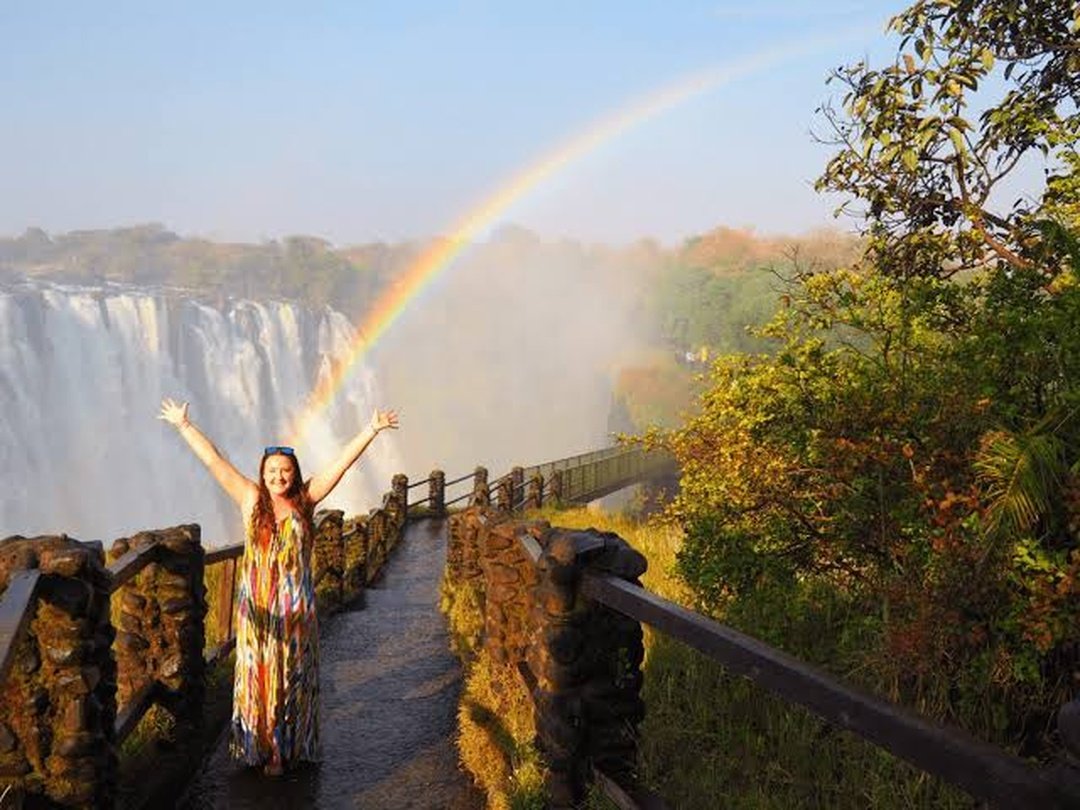
A safari to Victoria Falls brings together two of Southern Africa’s greatest travel experiences: the spectacular power of one of the world’s most famous waterfalls and exceptional wildlife viewing across some of the continent’s richest conservation areas. Located on the Zambezi River along the border between Zimbabwe and Zambia, Victoria Falls is much more than a sightseeing stop. It is a natural gateway to national parks, river safaris, game drives, cultural experiences, adventure activities and multi-country journeys through Zimbabwe, Zambia and Botswana.
Known locally as Mosi-oa-Tunya – “The Smoke That Thunders,” Victoria Falls stretches across a dramatic section of the Zambezi where enormous volumes of water plunge into the narrow Batoka Gorge below. The resulting spray, thunderous sound and changing rainbows create one of Africa’s most memorable landscapes. During periods of higher water, clouds of mist can rise high above the gorge and may be visible from considerable distances, while lower-water months reveal more of the geological formations and individual channels of the falls.
What makes a Victoria Falls safari particularly attractive is the ease with which travelers can combine the waterfall with genuine African wildlife encounters. A morning may begin with views across the falls before an afternoon cruise on the Zambezi River, where elephants, hippos, crocodiles and numerous bird species may be encountered. Longer itineraries can continue to Hwange National Park, Chobe National Park, Zambezi National Park or other renowned wilderness areas where classic game drives provide opportunities to search for elephants, lions, buffaloes, giraffes, antelopes and, with luck, leopards and African wild dogs.
Victoria Falls is therefore suitable for travelers who want more than a conventional waterfall visit. It works exceptionally well as the beginning or end of a wider Southern African safari and can be incorporated into short holidays, family trips, honeymoon safaris, luxury journeys and longer multi-country adventures. Whether your priority is wildlife, photography, river experiences, scenery, culture or adventure, a safari to Victoria Falls can be customized around the style and pace of travel that suits you.
Another major advantage is accessibility. Travelers can approach Victoria Falls through either Victoria Falls, Zimbabwe, or Livingstone, Zambia, while Botswana’s safari hub of Kasane lies within practical overland reach. This geographical position makes the destination especially valuable for travelers hoping to combine several Southern African highlights without spending excessive amounts of their holiday moving between distant destinations.
For many visitors, a safari to Victoria Falls becomes the centerpiece of an itinerary rather than simply another attraction. The combination of dramatic scenery, wildlife, the Zambezi River and easy connections to neighboring safari regions gives travelers an unusually diverse African experience within a relatively compact area.
Why Choose a Safari to Victoria Falls?
Choosing a safari to Victoria Falls means choosing a destination where spectacular natural scenery and traditional African safari experiences exist side by side. Unlike destinations that focus primarily on wildlife viewing or landscape sightseeing, Victoria Falls allows travelers to enjoy both. You can explore rainforest trails overlooking the waterfall, cruise along the Zambezi, watch elephants along the riverbanks and then continue into some of Southern Africa’s best-known national parks.
The destination also offers tremendous flexibility. A traveler with only a few days can experience the falls, enjoy a sunset cruise and take a wildlife excursion nearby. Those with more time can build a longer itinerary incorporating Chobe, Hwange, the Okavango Delta or other destinations across Zimbabwe, Zambia and Botswana. This makes Victoria Falls equally suitable for first-time visitors to Africa and experienced safari travelers searching for a broader Southern African journey.
Experience One of the Seven Natural Wonders
Victoria Falls is widely celebrated as one of the Seven Natural Wonders of the World and remains one of Africa’s most extraordinary natural attractions. The waterfall is created as the Zambezi River spreads across a broad basalt plateau before plunging dramatically into a narrow gorge. This unusual geological formation allows visitors to view large sections of the falling water from viewpoints positioned almost directly opposite the cascading curtain.
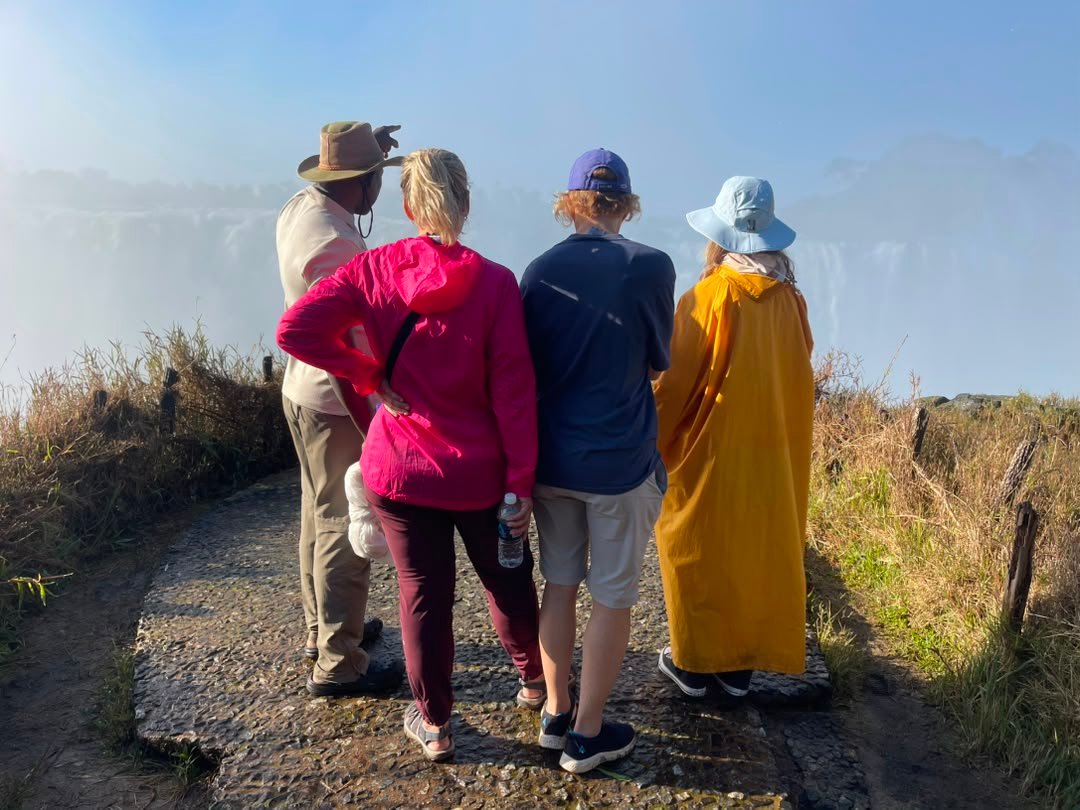
A guided walking tour provides one of the best ways to understand the scale of Victoria Falls. Trails lead through lush vegetation to a series of viewpoints, each offering a different perspective over the gorge. Depending on water levels and season, visitors may experience immense clouds of spray, powerful waterfalls, rainbows stretching across the gorge and distant views toward the Victoria Falls Bridge.
The experience changes considerably throughout the year, which gives Victoria Falls a different character depending on when you visit. Higher-water periods emphasize the waterfall’s extraordinary power and volume, while lower-water months reveal more of the rocky gorge and individual channels of water. Neither experience is necessarily better; they simply provide different perspectives on the same natural phenomenon.
Victoria Falls is also recognized for its outstanding natural importance as part of the Mosi-oa-Tunya/Victoria Falls UNESCO World Heritage Site. Its international recognition reflects not only the beauty of the waterfall itself but also the exceptional geological processes and surrounding river ecosystem that have shaped this landscape over thousands of years.
Adding Victoria Falls to a safari therefore gives travelers something that conventional wildlife-only itineraries cannot provide: the opportunity to stand beside one of Africa’s greatest natural landmarks while remaining within immediate reach of major safari country.
Combine Waterfalls with African Wildlife
One of the strongest reasons to choose a safari to Victoria Falls is the ability to combine the waterfall with rewarding wildlife experiences without traveling enormous distances between attractions. Victoria Falls lies within a broader conservation landscape where national parks, private reserves and river ecosystems protect substantial populations of African wildlife.
Close to the town of Victoria Falls, Zambezi National Park offers game drives along both riverine and inland routes. Wildlife sightings may include elephants, buffaloes, giraffes, zebras, antelopes, hippos and crocodiles, while predators such as lions and leopards are also present. The park is particularly appealing for travelers with limited time because meaningful wildlife activities can often be included alongside a visit to the falls.
Across the border in Zambia, Mosi-oa-Tunya National Park provides another nearby wildlife option. Visitors can combine the Zambian side of the waterfall with game viewing, river scenery and selected walking experiences. This makes Livingstone a convenient base for travelers interested in both adventure activities and nature-based excursions.
Travelers looking for a more intensive wildlife safari can continue to Hwange National Park, Zimbabwe’s largest national park and one of Southern Africa’s most significant wildlife destinations. Hwange is particularly famous for its elephants but also supports lions, buffaloes, giraffes, zebras, numerous antelope species and an impressive diversity of birds and predators.
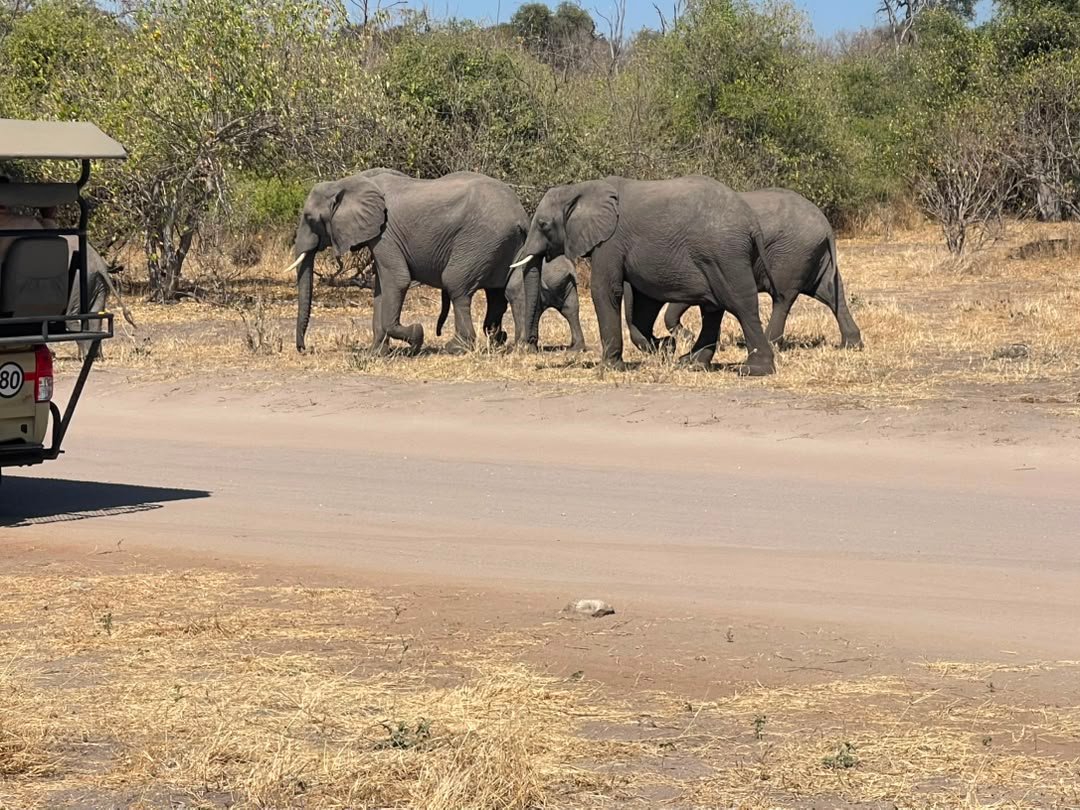
Botswana’s Chobe National Park is another natural extension to a Victoria Falls safari. The Chobe Riverfront is internationally renowned for elephant viewing, particularly during the drier months when large numbers of animals gather close to permanent water. A typical Chobe experience can combine a game drive with a boat safari, creating two very different perspectives on the park’s wildlife in a single day.
This ability to combine waterfalls, rivers and classic game viewing is what separates a safari to Victoria Falls from a simple sightseeing holiday. Travelers can experience one of Africa’s most powerful natural attractions and still enjoy the wildlife encounters that define a traditional African safari.
Easy Access from Zimbabwe, Zambia and Botswana
Victoria Falls occupies one of the most strategically useful locations in Southern African tourism. The waterfall sits directly between Zimbabwe and Zambia, while Botswana lies close enough for Chobe National Park to be incorporated into day trips and longer itineraries. For travelers planning a multi-country safari, this location significantly simplifies route planning.
On the Zimbabwean side, Victoria Falls town serves as the primary tourism center. The town provides access to the waterfall, Zambezi activities, accommodation, restaurants and excursions into nearby wildlife areas. Victoria Falls Airport connects the destination with important regional aviation hubs, helping international travelers integrate the waterfall into wider African itineraries.
On the Zambian side, Livingstone provides a similarly convenient base. Travelers can visit the Zambian viewpoints of the falls, explore the Zambezi River and continue into Zambia’s broader safari regions. Livingstone’s airport connections also make the destination practical as either an arrival point or departure point for a Southern African journey.
To the west, Kasane in Botswana acts as the gateway to Chobe National Park. The relatively short overland connection between the Victoria Falls region and Kasane means travelers do not necessarily need another flight to experience one of Botswana’s premier wildlife destinations. This makes a Victoria Falls and Chobe safari one of the most practical and popular combinations in the region.
The wider geography also opens possibilities for longer itineraries incorporating Hwange National Park, Chobe National Park, the Okavango Delta and other Southern African destinations. Travelers can therefore use Victoria Falls as a strategic anchor around which an entire regional safari can be constructed.
This accessibility is particularly valuable for visitors who want to experience more than one country during the same holiday. Zimbabwe, Zambia and Botswana each offer distinctly different safari environments, yet Victoria Falls allows them to be connected within a logical and efficient itinerary.
Excellent Year-Round Safari Opportunities
A safari to Victoria Falls can be enjoyed throughout the year, although the experience changes noticeably according to rainfall, river levels, vegetation and wildlife movements. Rather than having a single universally perfect month, Victoria Falls offers different advantages across the seasons.
During wetter periods, the Zambezi carries greater volumes of water and Victoria Falls becomes particularly dramatic. Spray rises from the gorge and the surrounding rainforest is lush and vibrant. This period appeals strongly to travelers whose primary goal is experiencing the waterfall at its most powerful.
As the dry season develops, conditions can become especially favorable for traditional wildlife viewing in nearby safari areas. Water becomes increasingly important to animals, encouraging wildlife to concentrate around rivers, waterholes and other permanent sources. Destinations such as Chobe and Hwange can therefore offer excellent game viewing during the drier part of the year.
Lower-water periods bring a different character to Victoria Falls itself. More of the underlying rock formations become visible, and certain activities that depend on suitable river conditions may become possible. Photographers may also appreciate clearer views of the gorge when heavy spray is reduced.
Birdwatching is another reason the broader Victoria Falls region remains rewarding throughout the year. River habitats, woodland, floodplains and national parks support substantial bird diversity, while seasonal movements can add further interest during particular months.
The year-round nature of the destination also gives travelers flexibility when combining Victoria Falls with other parts of Africa. Rather than planning solely around the waterfall, an itinerary can be timed according to the traveler’s main priority—whether that is wildlife concentrations, powerful water flow, photography, river activities or a combination of several experiences.
Perfect for Couples, Families and Private Travelers
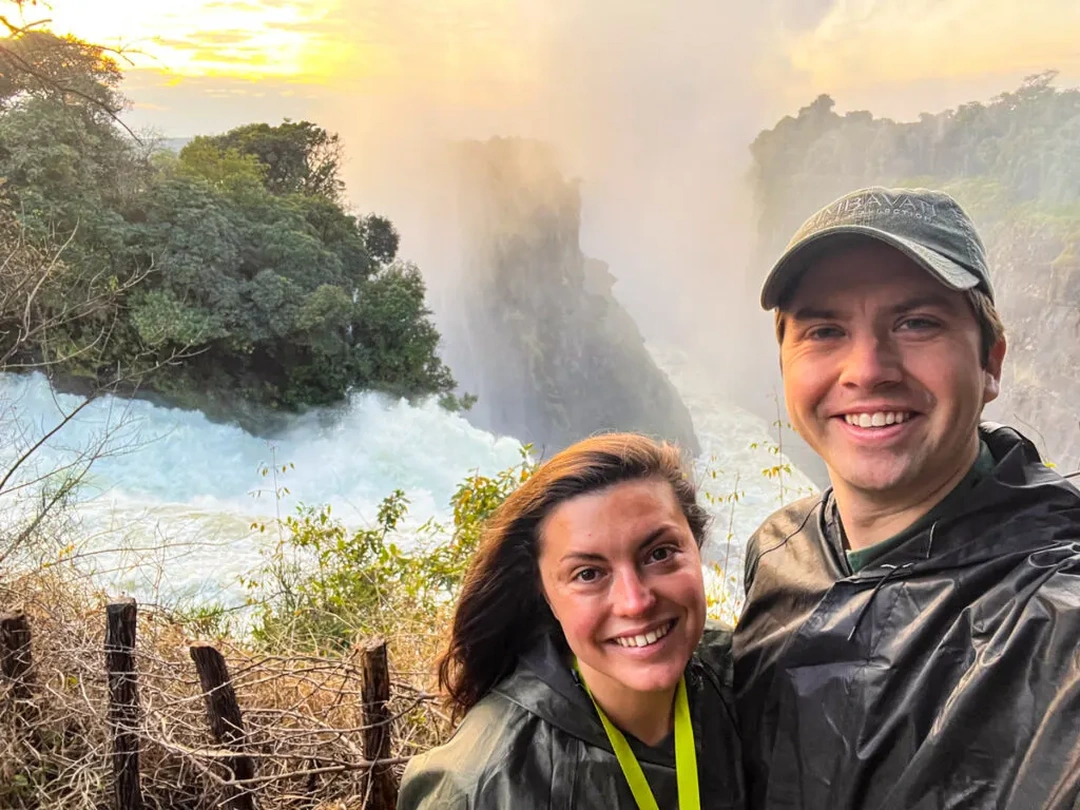
A major strength of a safari to Victoria Falls is its ability to suit many different types of travelers. Couples can build romantic itineraries around luxury lodges, private river cruises, scenic flights, candlelit dinners and exclusive game drives. The combination of dramatic scenery and safari wilderness makes Victoria Falls especially attractive for honeymoons, anniversaries and other special journeys.
Families also have a wide variety of activities available. Depending on the children’s ages and specific operator requirements, families can enjoy guided waterfall tours, wildlife drives, river cruises, cultural experiences and selected adventure activities. Combining several different types of experiences can be particularly valuable when traveling with children because every day does not have to revolve around long game drives.
Private travelers benefit from even greater flexibility. A private safari allows the daily schedule to be adapted according to interests, photography requirements, preferred meal times and desired pace. Travelers can spend longer at wildlife sightings, arrange private transfers and select lodges according to budget and comfort expectations.
Victoria Falls is equally suitable for first-time safari travelers. The destination provides an accessible introduction to African wildlife without requiring visitors to commit immediately to a very long wilderness itinerary. A traveler can begin with Victoria Falls, experience a nearby national park and later extend into Chobe or Hwange for a deeper safari experience.
Experienced Africa travelers can use Victoria Falls differently, combining it with remote camps, specialized photography safaris, walking experiences or multi-country routes. This flexibility means the destination does not belong to one particular style of traveler.
Whether you are planning a romantic escape, a family adventure, a private wildlife journey or your first trip to Africa, a safari to Victoria Falls provides an exceptionally adaptable foundation. With the waterfall, Zambezi River and major national parks all within reach, the experience can be built around exactly what you want from your Southern African safari.
Where Is Victoria Falls Located?
Victoria Falls is located on the Zambezi River along the international border between Zimbabwe and Zambia in Southern Africa. The waterfall lies between the town of Victoria Falls in Zimbabwe and the city of Livingstone in Zambia, making it one of the few major natural attractions in Africa that can be experienced from two different countries. This unique position gives travelers several ways to plan a safari to Victoria Falls, depending on where they arrive, which side of the waterfall they want to explore and whether they intend to continue to nearby safari destinations such as Chobe National Park, Hwange National Park or the wider Zambezi region.
The Zambezi River approaches Victoria Falls as a broad, relatively calm waterway before suddenly plunging into a series of narrow basalt gorges. The falls extend for roughly 1.7 kilometers across the river, creating an enormous curtain of falling water when river levels are high. Below the waterfall, the Zambezi becomes dramatically narrower as it flows through the Batoka Gorge toward Lake Kariba and eventually Mozambique.
Geographically, Victoria Falls sits in an exceptionally important safari region. Zimbabwe lies to the south of the river, Zambia to the north, while Botswana is only a relatively short overland journey to the west. This location allows travelers to combine Victoria Falls with several of Southern Africa’s best-known wildlife destinations without needing to travel across the entire continent.
For safari planning purposes, travelers usually choose between staying in Victoria Falls, Zimbabwe, or Livingstone, Zambia. Both provide access to the waterfall, accommodation, restaurants, transfers and adventure activities, but the actual viewing experience differs considerably between the two sides.
Victoria Falls on the Zimbabwe Side
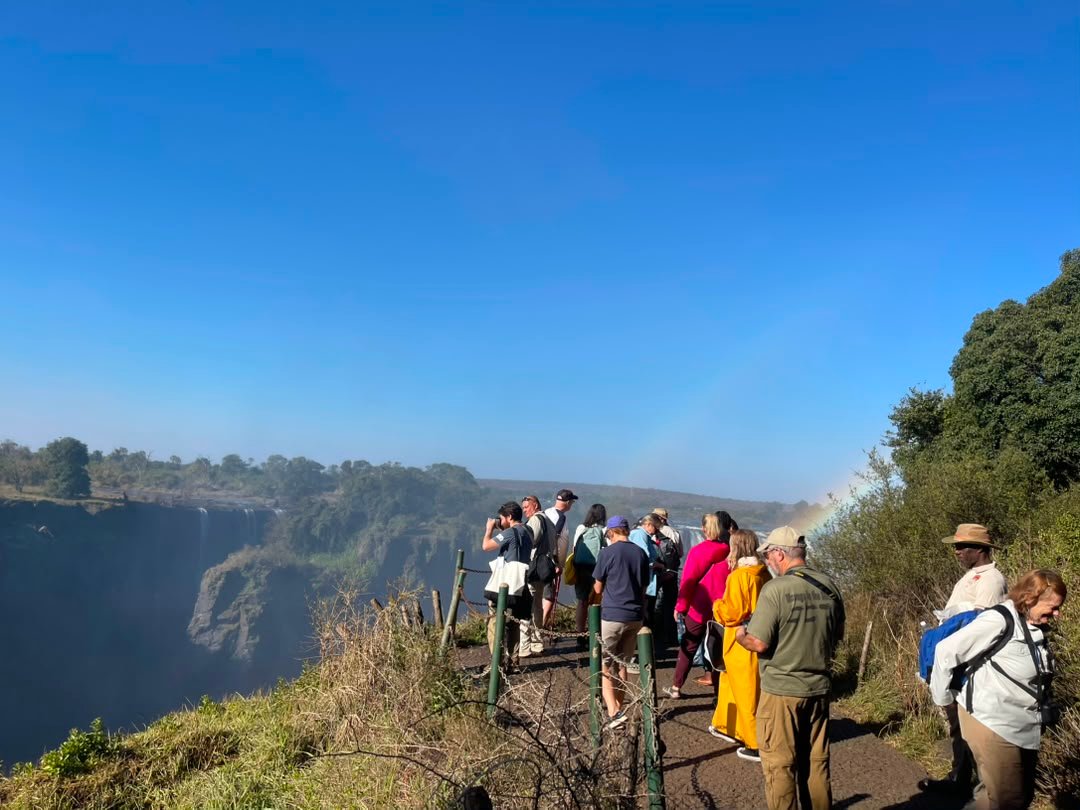
The Zimbabwe side of Victoria Falls provides access to a large proportion of the principal viewpoints overlooking the waterfall and is often chosen by travelers who want the broadest possible walking experience along the gorge. The town of Victoria Falls is located only a short distance from the waterfall entrance, making it convenient to combine sightseeing with other activities such as Zambezi River cruises, helicopter flights, game drives and excursions into nearby national parks.
The Zimbabwean section of the falls contains a long network of walking paths through the protected rainforest environment. These trails connect numerous viewpoints overlooking different sections of Victoria Falls, including areas facing some of the most dramatic parts of the waterfall. As travelers move along the trail, the perspective changes continuously, creating opportunities to appreciate both the width and power of the falls.
One of the major advantages of the Zimbabwe side is the ability to see a significant portion of the waterfall from viewpoints positioned opposite the main curtain of water. During higher river levels, visitors may encounter intense spray that creates a rainforest-like environment around the pathways. Waterproof clothing and protection for cameras and phones can be useful because the spray can become extremely heavy near some viewpoints.
The Zimbabwe side can also be attractive during lower-water periods because certain sections of Victoria Falls generally continue to carry water even when river levels decline significantly. While the appearance of the waterfall changes throughout the year, visitors can still enjoy dramatic views into the gorge and observe how the Zambezi has shaped the surrounding basalt landscape.
The town of Victoria Falls, Zimbabwe is itself a major tourism hub. Numerous hotels, safari lodges, restaurants and activity operators are based here, while Victoria Falls Airport provides regional air connections. This infrastructure makes the Zimbabwean side particularly convenient for travelers planning a standalone visit or a longer Victoria Falls safari.
Wildlife experiences are also readily accessible. Zambezi National Park lies close to town and can be explored through game drives and river-based activities. Travelers may encounter elephants, buffaloes, giraffes, antelopes, hippos, crocodiles and numerous bird species, while predators are also present within the broader ecosystem.
For travelers planning a longer Zimbabwe safari, the Victoria Falls side also provides a natural connection to Hwange National Park, one of the country’s premier wildlife destinations. This makes it easy to build an itinerary combining the waterfall with several days of classic game viewing.
A typical Zimbabwe-based Victoria Falls itinerary can include a guided walking tour of the falls, a Zambezi sunset cruise, a scenic helicopter flight, a safari in Zambezi National Park and an extension to Hwange or neighboring Botswana.
Victoria Falls on the Zambia Side
The Zambia side of Victoria Falls is accessed from the city of Livingstone and offers a different perspective of the waterfall. The protected area surrounding the falls is known as Mosi-oa-Tunya National Park, taking its name from the local expression commonly translated as “The Smoke That Thunders.”
One of the defining features of the Zambian side is how close visitors can get to certain sections of the waterfall. Walking trails and viewpoints allow travelers to experience the immense force of the Zambezi from close range, particularly when river levels are high.
The famous Knife-Edge Bridge is one of the best-known features of the Zambian viewing experience. During periods of substantial water flow, visitors crossing this footbridge can be surrounded by heavy spray while enjoying dramatic views across the gorge and toward sections of the falls. The combination of mist, sunlight and rapidly moving water can create spectacular rainbow effects.
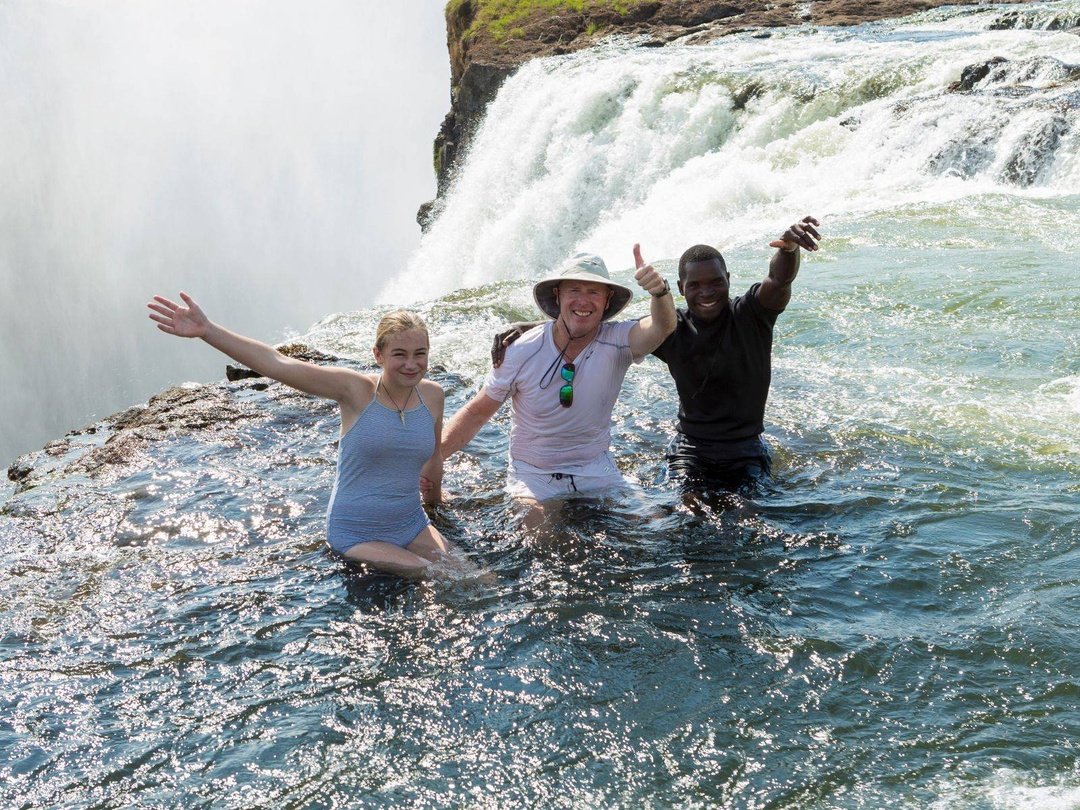
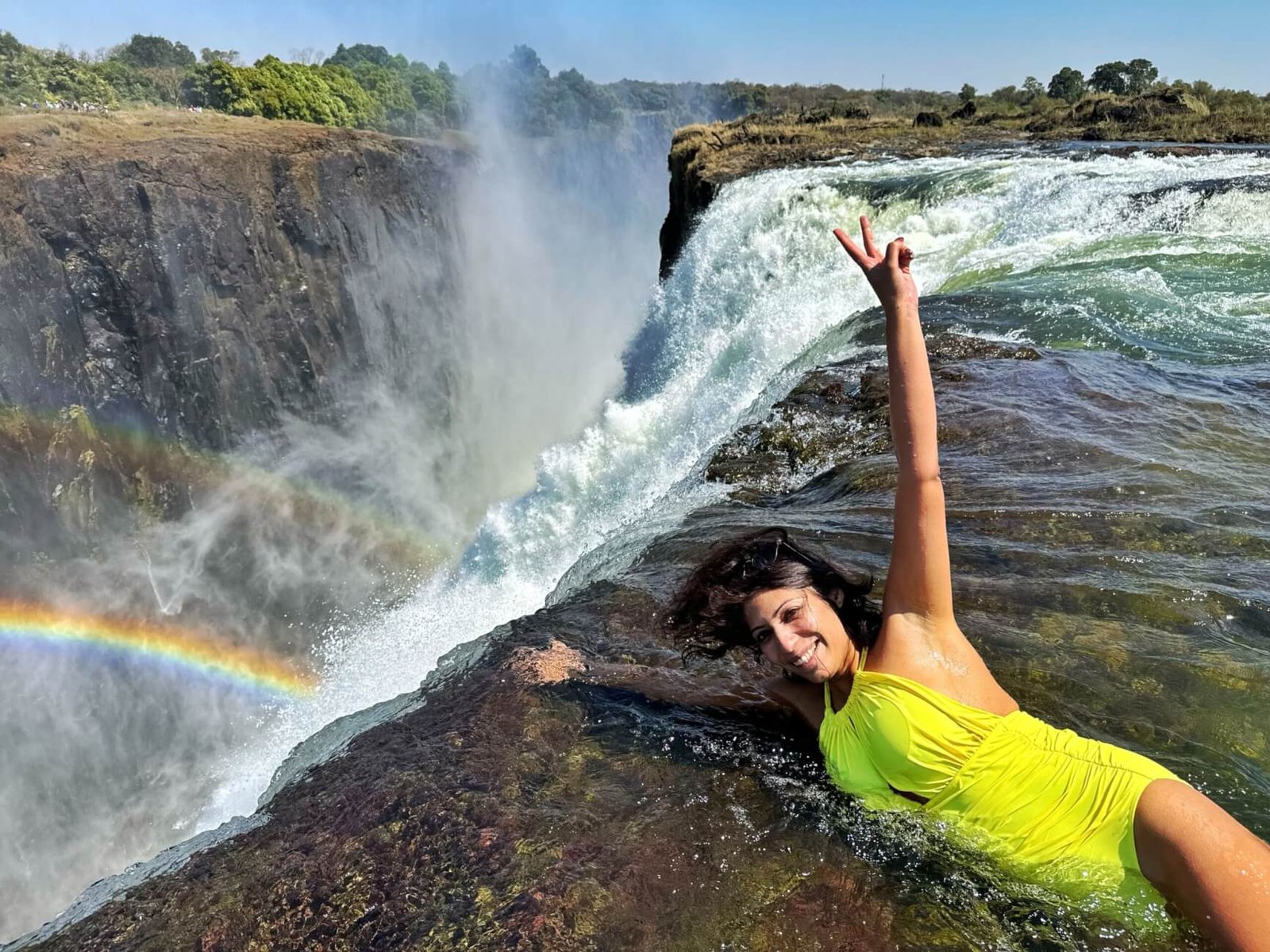
The Zambia side is also associated with Livingstone Island, which sits close to the edge of Victoria Falls and can be visited when river conditions permit. During suitable low-water periods, some travelers also visit Devil’s Pool, a natural rock pool near the edge of the falls. Access is highly dependent on water levels and operational safety conditions, so it should never be assumed to be available throughout the year.
Livingstone itself offers a wide range of accommodation, from guesthouses and comfortable hotels to high-end lodges positioned along the Zambezi River. Many properties provide easy access to river cruises, cultural excursions, scenic flights and adventure activities.
Visitors staying on the Zambian side can also combine the waterfall with wildlife viewing in Mosi-oa-Tunya National Park. Although smaller than some of Southern Africa’s major safari parks, it can provide an enjoyable introduction to the region’s wildlife and landscapes.
Livingstone is also strategically positioned for travelers heading deeper into Zambia or across the border toward Botswana. Chobe National Park can be incorporated into a day trip or multi-day extension, making the Zambia side suitable for travelers interested in creating a broader cross-border safari.
One important seasonal consideration is that parts of the Zambian side can become significantly drier when Zambezi water levels are very low. During such periods, the appearance of the falls may differ dramatically from the high-water months, with more exposed rock visible along portions of the cliff.
For some travelers, however, this lower-water period has its own advantages. It can provide clearer views of the rock formations and gorge while allowing access to selected seasonal activities that are not possible when water levels are extremely high.
Zimbabwe vs Zambia – Which Side Is Better?
Choosing between the Zimbabwe and Zambia sides of Victoria Falls depends on what you want to experience, the season of travel and how the waterfall fits into the rest of your safari itinerary. Neither side is universally better for every traveler, because each offers a different perspective.
For travelers whose primary goal is to see the broadest possible views of the waterfall, Zimbabwe is often the stronger choice. A large proportion of the main viewing trail lies on the Zimbabwean side, allowing visitors to walk between numerous viewpoints overlooking different sections of the falls. This is particularly useful for first-time visitors who want to appreciate the overall scale of Victoria Falls.
The Zimbabwe side can also be attractive during lower-water periods because some sections tend to retain stronger water flow than portions of the Zambian side. For travelers visiting when the Zambezi is relatively low, this can make a considerable difference to the visual experience.
Zambia, however, offers a more intimate experience in certain areas. Visitors can get extremely close to the falling water, especially around Knife-Edge Bridge when water levels are high. The sensation of walking through heavy spray with the waterfall thundering beside you can be one of the most memorable aspects of visiting Victoria Falls.
Zambia is also the side associated with Livingstone Island and Devil’s Pool, which can be important for travelers specifically interested in those experiences. Their operation is seasonal, so travelers should always confirm availability for their intended dates.
For accommodation, both sides offer excellent options. Victoria Falls town in Zimbabwe tends to have a concentrated tourism infrastructure close to the waterfall, while Livingstone provides a broader city environment with properties spread between the town and the Zambezi River.
For wildlife combinations, Zimbabwe has a particularly strong advantage for travelers heading to Hwange National Park, while both Zimbabwe and Zambia provide practical access to Botswana and Chobe National Park. Travelers planning a safari centered on Zimbabwe may therefore prefer to stay on the Victoria Falls side, whereas those continuing deeper into Zambia may find Livingstone more convenient.
Photography priorities can also influence the choice. The Zimbabwe side generally provides broader frontal views across the waterfall, while the Zambian side can offer dramatic closer perspectives and views into the gorge. Serious photographers may benefit from visiting both.
In reality, travelers do not necessarily need to choose only one country. The Victoria Falls Bridge links Zimbabwe and Zambia, making it possible to explore both sides when border and visa conditions allow. Visiting both gives travelers the most complete understanding of Victoria Falls because the waterfall looks and feels different from each country.
For travelers with only one day and whose priority is the widest range of waterfall viewpoints, the Zimbabwe side is generally the more practical choice. For travelers seeking close-up experiences, Livingstone Island opportunities and the atmosphere of the Zambian side, Zambia can be equally rewarding.
Those spending two or more days around Victoria Falls should seriously consider experiencing both sides. A well-planned safari to Victoria Falls can include the Zimbabwean rainforest viewpoints, the Zambian perspective, a Zambezi River cruise and nearby wildlife experiences, creating a much more complete visit than seeing the waterfall from only a single location.
Ultimately, the best side of Victoria Falls depends on the season and your overall travel plans. Zimbabwe is generally strongest for panoramic waterfall viewing, while Zambia excels in close-range experiences and access to selected seasonal activities. Visiting both provides the most comprehensive Victoria Falls experience.
Best Time for a Safari to Victoria Falls
The best time for a safari to Victoria Falls depends on what you most want to experience because the destination changes dramatically throughout the year. Victoria Falls is a year-round destination, but water levels, wildlife viewing conditions, temperatures, rainfall, photography opportunities and available activities vary considerably from one season to another. A traveler whose main priority is seeing Victoria Falls at its most powerful may choose completely different months from someone primarily interested in game viewing in Chobe or Hwange National Park.
Generally, the Zambezi River reaches its highest levels between approximately February and May, following seasonal rainfall across its vast upstream catchment. During this period, Victoria Falls can become an enormous curtain of water accompanied by tremendous spray and thunder. By contrast, water levels usually decline progressively through the dry season and are typically at their lowest around October and November, before rainfall begins replenishing the river system.
For travelers combining the waterfall with wildlife, the dry season from roughly June through October is particularly attractive. Vegetation becomes thinner, wildlife gathers increasingly around permanent water sources, and game viewing in nearby destinations such as Chobe National Park, Hwange National Park and Zambezi National Park can be outstanding.
There is therefore no single month that is perfect for everybody. March and April can be exceptional for sheer waterfall power. June through August provide an excellent balance between significant water flow, comfortable weather and strong safari conditions. September and October are particularly rewarding for wildlife viewing and clearer photography of the gorge, although water levels are considerably lower.
Understanding these seasonal differences makes it easier to choose the right time for your Victoria Falls safari rather than simply booking according to the conventional idea of a single “best season.”
Victoria Falls High-Water Season
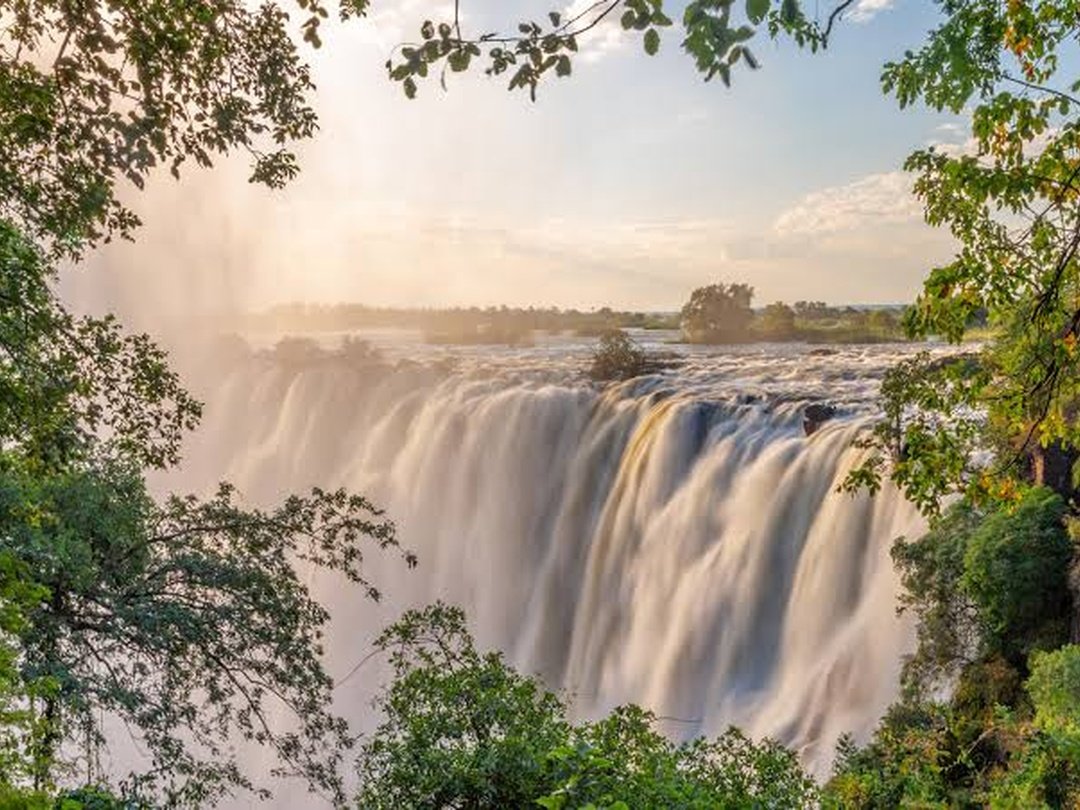
The high-water season at Victoria Falls is one of the most spectacular times to experience the waterfall. Water levels generally begin rising substantially after the summer rains and often become particularly impressive between February and May, although exact conditions vary each year because the Zambezi River drains an enormous catchment extending far beyond Victoria Falls itself.
Around the peak of the high-water period, enormous volumes of water plunge into the Batoka Gorge, producing the famous clouds of mist responsible for the local name Mosi-oa-Tunya, commonly translated as “The Smoke That Thunders.” From a distance, the rising spray can resemble smoke above the landscape, while visitors standing along the viewpoints may become completely soaked even when there is no rain.
This is an exceptional season for travelers who want to experience the raw power of Victoria Falls. The sound can be extraordinary, the surrounding rainforest becomes lush and vibrant, and rainbows frequently appear when sunlight interacts with the clouds of spray. The entire experience feels energetic and dramatic.
However, high water also presents certain limitations. Heavy spray can sometimes obscure parts of the waterfall from ground-level viewpoints. Instead of seeing every geological detail of the gorge, visitors may find themselves surrounded by mist and enormous walls of water. This does not make the experience worse, but it creates a very different style of viewing.
For photographers, waterproof protection becomes extremely important during high water. Camera bodies, lenses, phones and other electronics should be protected because moisture can be intense along the viewing trails. A lightweight rain jacket or poncho is also valuable even on sunny days.
A helicopter flight over Victoria Falls can be particularly worthwhile during high water because the aerial perspective helps visitors appreciate the enormous scale of the falls when ground-level visibility is partly restricted by spray. From above, travelers can see the Zambezi River approaching the cliff, the long line of the waterfall and the zigzagging Batoka Gorge downstream.
Some river-based activities are affected by high water and safety conditions. Activities close to the edge of the falls, including experiences such as Devil’s Pool, operate only when river conditions are considered suitable. Travelers should therefore avoid planning a high-water safari around activities that depend specifically on low river levels.
For travelers whose main dream is to see Victoria Falls at its fullest and most dramatic, approximately February through May is generally one of the strongest periods to consider.
Victoria Falls Low-Water Season
The low-water season at Victoria Falls offers a completely different experience from the dramatic high-water months and can be an excellent time for travelers who want clearer views of the gorge, exposed rock formations and seasonal adventure activities. Water levels on the Zambezi River generally begin dropping significantly from around August, with the lowest levels commonly experienced between October and November. During this period, the enormous curtain of water seen earlier in the year becomes divided into separate channels, revealing much more of the basalt cliff, islands and geological structure that shape Victoria Falls.
One of the major advantages of visiting during the low-water season is improved visibility. During peak water levels, enormous clouds of spray can sometimes obscure sections of Victoria Falls, particularly from viewpoints positioned close to the main flow. As the water level falls, the mist decreases and travelers can see much deeper into the Batoka Gorge. This makes the low-water period particularly interesting for photographers who want to capture the cliffs, individual waterfalls, rock formations and the dramatic depth of the gorge without their views being constantly hidden by spray.
The experience can differ considerably between the Zimbabwe and Zambia sides of Victoria Falls. During very low water, parts of the Zambian side may have substantially reduced flow, exposing large areas of the rocky cliff. The Zimbabwean side generally retains stronger views of flowing water across some sections of the falls, making it especially valuable for travelers visiting toward the end of the dry season. For this reason, travelers planning a safari to Victoria Falls during September, October or November may benefit from visiting both sides, allowing them to appreciate the different perspectives and understand how dramatically the Zambezi changes throughout the year.
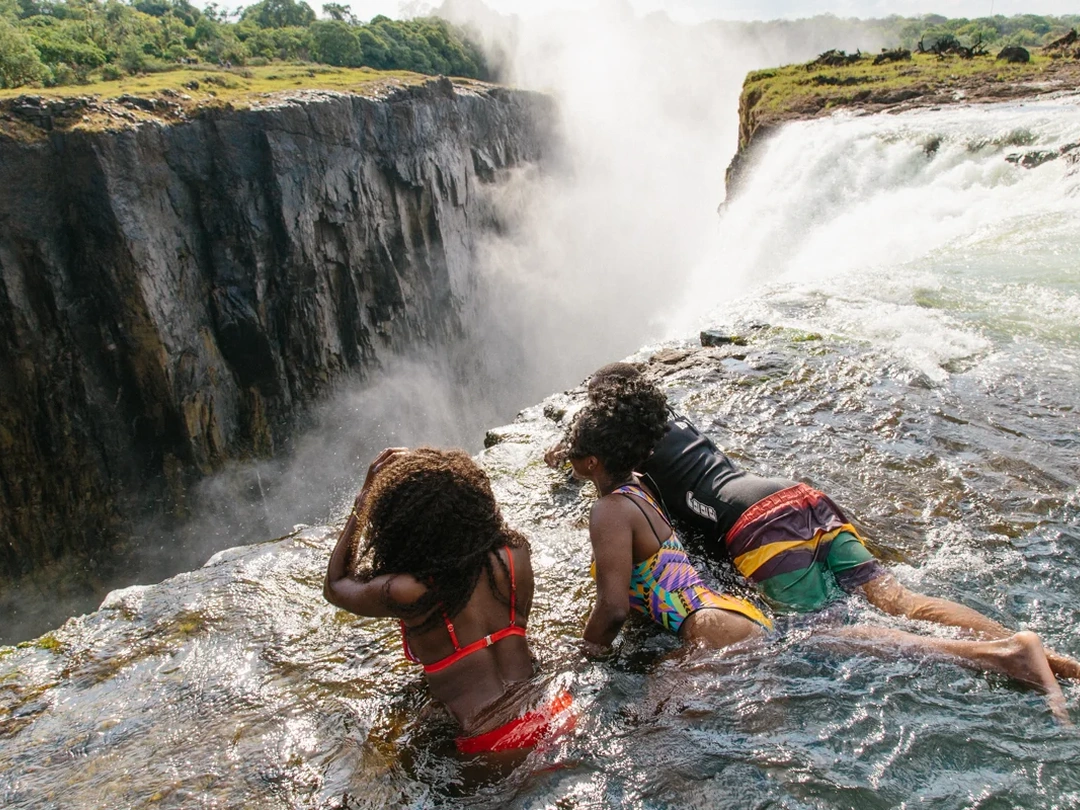
Low water also creates opportunities for some of Victoria Falls’ most famous seasonal activities. Experiences associated with Livingstone Island and Devil’s Pool may operate when river levels and safety conditions are suitable. Devil’s Pool is a naturally formed rock pool close to the edge of Victoria Falls on the Zambian side and has become one of the region’s best-known adventure experiences. Access should always be arranged through authorized operators, and availability depends entirely on current river conditions rather than fixed calendar dates.
Another major reason to consider the low-water months is their overlap with some of the strongest wildlife-viewing conditions in Southern Africa. As the dry season progresses, animals become increasingly dependent on permanent rivers and waterholes. This can make destinations such as Chobe National Park, Hwange National Park and Zambezi National Park particularly rewarding. Travelers can therefore combine clearer views of Victoria Falls with excellent game drives, river safaris and opportunities to see elephants, buffaloes, giraffes, zebras, lions and other wildlife.
Temperatures also change as the dry season advances. August and September can provide warm, generally dry conditions, while October is often considerably hotter. Travelers visiting during these months should carry lightweight breathable clothing, sun protection, a hat and plenty of drinking water during outdoor activities. Early-morning excursions are often particularly comfortable and can also provide attractive light for photography.
The low-water season should not be considered an inferior time to visit Victoria Falls. It simply reveals a different character of the waterfall. High water emphasizes enormous volume, thunder and spray, while low water exposes the extraordinary geology of the gorge and creates access to experiences that may not be available during periods of stronger river flow. For travelers interested in photography, wildlife safaris, Devil’s Pool, Livingstone Island and clearer gorge views, the low-water months can be among the most rewarding periods for a safari to Victoria Falls.
Best Time for Wildlife Safaris
For wildlife enthusiasts, the best time for a safari to Victoria Falls is generally during the dry season from approximately June to October. These months tend to provide increasingly favorable game-viewing conditions across many of the national parks surrounding Victoria Falls.
As seasonal water sources begin to disappear, animals become increasingly dependent on permanent rivers, waterholes and other reliable sources of water. This concentration can make wildlife easier to locate than during wetter periods when animals may disperse across a much larger landscape.
Chobe National Park in Botswana is especially renowned during the dry season. The Chobe River becomes an essential water source for enormous numbers of animals, including the elephants for which the park is internationally famous. Herds can often be observed drinking, swimming and feeding close to the river while buffaloes, giraffes, antelopes, hippos and numerous bird species occupy the surrounding floodplain.
A Chobe safari can combine a traditional game drive with a Chobe River boat cruise, providing two very different wildlife-viewing experiences. From the water, travelers can observe animals along the riverbanks from perspectives that are impossible to achieve during a vehicle safari.
Hwange National Park also becomes particularly rewarding as the dry season advances. Wildlife increasingly gathers around waterholes, creating opportunities to see elephants, buffaloes, zebras, giraffes, antelopes and predators within relatively concentrated areas.
Hwange’s elephant populations are one of its greatest attractions, and some waterholes can become exceptionally active during the driest months. Lions, leopards, African wild dogs and spotted hyenas may also be encountered, although predator sightings are never guaranteed.
Closer to Victoria Falls, Zambezi National Park offers convenient game viewing for travelers with limited time. Elephants, buffaloes, giraffes, zebras, antelopes, hippos, crocodiles and diverse birdlife may be encountered, making the park an excellent complement to the waterfall.
The green season, however, should not be overlooked. Approximately November through April, rainfall transforms many safari landscapes. Vegetation becomes green, migrant birds arrive, and numerous herbivores give birth during portions of the season.
Green-season safaris can be particularly rewarding for birdwatchers and travelers who appreciate dramatic landscapes. Predator activity continues throughout the year, and young animals can create fascinating wildlife interactions.
The difference is largely one of visibility and concentration. During the dry months, animals tend to gather around predictable water sources and vegetation is generally less dense. During wetter months, wildlife becomes more dispersed but the environment is greener and often particularly beautiful.
For travelers wanting the strongest combination of Victoria Falls and traditional wildlife safari conditions, June, July, August and September are especially attractive months.
Best Months for Photography
Victoria Falls offers exceptional photography throughout the year, but the best months for photography depend on the type of images you want to capture.
During February, March, April and May, photographers can capture Victoria Falls at extraordinary volume. Huge clouds of spray, powerful sections of falling water and frequent rainbows can produce dramatic images that communicate the immense scale of the waterfall.
The challenge during this period is moisture and visibility. Heavy spray may cover lenses almost immediately and sometimes obscure sections of the falls completely. Photographers should carry lens cloths, waterproof camera protection and equipment that can be quickly covered between shots.
Aerial photography can be particularly effective during higher water. Scenic helicopter flights reveal the entire geological structure of Victoria Falls, from the broad upper Zambezi River to the waterfall and the succession of gorges downstream.
June through August can offer an excellent photographic balance. Water levels are normally declining from their peak, yet the falls remain impressive while spray may become more manageable. The dry-season skies and increasingly favorable wildlife conditions also make these months attractive for photographers wanting both landscape and safari images.
During September and October, reduced spray can provide some of the clearest views into the Batoka Gorge. Photographers can capture rock formations, individual channels of falling water and the dramatic depth of the cliff more easily than during the peak-water months.
These months are also excellent for wildlife photography in Chobe and Hwange. Animals concentrating near rivers and waterholes can create superb photographic opportunities, particularly during the golden light of early morning and late afternoon.
The Zambezi River at sunset is another important photography opportunity throughout much of the year. Sunset cruises provide chances to photograph silhouettes of elephants, hippos, river scenery and African sunsets reflected across the water.
Light around Victoria Falls is often most attractive during the early morning and later afternoon. The angle of the sun can also influence where rainbows appear within the spray, making repeat visits to the viewpoints worthwhile for serious photographers.
Travelers focused primarily on photographing the waterfall at maximum force may prefer March to May, while those seeking a balanced combination of waterfall landscapes and wildlife photography may find June through September particularly rewarding.
Weather and Seasonal Conditions
Victoria Falls has a generally warm subtropical climate characterized by a wet summer season and a dry winter season. Understanding these patterns is important when planning clothing, activities, safari extensions and expectations for water levels.
The wet season generally runs from around November through April. These months are warmer and more humid, with rainfall commonly arriving as afternoon or evening thunderstorms. The landscape becomes green and lush, and the rains eventually contribute to rising water levels at Victoria Falls.
December through February can be particularly warm and humid. Daytime conditions may feel hot, while rainstorms can be heavy but are not necessarily continuous throughout the entire day.
The waterfalls do not respond instantly to rainfall around Victoria Falls because much of the Zambezi’s water originates far upstream. There is therefore a delay between the heaviest rainy months and the peak water levels at the falls. This is why some of the most powerful waterfall conditions often occur after the central rainy season has already progressed.
The dry season generally extends from May through October. Rain becomes increasingly uncommon, humidity decreases, and conditions are often very pleasant for outdoor activities.
June and July are among the coolest months. Days are generally comfortable, but mornings and evenings can feel surprisingly cool, particularly during open-vehicle game drives. Travelers should pack layers, including a warm fleece or light jacket for early departures.
Temperatures begin increasing through August and September, while October can become very hot, particularly before the seasonal rains arrive. Travelers visiting during these hotter months should prioritize sun protection, hydration and lightweight breathable clothing.
The dry season is particularly important for wildlife safaris because vegetation becomes progressively thinner and animals concentrate around water. Consequently, travelers combining Victoria Falls with Chobe or Hwange frequently select the period between June and October.
A simple way to understand the seasons when planning a safari to Victoria Falls is:
- January–February: Green, warm and rainy; river levels generally rising.
- March–April: Among the strongest periods for experiencing Victoria Falls at high water.
- May–June: Powerful waterfall conditions combined with increasingly dry and comfortable weather.
- July–August: Excellent overall balance of waterfall viewing, wildlife safaris and pleasant temperatures.
- September: Excellent wildlife viewing with lower water and clearer gorge views.
- October: Hot, very dry and excellent for game viewing, but waterfall volume is significantly reduced.
- November: Often among the lowest-water periods before seasonal rains begin restoring the river system.
- December: Green-season conditions return and water levels gradually begin their annual recovery.
For most travelers seeking a well-rounded experience, June through August is one of the strongest periods for a safari to Victoria Falls because it provides a particularly good compromise between waterfall volume, comfortable weather and excellent wildlife opportunities. Travelers primarily interested in the tremendous power of Victoria Falls should consider March through May, while serious wildlife enthusiasts may favor July through October.
Ultimately, the best time to visit depends on whether the priority is high water, wildlife, photography, adventure activities or a combination of several experiences. Victoria Falls is compelling throughout the year, but choosing the season according to your interests can transform a good journey into an exceptional Southern African safari.
How to Get to Victoria Falls
Getting to Victoria Falls is relatively straightforward because the destination is served by two international airports and several important overland routes connecting Zimbabwe, Zambia, Botswana and South Africa. Travelers planning a safari to Victoria Falls can fly directly into Victoria Falls International Airport on the Zimbabwean side or Harry Mwaanga Nkumbula International Airport in Livingstone on the Zambian side. Those already exploring Southern Africa can also travel overland from Kasane and Chobe National Park in Botswana or connect through Johannesburg, one of the region’s major aviation hubs.
The best arrival route depends largely on where you plan to stay and what you intend to combine with Victoria Falls. Travelers staying in Victoria Falls town or continuing to Hwange National Park will normally find the Zimbabwean airport particularly convenient. Those staying in Livingstone or continuing deeper into Zambia may prefer the Livingstone airport. Visitors combining Victoria Falls and Chobe National Park can easily incorporate an organized cross-border road transfer through the wider Kazungula region.
Because Victoria Falls sits directly on the Zimbabwe–Zambia border, international travelers should also consider visa requirements when choosing an arrival airport. Eligible visitors planning to move repeatedly between Zimbabwe and Zambia may benefit from the KAZA UNIVISA, which currently allows multiple entries between the two countries for up to 30 days and also covers qualifying day trips into Botswana through the Kazungula border.
Flying to Victoria Falls Airport, Zimbabwe
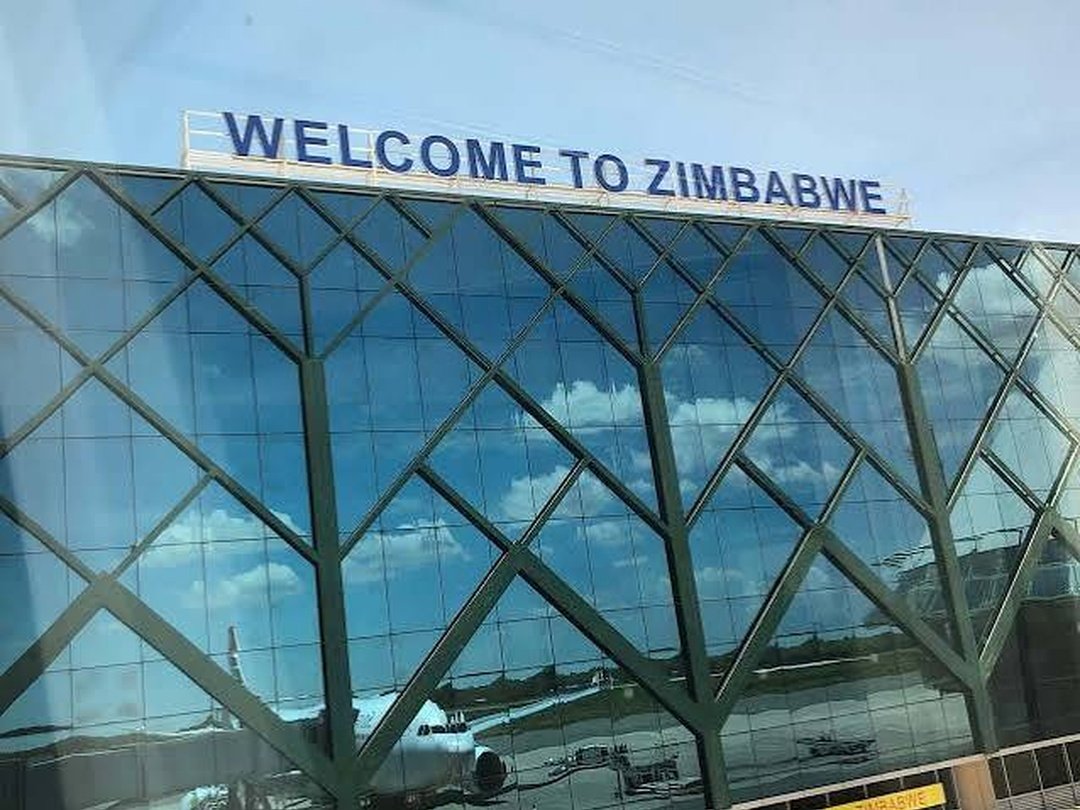
Victoria Falls International Airport (VFA) is the principal aviation gateway for travelers staying on the Zimbabwean side of Victoria Falls. The airport serves the internationally important tourism region surrounding Victoria Falls and provides one of the easiest ways to begin a safari that combines the waterfall with destinations such as Hwange National Park, Zambezi National Park and Chobe National Park. Zimbabwe’s Civil Aviation Authority lists Victoria Falls International Airport among the country’s major international airports.
For many international travelers, Victoria Falls Airport is reached through a regional connection rather than a long overland journey. Johannesburg is particularly important because scheduled services connect Johannesburg with Victoria Falls, making it possible for travelers arriving in South Africa from Europe, North America, Asia, Australia and elsewhere to continue into the Victoria Falls region. Airlink currently markets direct Johannesburg–Victoria Falls services as well as connections from Cape Town. Flight schedules are seasonal and can change, so they should always be checked when a safari is booked.
Once travelers arrive at Victoria Falls International Airport, the final journey to Victoria Falls town is a relatively short road transfer. Most safari travelers arrange an airport pickup in advance through their lodge, hotel or safari operator. Pre-arranged transfers are particularly convenient because the driver meets guests after immigration and baggage collection and transfers them directly to their accommodation without the need to negotiate transport after arrival.
Arriving through Victoria Falls Airport is especially practical if the Zimbabwe side of Victoria Falls will form the main base of the trip. The Zimbabwean viewing area contains a large number of viewpoints facing different sections of the waterfall, while the town itself provides easy access to sunset cruises, helicopter flights, Zambezi activities and nearby wildlife experiences.
The airport is also a useful gateway for travelers continuing to Hwange National Park. Victoria Falls and Hwange form one of Zimbabwe’s strongest safari combinations because travelers can experience the waterfall before continuing south into a major wildlife area for several nights of game drives and other safari activities.
A typical itinerary may therefore begin with arrival at Victoria Falls Airport, followed by two or three nights around the falls and then an extension to Hwange. Alternatively, visitors can stay at Victoria Falls before traveling west toward Botswana for a Chobe safari.
For travelers booking a multi-country safari to Victoria Falls, arriving through VFA does not mean they are restricted to Zimbabwe. The Victoria Falls border connects Zimbabwe directly with Zambia, while Botswana can be reached overland through the Kazungula area.
Visa requirements should nevertheless be checked before departure. Zimbabwe operates an official eVisa system, and the appropriate visa arrangement depends on nationality and intended movements between countries.
Flying to Livingstone Airport, Zambia
Travelers wishing to stay on the Zambian side can fly into Harry Mwaanga Nkumbula International Airport, commonly referred to as Livingstone Airport. The airport serves Livingstone, Zambia’s main gateway city for Victoria Falls, and is officially operated as one of Zambia’s designated international airports by Zambia Airports Corporation Limited.
Livingstone is an excellent entry point for travelers whose itinerary focuses on the Zambian side of Victoria Falls, the upper Zambezi River or onward travel through Zambia. From the airport, visitors can transfer directly to hotels in Livingstone, riverside lodges along the Zambezi or properties located closer to Mosi-oa-Tunya National Park and Victoria Falls.
One advantage of arriving in Livingstone is the ease with which travelers can begin their trip on the Zambian side before crossing into Zimbabwe later. This can be particularly useful for travelers who want to experience both sides of Victoria Falls rather than choosing only one.
The Zambian side offers distinctive waterfall experiences, including Knife-Edge Bridge and, when river levels and safety conditions permit, excursions associated with Livingstone Island and Devil’s Pool. Travelers can then cross the Victoria Falls border to experience the wider series of Zimbabwean viewpoints.
Johannesburg is also an important gateway for flights to Livingstone. Airlink currently offers Johannesburg–Livingstone services, allowing international travelers arriving through South Africa to connect onward to the Zambian side of Victoria Falls.
Livingstone is also convenient for travelers planning a safari extension into Botswana. Road transfers can connect the city with the Kasane and Chobe region, allowing travelers to combine Victoria Falls with one of Botswana’s most famous wildlife destinations without taking another flight.
For guests planning to travel between Zambia and Zimbabwe several times, visa planning is particularly important. Zambia’s Department of Immigration currently lists the KAZA UNIVISA as available at Harry Mwaanga Nkumbula International Airport, the Victoria Falls border and Kazungula Border Control for eligible nationalities.
This makes Livingstone Airport an especially useful gateway for itineraries combining Livingstone, Victoria Falls, Chobe and other destinations within the Kavango-Zambezi region.
Traveling from Kasane and Chobe
Traveling from Kasane or Chobe National Park to Victoria Falls is one of the most popular overland safari connections in Southern Africa. Kasane sits close to Chobe National Park and serves as an important tourism center for travelers exploring northern Botswana. From here, organized cross-border road transfers connect travelers with both Victoria Falls in Zimbabwe and Livingstone in Zambia.
This geographical proximity is one of the reasons the Victoria Falls and Chobe safari combination works so well. Instead of taking another flight, travelers can move between a major waterfall destination and one of Africa’s renowned wildlife areas by road.
If travelers are moving from Kasane to Victoria Falls, Zimbabwe, they generally travel through the Botswana–Zimbabwe border system in the Kazungula area before continuing toward Victoria Falls. Visitors heading from Kasane to Livingstone, Zambia, instead cross from Botswana into Zambia and continue by road toward Livingstone.
Actual transfer time varies because international border formalities can influence the journey considerably. Traffic, passport processing, visa requirements, vehicle procedures and the number of travelers arriving at the same time can all affect how quickly a border crossing is completed. It is therefore better to treat transfer times as estimates rather than fixed promises.
A properly organized safari transfer can make the journey much simpler. Cross-border operators coordinate the different stages of transportation and can help ensure travelers know which immigration procedures apply. This is particularly useful on itineraries where guests need to arrive in Chobe in time for a morning game drive or return to Victoria Falls after an afternoon river safari.
Travelers staying at Victoria Falls can also visit Chobe National Park as a day trip. These excursions usually start early in the morning because the journey includes international border formalities before safari activities begin. Once inside the Chobe region, a typical day trip may combine a game drive with a boat safari along the Chobe River before returning to Victoria Falls later in the day.
For travelers with more time, staying one, two or three nights in Chobe provides a deeper safari experience. Multiple game drives and boat cruises allow visitors to experience different wildlife areas and different times of day rather than trying to fit everything into a single excursion.
The region is particularly famous for elephants. During the drier months, large numbers of elephants and other animals congregate around the Chobe River, creating excellent opportunities for wildlife viewing from both safari vehicles and boats.
The KAZA UNIVISA can also simplify certain itineraries for eligible travelers. Zambia’s Department of Immigration states that the visa permits multiple movements between Zambia and Zimbabwe and also covers day trips into Botswana through Kazungula while the traveler remains within the applicable visa conditions.
For this reason, travelers planning a Victoria Falls and Chobe safari should discuss border arrangements and visa requirements before beginning the trip rather than waiting until the day of travel.
Traveling from Johannesburg
Johannesburg is one of the most important international gateways for a safari to Victoria Falls. O.R. Tambo International Airport connects Southern Africa with a large international aviation network, making Johannesburg a convenient transit point for travelers arriving from other continents before continuing to Zimbabwe or Zambia.
The simplest option is to fly from Johannesburg directly to either Victoria Falls International Airport (VFA) in Zimbabwe or Harry Mwaanga Nkumbula International Airport (LVI) in Livingstone, Zambia. Current Airlink services include Johannesburg connections to both Victoria Falls and Livingstone.
Which airport you choose should depend on your itinerary rather than simply the lowest airfare. Travelers staying primarily in Victoria Falls, Zimbabwe, or continuing toward Hwange National Park may find VFA more convenient. Travelers beginning their journey in Livingstone or continuing through Zambia may prefer LVI.
Travelers planning to visit both countries should compare the complete safari route before purchasing flights. For example, an itinerary could fly Johannesburg to Victoria Falls, explore the Zimbabwean side, cross into Zambia and eventually depart from Livingstone. The reverse direction can work equally well.
Johannesburg is also useful for travelers combining Victoria Falls with other major Southern African destinations. A longer holiday might include Cape Town, Kruger, Botswana or Namibia before or after the Victoria Falls portion of the journey.
Although overland travel between Johannesburg and Victoria Falls is possible, the distance is substantial and flying is generally far more practical for travelers with limited safari time. Long-distance road journeys can consume valuable days that could otherwise be spent at Victoria Falls, Chobe or Hwange.
For this reason, international visitors planning a relatively short Southern African safari often use Johannesburg primarily as an aviation hub and then fly directly into the Victoria Falls region.
When booking separate international and regional tickets, travelers should allow adequate connection time in Johannesburg. Immigration procedures, baggage collection and rechecking requirements can vary depending on how the flights are ticketed, so tight connections are best avoided.
Border Crossings Between Zimbabwe and Zambia
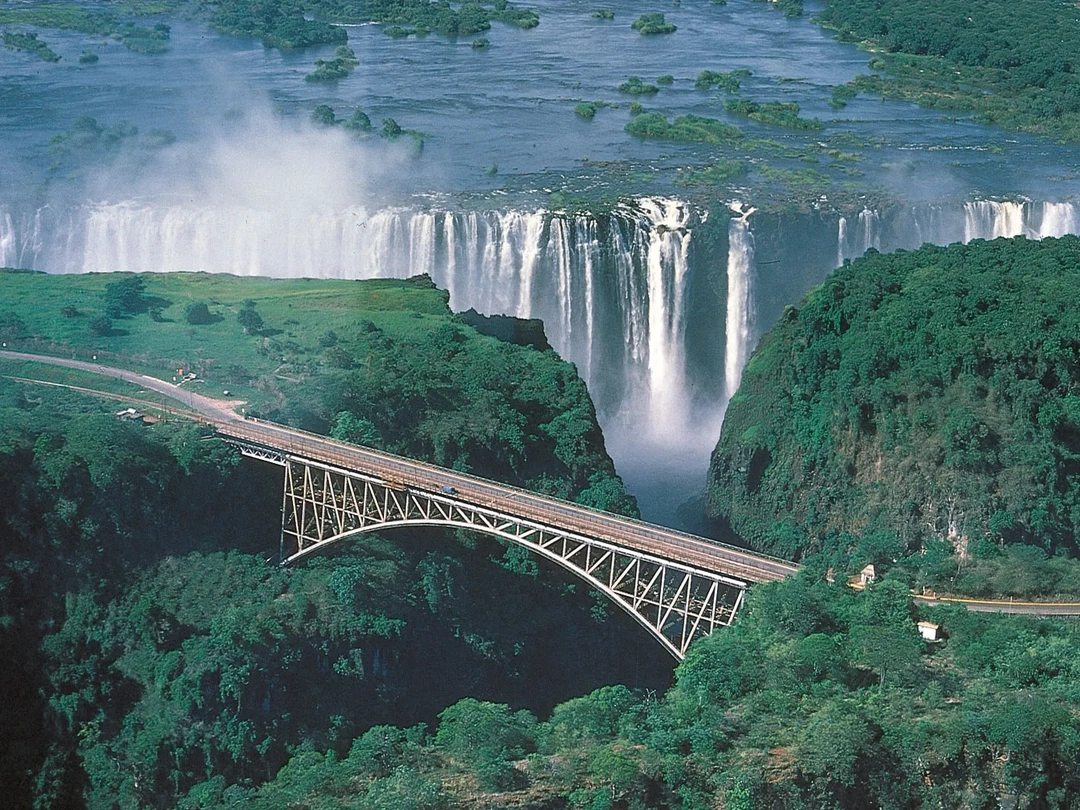
One of the great advantages of visiting Victoria Falls is that travelers can experience the waterfall from both Zimbabwe and Zambia during the same safari. The two countries are connected at Victoria Falls by the famous Victoria Falls Bridge, which crosses the Zambezi Gorge immediately downstream from the waterfall.
Travelers moving from Victoria Falls town to Livingstone, or from Livingstone to Victoria Falls, must complete immigration procedures because they are crossing an international border. This applies even when the purpose of crossing is simply to visit the other side of the waterfall for a few hours.
The process normally involves formally exiting one country, crossing the bridge and completing entry procedures for the other. Travelers should carry their passports and ensure they have the correct visa or visa exemption for their nationality.
The KAZA UNIVISA can be particularly useful for eligible visitors who plan to cross repeatedly between Zimbabwe and Zambia. According to Zambia’s Department of Immigration, the current KAZA arrangement costs US$50, is valid for up to 30 days under its stated conditions and permits multiple entries between Zambia and Zimbabwe. It can also cover qualifying day visits to Botswana through Kazungula.
However, not every nationality has the same visa requirements, and immigration regulations can change. Travelers should therefore check the latest official requirements before departure rather than relying on older travel blogs or previous safari experiences.
Crossing the border can be incorporated into a guided Victoria Falls tour. For example, a traveler staying in Zimbabwe might spend the morning exploring the Zimbabwean viewpoints before crossing into Zambia to see the falls from a different angle. Visitors based in Livingstone can do the reverse.
The border is also important for travelers moving between the two airports. A guest may arrive at Victoria Falls International Airport in Zimbabwe but stay at a lodge on the Zambian side, or arrive in Livingstone and stay in Victoria Falls town. Such arrangements are entirely possible, but they require a cross-border transfer and appropriate immigration documentation.
For families, larger groups and travelers carrying significant luggage, pre-arranged transfers are usually the most comfortable option. The safari operator can coordinate vehicles and border logistics while allowing enough time for immigration procedures.
Travelers should also remember that crossing the Zimbabwe–Zambia border is different from simply walking onto Victoria Falls Bridge for sightseeing. Entry and exit requirements depend on exactly how far a visitor travels and whether they formally enter the neighboring country. When in doubt, travelers should confirm the procedure with immigration officials or their safari operator before leaving the country in which they are staying.
Overall, access is one of the strongest advantages of a safari to Victoria Falls. Travelers can fly directly into Zimbabwe or Zambia, connect easily through Johannesburg, travel overland from Chobe and Kasane, and cross between the Zimbabwean and Zambian sides of the waterfall. This connectivity makes Victoria Falls an ideal centerpiece for a wider Southern African itinerary combining Victoria Falls, Chobe National Park, Hwange National Park and the Zambezi River region.
Top Things to Do on a Safari to Victoria Falls
A safari to Victoria Falls offers far more than simply standing beside the waterfall and taking photographs. The wider Victoria Falls region combines spectacular scenery, the Zambezi River, wildlife, adventure activities, cultural experiences and easy access to several important conservation areas. This diversity allows travelers to build an itinerary that balances sightseeing with traditional African safari experiences, whether they are visiting for two days or including Victoria Falls within a longer Southern African journey.
Some activities, such as a guided tour of Victoria Falls and a sunset cruise on the Zambezi River, suit almost every visitor. Others are more adventurous and depend on personal fitness, water levels or seasonal operating conditions. Travelers interested in wildlife can also include game drives, nature walks and excursions to nearby national parks. Couples may prefer a slower itinerary combining scenic flights and river cruises, while families and adventurous travelers can choose from a much wider selection of experiences.
The following are some of the best things to do on a safari to Victoria Falls and can be combined according to the season, available time and individual interests.
Guided Victoria Falls Walking Tour
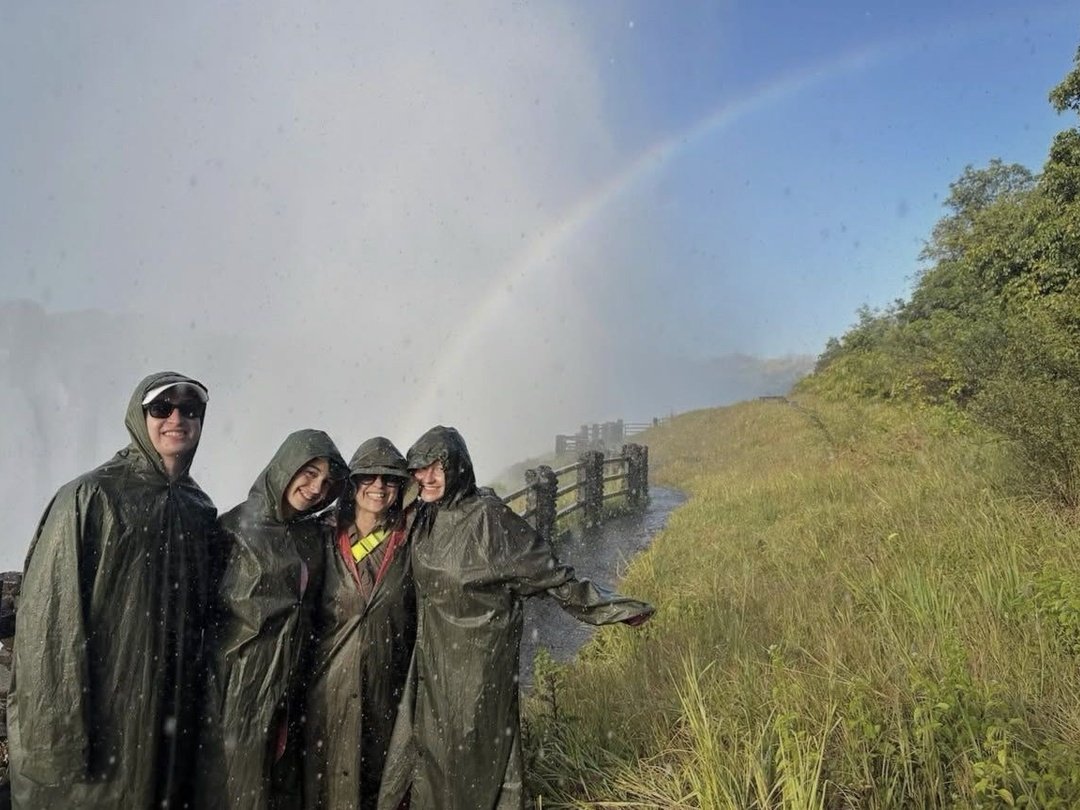
A guided Victoria Falls walking tour is one of the most important experiences to include when visiting the destination. Rather than seeing the waterfall from only one viewpoint, the walking trails take visitors along the edge of the gorge where a sequence of viewpoints reveals different sections of Victoria Falls. The scenery changes continuously as you move through the rainforest, making the experience considerably more rewarding than simply stopping for a quick photograph.
On the Zimbabwe side, the trail passes a broad range of viewpoints overlooking major sections of the falls. Depending on water levels, visitors can experience enormous clouds of spray, powerful curtains of falling water and spectacular views into the deep Batoka Gorge. During high-water periods, the spray can be so intense that sections of the trail feel like walking through heavy rainfall even when the sky is clear.
The Zambian side provides a different perspective and can bring visitors very close to the force of the water. Areas around Knife-Edge Bridge are particularly dramatic when the Zambezi is carrying substantial water. Walking across this section while surrounded by mist and the sound of the waterfall is one of the defining experiences of a visit to Victoria Falls.
Using an experienced guide adds considerable value because Victoria Falls is not only visually impressive but also geologically and historically fascinating. A guide can explain how the Zambezi River created the successive gorges, how seasonal river levels affect the appearance of the falls and how the surrounding rainforest survives in an environment created largely by permanent spray.
Guides can also point out birds, plants, monkeys and other wildlife that visitors might otherwise overlook. The rainforest around Victoria Falls supports a distinctive ecosystem because moisture from the waterfall creates unusually lush vegetation compared with the surrounding woodland.
Photography is another major part of the walking tour. During high water, waterproof protection for cameras and phones is highly recommended because spray can soak visitors within minutes. During lower water, visibility into the gorge improves dramatically, making it easier to photograph geological formations and individual channels of falling water.
Travelers with enough time should consider viewing Victoria Falls from both Zimbabwe and Zambia. The perspectives are different enough that visiting the second side does not simply repeat the first experience.
For first-time visitors, a guided Victoria Falls tour should usually be considered one of the essential activities of the entire safari.
Zambezi River Sunset Cruise
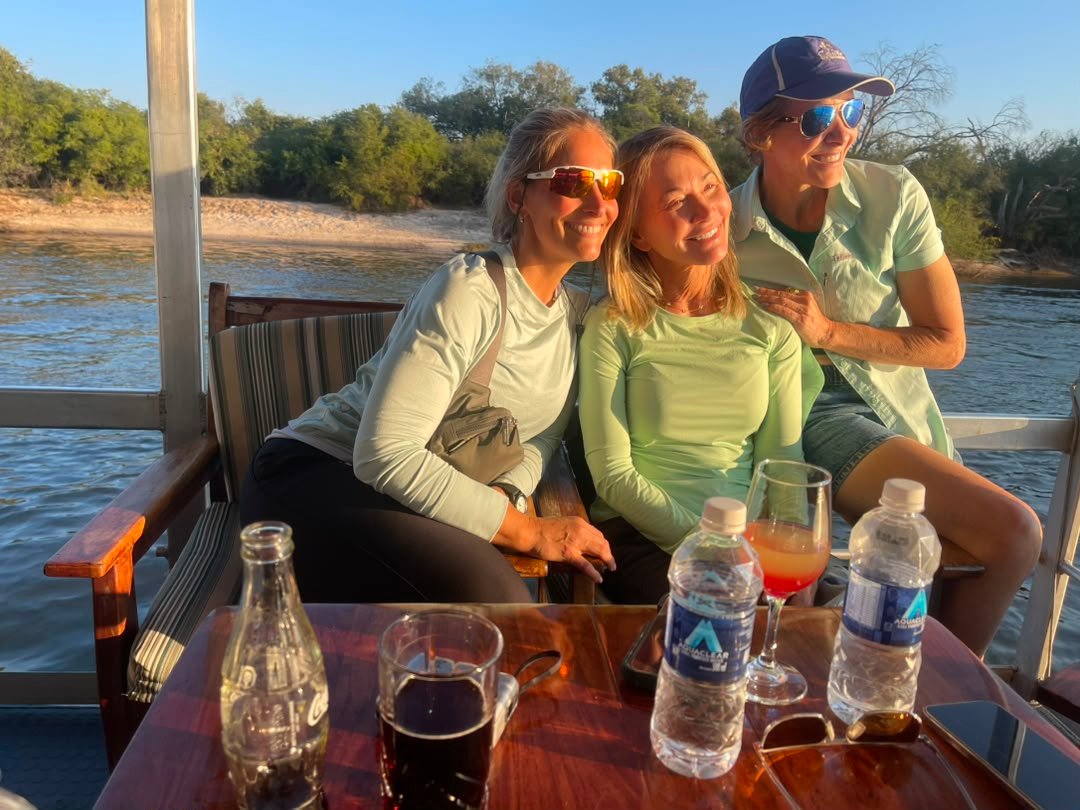
A Zambezi River sunset cruise offers a completely different atmosphere from the dramatic experience of standing beside Victoria Falls. Upstream from the waterfall, the Zambezi becomes broad and relatively peaceful, creating an ideal setting for an evening of wildlife viewing, photography and relaxation.
Cruises normally take place during the late afternoon, allowing travelers to enjoy the river as the temperature begins to cool and animals become more active. Hippos are frequently associated with the Zambezi, while crocodiles may be seen along the banks or resting near quieter sections of the river. Elephants, antelopes and other animals may also appear near the shoreline, although wildlife sightings can never be guaranteed.
The Zambezi is particularly important for birdlife. Fish eagles, kingfishers, herons, egrets and numerous other species can be encountered around the river, islands and surrounding woodland. For birdwatchers, a slower-moving cruise allows time to observe species that can easily be missed during faster safari activities.
The sunset itself is often one of the highlights. As the sun drops toward the horizon, the river can change from brilliant reflections to deep silhouettes of trees and wildlife. Photographers may have opportunities to capture elephants against the setting sun or hippos emerging from calm sections of water.
Different styles of cruises are available, ranging from larger shared vessels to smaller premium and private boats. Couples and honeymooners may prefer a more intimate cruise, while families and groups may enjoy the social atmosphere of larger vessels.
A sunset cruise also works exceptionally well after a busy day. Travelers can spend the morning walking around Victoria Falls, enjoy lunch or a scenic flight in the afternoon and finish the day peacefully on the Zambezi.
For many visitors, the combination of a Victoria Falls walking tour and Zambezi sunset cruise provides an ideal first day because it shows two entirely different personalities of the same river: calm and expansive above the falls, then incredibly powerful as it plunges into the gorge.
Helicopter Flight Over Victoria Falls
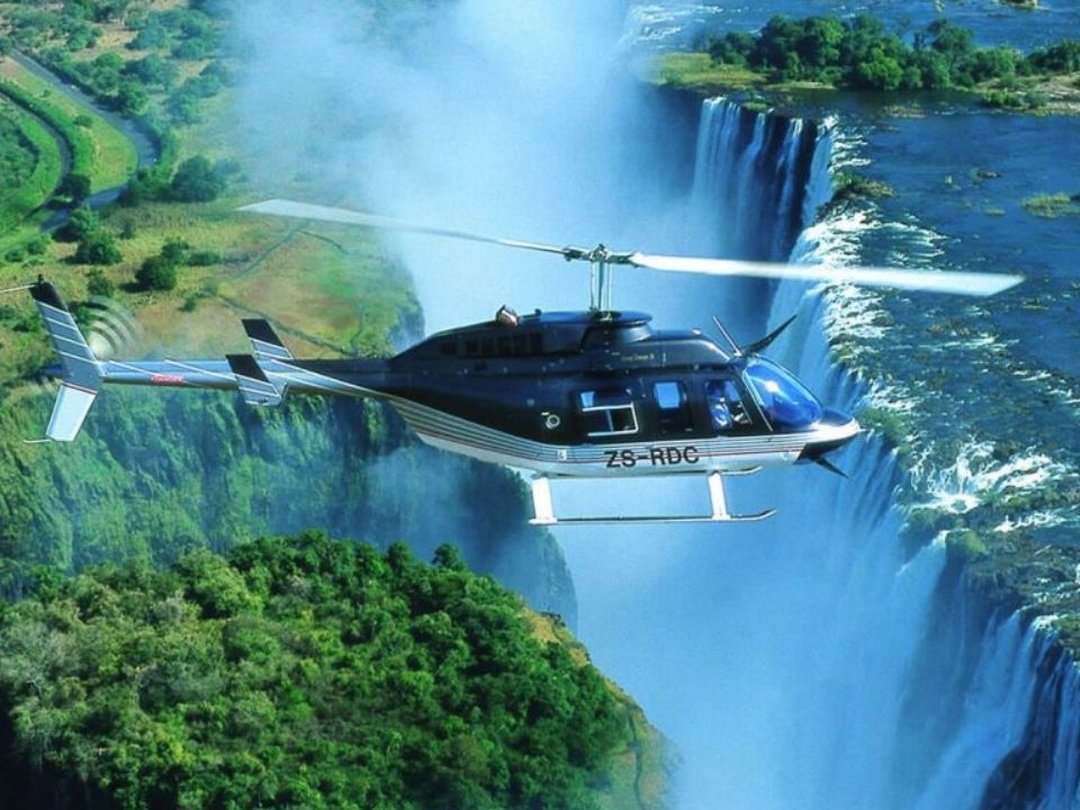
A helicopter flight over Victoria Falls provides one of the best ways to understand the true scale of the waterfall and the extraordinary landscape surrounding it. From ground level, visitors see only individual sections at a time, but from the air the entire geological structure becomes much easier to appreciate.
Scenic flights are often described as the “Flight of Angels,” a reference connected with early descriptions of Victoria Falls. From above, travelers can see the broad Zambezi River approaching the waterfall before suddenly disappearing into the narrow gorge below.
The aerial view also reveals the extraordinary sequence of zigzagging gorges downstream. These formations demonstrate how Victoria Falls has gradually moved upstream over geological time as erosion reshaped the basalt landscape.
During high water, helicopter flights can be particularly impressive because the immense cloud of spray can obscure sections of the falls from ground viewpoints. Rising above the mist allows travelers to appreciate the width and magnitude of the waterfall in a way that may be impossible from the walking trails.
During lower water, the flight offers a different advantage. Rock formations become more visible, individual channels can be clearly distinguished, and travelers can see how dramatically the Zambezi’s flow changes across the seasons.
Some scenic flights also provide broader views over the surrounding national parks and river systems. Depending on the route, travelers may see islands, woodland, wildlife and the Victoria Falls Bridge from the air.
A helicopter experience can be especially valuable for photographers, honeymooners and travelers visiting Victoria Falls only once in their lifetime. Although it is normally one of the more expensive activities available, the perspective is genuinely different from anything experienced on the ground.
For a well-rounded safari to Victoria Falls, combining a walking tour with an aerial flight gives travelers both the intimate sensation of standing beside the waterfall and the wider perspective required to understand its enormous scale.
White-Water Rafting on the Zambezi
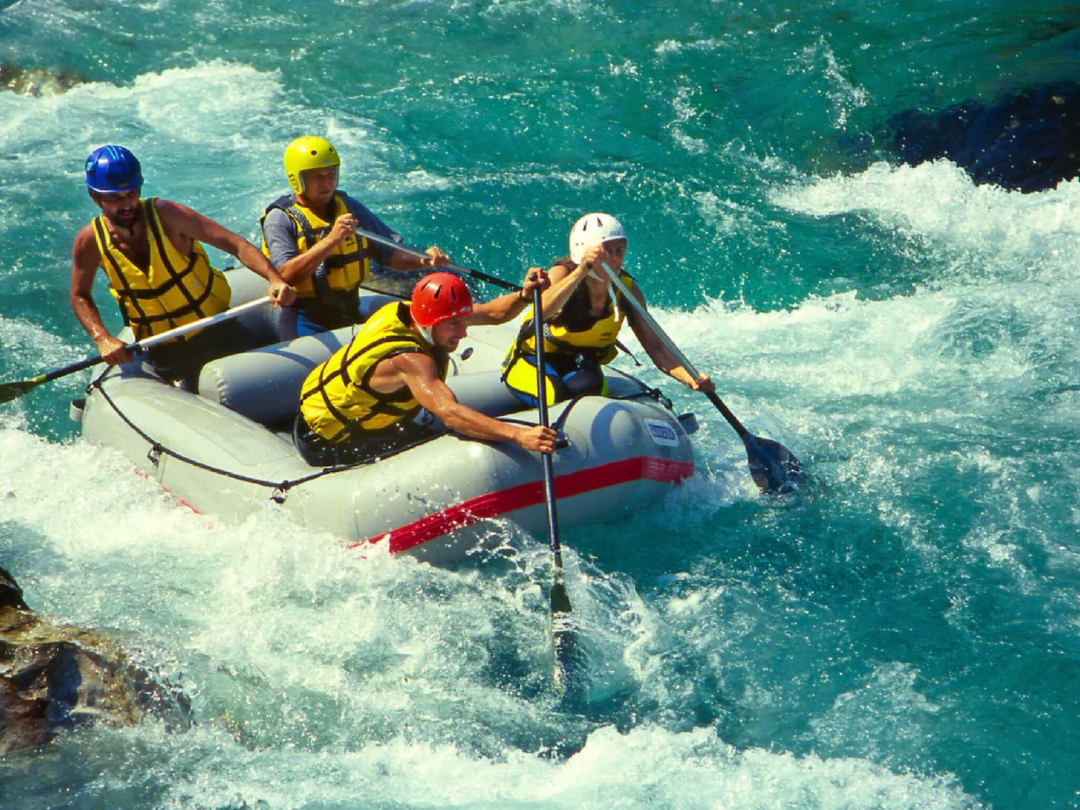
For adventure travelers, white-water rafting on the Zambezi River is one of the most exciting activities available around Victoria Falls. Downstream from the waterfall, the river enters the spectacular Batoka Gorge, where powerful rapids have helped establish the Zambezi as one of Africa’s most famous rafting destinations.
The experience begins beneath towering gorge walls where the river is dramatically different from the broad and peaceful Zambezi found above Victoria Falls. Strong currents, waves and technical rapids create a demanding adventure that is aimed at travelers who are comfortable with physically active experiences.
Rafting conditions change substantially according to river levels. Different sections of the river may operate during different parts of the year, and some periods can have restrictions when water levels make particular stretches unsuitable. Anyone planning a rafting trip should therefore confirm operational conditions for their exact travel dates.
Professional operators normally provide safety equipment, rafting instructions and experienced river guides. Participants receive a safety briefing before entering the water and are taught how to respond if the raft overturns or if someone enters the river.
Travelers should recognize that Zambezi rafting is not simply a gentle sightseeing cruise. It can be physically demanding, and participants should carefully consider fitness, swimming confidence, age restrictions and medical conditions before booking.
One of the most memorable aspects of the experience is the landscape. The steep walls of Batoka Gorge create a dramatic wilderness setting that most visitors to Victoria Falls never experience from the normal viewpoints.
Combining rafting with a conventional safari can add an entirely different dimension to the journey. A traveler might spend one day observing elephants and buffaloes before spending the next navigating the Zambezi’s rapids.
For active travelers seeking more than wildlife viewing, Zambezi white-water rafting can be one of the most memorable additions to a Victoria Falls safari.
Devil’s Pool Experience
Devil’s Pool is one of the most famous seasonal experiences associated with Victoria Falls. Located near the edge of the waterfall on the Zambian side, this naturally formed rock pool allows visitors, under controlled conditions and with trained guides, to experience an extraordinary perspective close to where the Zambezi plunges into the gorge.
The activity is only possible when river levels are considered suitable. It is therefore strongly seasonal and should never be treated as a guaranteed year-round Victoria Falls experience. Exact opening and closing dates vary according to annual Zambezi water levels and safety assessments.
Access normally forms part of a guided Livingstone Island experience. Visitors travel to the island before being escorted by trained guides toward the pool. Safety procedures are essential because of the location and strength of the river.
The attraction of Devil’s Pool comes from the extraordinary perspective it provides. From the pool, travelers can look toward the immense gorge while being positioned remarkably close to the edge of one of the world’s most famous waterfalls.
Although photographs of Devil’s Pool often dominate social media, visitors should approach the experience as a professionally managed activity rather than simply an opportunity to reproduce a dramatic photograph. Instructions from guides must be followed precisely.
Travelers uncomfortable around heights or moving water may decide that Devil’s Pool is not suitable for them, and there is no shortage of alternative Victoria Falls experiences. Scenic flights, waterfall walks and river cruises offer exceptional views without requiring participation in such an adventurous activity.
For suitable travelers visiting during the correct season, however, the Devil’s Pool experience at Victoria Falls can become one of the most unusual memories of a Southern African journey.
Livingstone Island Tour
Livingstone Island sits within the Zambezi River close to the edge of Victoria Falls on the Zambian side and provides one of the most distinctive perspectives of the waterfall. The island carries strong historical associations with David Livingstone, the Scottish explorer who recorded seeing Victoria Falls in 1855.
Reaching Livingstone Island generally involves traveling by boat across sections of the upper Zambezi. The journey itself provides beautiful views of the river before visitors arrive on an island positioned exceptionally close to the falling water.
A guided tour introduces visitors to the history and natural setting of the island while offering perspectives that differ significantly from the conventional viewing trails. Standing on the island demonstrates just how broad and deceptively calm the Zambezi can appear immediately before it drops into the gorge.
Depending on the particular experience booked, visits may be combined with breakfast, lunch, afternoon refreshments or other meals. This gives travelers an opportunity to enjoy the setting rather than treating the island purely as a brief sightseeing stop.
Livingstone Island is also the departure point for the famous Devil’s Pool experience when river levels permit. However, visitors do not necessarily need to participate in Devil’s Pool to appreciate the island itself.
Access is dependent on river conditions, which means Livingstone Island tours can be restricted when water levels are unsuitable. Travelers specifically interested in the experience should check seasonal availability before structuring an entire itinerary around it.
For history enthusiasts, photographers and travelers wanting a less conventional view of Victoria Falls, Livingstone Island adds considerable depth to the safari experience.
Bungee Jumping and Adventure Activities
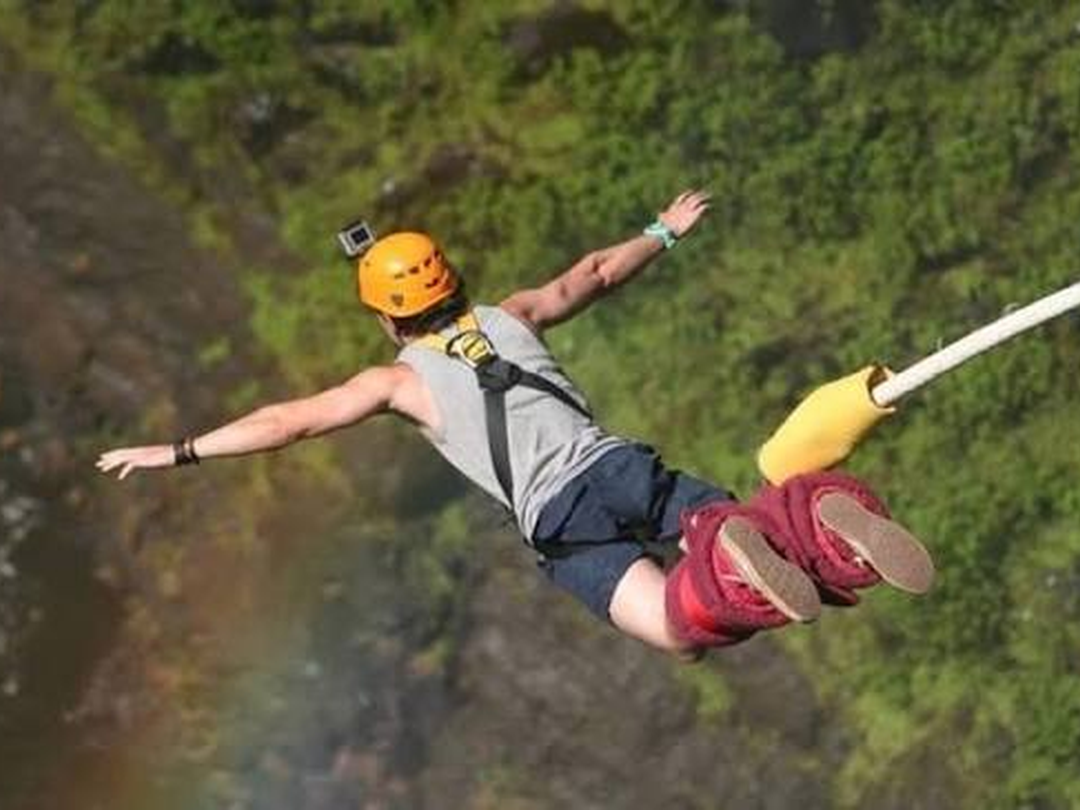
Victoria Falls has developed a reputation as one of Southern Africa’s leading adventure destinations, making it especially appealing to travelers who want to combine wildlife safaris with adrenaline-focused experiences.
One of the most famous activities is bungee jumping from the Victoria Falls Bridge, where participants jump above the dramatic Batoka Gorge with the Zambezi River below. The setting is what makes this experience particularly distinctive; very few bungee jumps take place beside a natural attraction as spectacular as Victoria Falls.
Other bridge-based activities can include gorge swings, zip-line style experiences and related high-adrenaline adventures. Availability and operating arrangements can vary, so travelers should confirm current options before traveling.
Away from the bridge, the wider Victoria Falls region offers additional activities such as rafting, kayaking in appropriate river sections and scenic flights. Some travelers also incorporate fishing or other Zambezi-based activities into longer stays.
Adventure activities should always be booked with established professional operators that follow recognized safety procedures. Travelers should disclose medical conditions, follow age and weight restrictions and carefully listen to all safety instructions.
An important advantage of Victoria Falls is that not everybody in a group needs to participate in the same activities. One traveler may choose bungee jumping while another enjoys a spa treatment, river cruise or guided tour. Families and mixed-interest groups can therefore travel together without every day having to follow the same program.
The abundance of adventure options helps distinguish a Victoria Falls safari from many conventional African safari destinations where activities revolve primarily around game drives.
Cultural Village Experiences
A safari to Victoria Falls becomes much richer when travelers take time to understand the people and communities who live around the Zambezi region. Cultural village experiences can provide insight into local traditions, family life, food, architecture, crafts and the relationship between communities and the surrounding natural environment.
These experiences are available on both the Zimbabwean and Zambian sides of Victoria Falls. Programs differ between communities and operators, but responsible visits should emphasize genuine interaction and respectful cultural exchange rather than staged performances designed solely for tourists.
Visitors may learn about traditional homesteads, agricultural practices, cooking methods and the use of locally available materials. Some experiences include opportunities to meet artisans or purchase locally produced crafts directly from community members.
Traditional music, dance and storytelling can also form part of cultural programs. These activities provide context that cannot be gained simply by moving between hotels, safari vehicles and national parks.
Community tourism can also create direct economic benefits when experiences are properly structured. Spending with local guides, artisans and community projects helps ensure that tourism revenue reaches people living near major attractions.
Travelers should approach cultural experiences with the same respect they would expect when visitors enter their own communities. Photography should only be taken when permission is given, and local customs should be respected.
For families, cultural visits can be particularly educational because they introduce children and young travelers to aspects of Southern African life that extend beyond wildlife viewing.
Including a cultural experience adds human context to a safari to Victoria Falls, helping visitors understand that the destination is not simply a waterfall and tourism center but part of a much wider living cultural landscape.
Wildlife and Nature Walks
Although Victoria Falls is primarily famous for its waterfall, the surrounding region is also an important wildlife landscape. Wildlife and nature walks provide travelers with an opportunity to slow down and explore details that are often overlooked during vehicle-based safari activities.
Walking experiences may focus on plants, birds, animal tracks, insects, geology and the broader ecology of the Zambezi region. Instead of searching only for large animals, participants learn how smaller elements of the environment fit together to support the ecosystem.
The rainforest immediately surrounding Victoria Falls is particularly interesting. Constant moisture created by waterfall spray supports lush vegetation that contrasts strongly with the drier woodland found further away from the gorge.
Birdlife can be excellent around the river, forest and woodland habitats. Travelers interested in birding can look for kingfishers, hornbills, raptors, waterbirds and many other species associated with the Zambezi ecosystem.
In suitable wildlife areas, guided walks may also introduce travelers to animal tracks, dung, feeding signs and other indicators of wildlife activity. Learning to interpret these signs provides a deeper understanding of the bush than simply seeing an animal from a safari vehicle.
Any walking safari in areas containing potentially dangerous wildlife should be undertaken only under the guidance of appropriately trained professionals and according to local park regulations. Travelers should never walk independently in wildlife areas where large animals may be present.
Nature walks can be especially rewarding for repeat safari travelers who already have experience with traditional game drives and want to understand African ecosystems in greater detail.
For photographers, walking also allows more time to concentrate on landscapes, plants, insects and smaller wildlife that can be difficult to photograph from a moving vehicle.
A carefully planned safari to Victoria Falls can therefore include far more than the waterfall itself. A guided Victoria Falls tour introduces the natural wonder at the heart of the destination, while a Zambezi sunset cruise reveals the peaceful upper river. Helicopter flights provide spectacular aerial perspectives, rafting and bungee jumping satisfy adventure travelers, and seasonal experiences such as Devil’s Pool and Livingstone Island provide some of the region’s most unusual viewpoints.
Cultural visits and nature walks add another layer by connecting travelers with the communities and ecosystems surrounding Victoria Falls. When these activities are combined with wildlife safaris in Zambezi National Park, Hwange National Park or Chobe National Park, Victoria Falls becomes far more than a short sightseeing stop. It becomes a complete Southern African safari destination capable of combining scenery, wildlife, culture, relaxation and adventure within a single journey.
Wildlife Safaris Near Victoria Falls
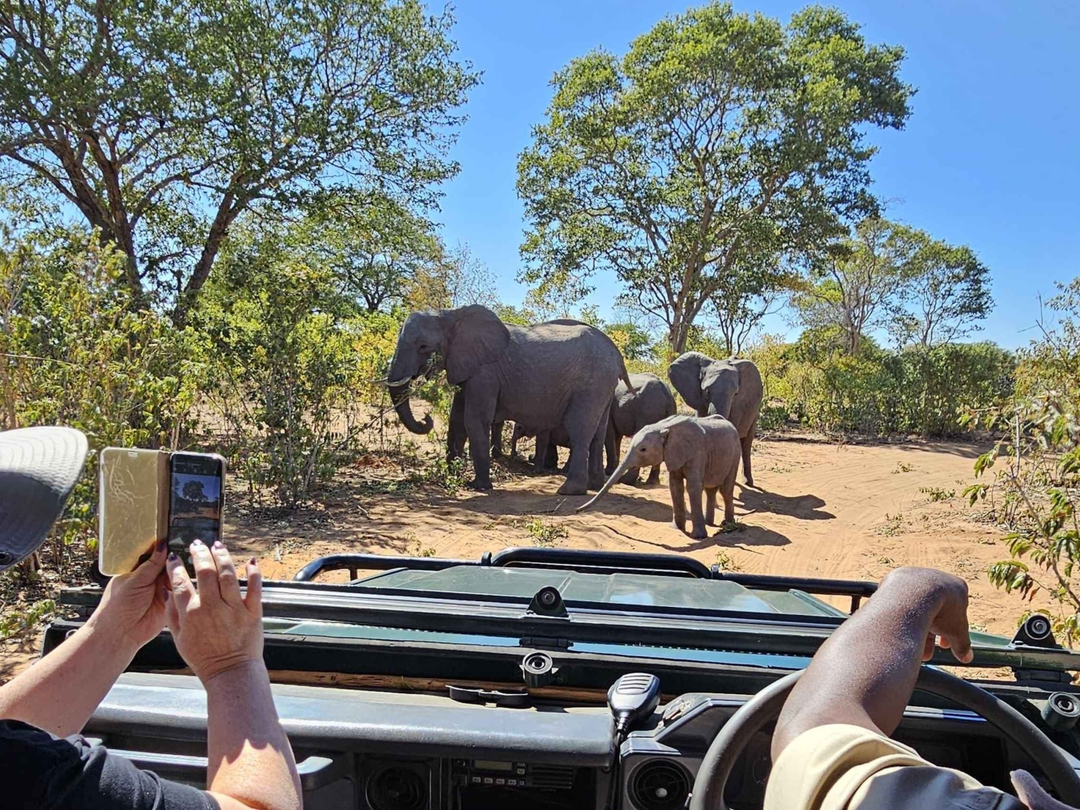
A safari to Victoria Falls can easily become a genuine wildlife safari because several excellent national parks and private reserves lie within reach of the waterfall. Travelers do not have to choose between seeing Victoria Falls and experiencing African wildlife; the two can be combined within the same itinerary, sometimes even on the same day. From short game drives close to Victoria Falls town to multi-day safaris in Hwange and Chobe, the region offers opportunities to see elephants, buffaloes, lions, leopards, giraffes, zebras, antelopes, hippos, crocodiles and an extraordinary variety of birds.
The closest wildlife areas are Zambezi National Park and the Victoria Falls Private Game Reserve on the Zimbabwean side and Mosi-oa-Tunya National Park near Livingstone in Zambia. These are particularly useful for travelers staying only two or three nights around Victoria Falls and wanting to include a game drive without traveling far from their hotel.
For visitors seeking a deeper traditional African safari, Hwange National Park in Zimbabwe and Chobe National Park in Botswana are among the strongest extensions. Hwange is Zimbabwe’s largest national park and supports around 100 mammal species, while Chobe combines excellent game drives with wildlife viewing from boats on the Chobe River.
This variety is one of the greatest strengths of Victoria Falls as a safari destination. A traveler can spend one morning walking beside one of the world’s most spectacular waterfalls and, within the wider itinerary, watch elephants beside the Zambezi or Chobe River, search for lions across open woodland or spend several nights immersed in the wilderness of Hwange.
Zambezi National Park Safari
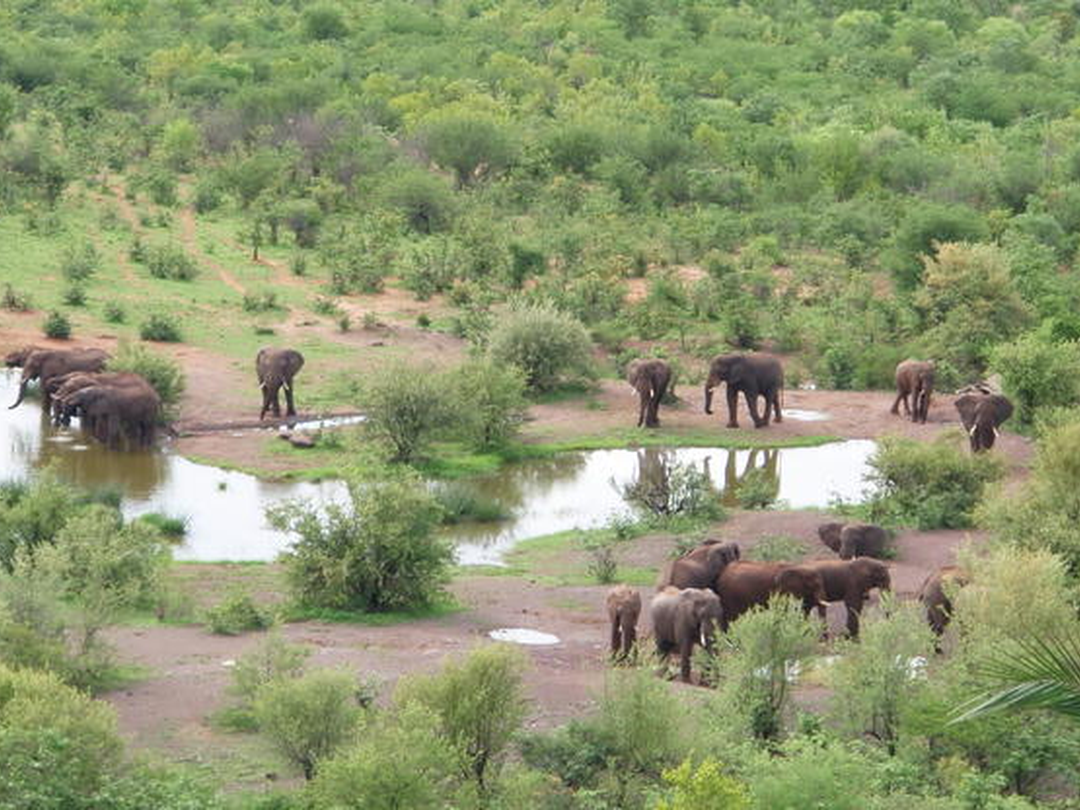
Zambezi National Park is one of the easiest wildlife destinations to combine with a stay in Victoria Falls, particularly for travelers based on the Zimbabwean side. The park lies immediately upstream from Victoria Falls and includes approximately 40 kilometers of Zambezi River frontage. Zimbabwe Parks and Wildlife Management Authority identifies elephant, lion, buffalo and leopard among the major species present in the park.
Its proximity to Victoria Falls makes Zambezi National Park particularly attractive to travelers who do not have enough time for a multi-night safari in Hwange or Chobe. Instead of spending much of the day transferring between destinations, visitors can leave Victoria Falls for a morning or afternoon game drive and return to town afterward.
The landscape is an important part of the experience. Sections of the park follow the Zambezi River, where riverine vegetation creates productive wildlife habitat, while other areas move inland through woodland and more open country. The contrast allows game drives to explore different environments within a relatively short excursion.
Elephants are among the animals visitors may encounter, particularly around areas where water and vegetation provide favorable feeding conditions. Buffaloes, giraffes, zebras, kudu, impala, waterbuck and other antelopes may also be seen, while lion and leopard occur within the ecosystem. As with any unfenced wilderness safari, predator sightings depend on luck, timing, tracking skill and the animals’ natural movements.
The Zambezi River adds another dimension to wildlife viewing. Hippos and crocodiles inhabit the river system, while the combination of water, woodland and riverbanks attracts diverse birdlife. For birdwatchers, this mixture of habitats can make the park particularly rewarding.
Morning game drives are excellent for travelers who enjoy cool conditions and early wildlife activity. Afternoon drives provide a different atmosphere as temperatures begin to fall and the light becomes softer toward sunset. Travelers staying at safari lodges around the park can potentially experience several drives rather than treating Zambezi National Park as only a short excursion.
A major advantage of a Zambezi National Park safari is that it works naturally alongside other Victoria Falls activities. A traveler might enjoy a morning game drive followed by a guided tour of Victoria Falls in the afternoon, or visit the falls earlier in the day before taking an evening safari excursion.
Travelers can also combine wildlife viewing with river-focused experiences. The upper Zambezi is well known for boat activities, giving visitors the opportunity to experience the landscape both from land and from the water. This creates a more varied safari than game driving alone.
For travelers whose priority is convenience, Zambezi National Park is one of the best wildlife areas near Victoria Falls. It may not provide the same scale of wilderness as a multi-day Hwange safari, but its location and diversity make it extremely valuable within a shorter Victoria Falls safari itinerary.
Victoria Falls Private Game Reserve
The Victoria Falls Private Game Reserve, also associated with the Stanley & Livingstone area, offers another valuable game-viewing option close to Victoria Falls town. One of its most distinctive attractions is its black rhino conservation program. The reserve has been designated as an Intensive Protection Zone for rhino, and wildlife activities include guided excursions focused on locating these endangered animals.
For many travelers, this is important because rhino sightings are not a standard feature of every safari destination around Victoria Falls. Visitors may spend days in excellent wildlife areas without encountering a rhino, so the conservation-focused experience in the private reserve provides a different reason to include it in an itinerary.
The reserve also supports other members of the Big Five, along with a wider range of African wildlife and bird species. The experience generally feels different from a large national park because game drives take place within a privately managed conservation area where visitor numbers and activities can be more tightly controlled.
A typical game drive takes travelers through woodland and open sections of the reserve with an experienced guide who interprets animal tracks, behavior, vegetation and conservation issues. Rather than simply moving quickly from one large animal to another, a good guide can use the smaller details of the bush to explain how the ecosystem functions.
Black rhino encounters are especially meaningful when they include interpretation about conservation. Rhino populations across Africa have faced severe pressure from poaching, making protected reserves and intensive monitoring important parts of regional conservation strategies. The Victoria Falls Private Game Reserve’s rhino program therefore gives visitors an opportunity to connect wildlife viewing with a broader understanding of conservation.
The reserve is also useful for travelers who want a short safari close to Victoria Falls without using an entire day. Morning and afternoon activities can often be fitted around waterfall tours, helicopter flights, cultural visits or Zambezi cruises.
Private-reserve game drives can be particularly attractive for couples, honeymooners and travelers wanting a more intimate experience. Depending on the activity and operator, the atmosphere may feel less like a busy public excursion and more like a personalized wildlife experience.
Photographers can also benefit from a smaller-scale safari because guides may have more flexibility to position vehicles appropriately when conditions permit. Early and late light can be especially attractive for wildlife portraits and landscape photography.
It is important, however, to maintain realistic expectations. Even within a reserve containing major species, wildlife remains wild. No responsible operator should guarantee sightings of every member of the Big Five on a single drive.
For visitors staying only briefly in Victoria Falls, the private reserve is particularly appealing because it can add a meaningful safari component without requiring a transfer to a distant national park. For longer itineraries, it can complement rather than replace destinations such as Hwange or Chobe.
Mosi-oa-Tunya National Park
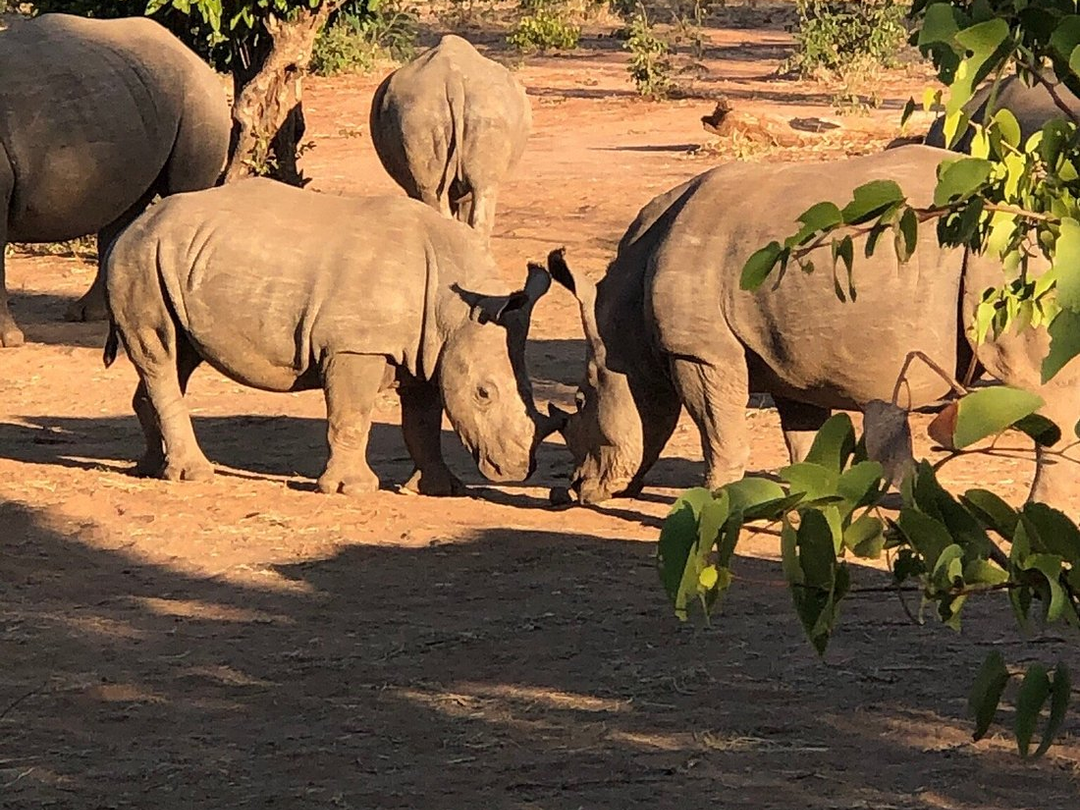
Mosi-oa-Tunya National Park lies on the Zambian side of Victoria Falls near Livingstone and is one of the most accessible wildlife areas for travelers staying in Zambia. The park extends for about 12 kilometers along the Zambezi River above Victoria Falls and contains a combination of riverine forest, mopane woodland and grassland.
Although much smaller than famous destinations such as Hwange or Chobe, Mosi-oa-Tunya provides an excellent introduction to African wildlife, especially for travelers with limited time. Zambia Tourism specifically highlights it as an easily accessible park from Livingstone that can be explored by vehicle, guided walking safari and boat.
One of the park’s most important attractions is its white rhino population. Zambia Tourism identifies Mosi-oa-Tunya as the country’s only wildlife area with white rhinos and notes that they are closely protected by wildlife scouts.
Guided rhino walks can therefore be a significant highlight for travelers visiting Livingstone. Accompanied by trained guides and rangers, visitors can learn about rhino conservation while experiencing the bush on foot. The walking element creates a very different relationship with the environment compared with viewing animals solely from a safari vehicle.
The park also supports giraffes, buffaloes, zebras, wildebeest, waterbuck, impala, bushbuck, warthogs, baboons and monkeys. Elephants may move through the area, particularly during drier periods, while hippos and crocodiles are associated with the Zambezi River.
An important characteristic of Mosi-oa-Tunya is the absence of large resident predators within its contained wildlife sanctuary. For some experienced safari travelers this means the park may feel less dramatic than Hwange or Chobe. For families, first-time safari visitors and travelers particularly interested in rhinos, however, that same characteristic can make it a comfortable and accessible introduction to wildlife.
Birdlife is another attraction. The river, woodland and gorge environments support many species, and Zambia Tourism notes a notable diversity of raptors as well as water-associated birds.
A Mosi-oa-Tunya National Park safari fits particularly well into a short Livingstone itinerary. Visitors can spend several hours wildlife viewing and still have enough time to explore the Zambian side of Victoria Falls or enjoy an afternoon Zambezi cruise.
For travelers crossing between Zimbabwe and Zambia, the park can also complement Zambezi National Park rather than compete with it. The two offer different landscapes and wildlife experiences on opposite sides of the Zambezi.
Hwange National Park Safari
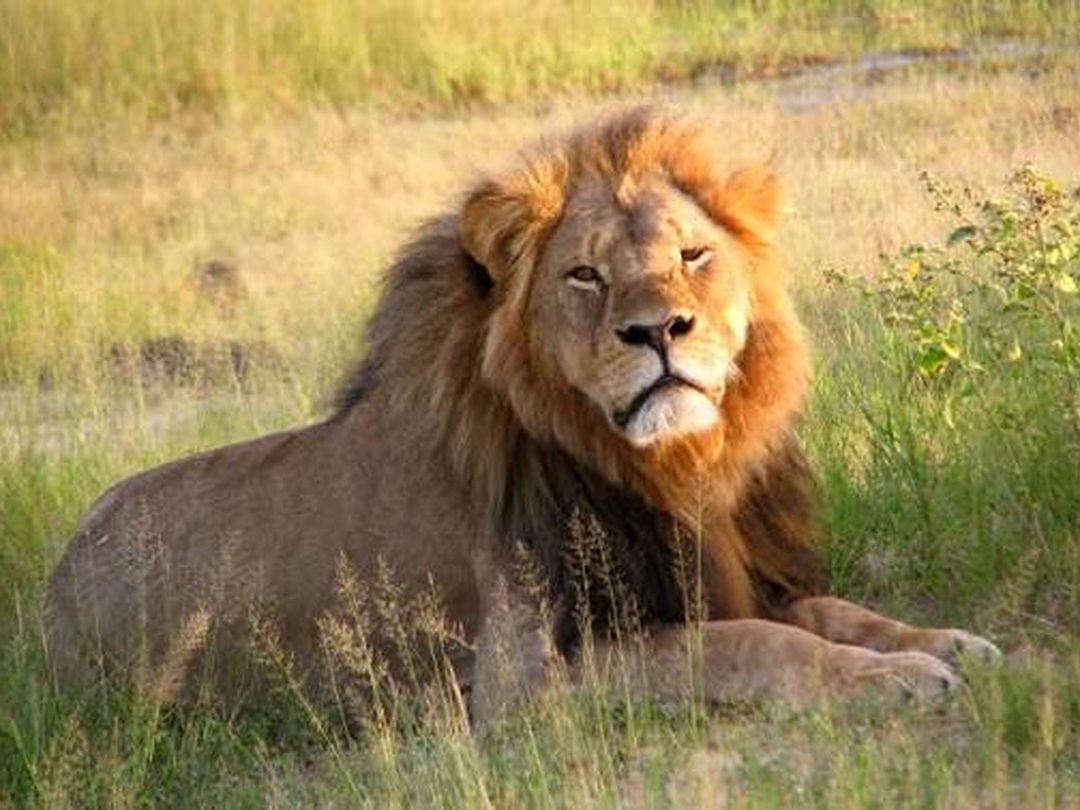
For travelers who want a much deeper wildlife experience, a Hwange National Park safari is one of the strongest combinations with Victoria Falls. Hwange is Zimbabwe’s largest national park, and Zimbabwe Parks and Wildlife Management Authority lists elephant, lion, leopard and buffalo among its major wildlife while noting that the park supports around 100 mammal species.
The enormous scale of Hwange immediately distinguishes it from the smaller wildlife areas surrounding Victoria Falls. Rather than fitting a game drive between other sightseeing activities, visitors normally dedicate at least a few days to the park, staying at safari camps or lodges and participating in repeated morning and afternoon wildlife activities.
Hwange is particularly famous for elephants. During the dry season, water becomes increasingly important, and wildlife often gathers around permanent or pumped waterholes. These areas can produce remarkable scenes involving elephants, buffaloes, antelopes and predators within the same broader landscape.
The park’s diversity extends far beyond elephants. Lions, leopards, African wild dogs, hyenas, giraffes, zebras and numerous antelope species occur within the ecosystem, giving travelers the possibility of a varied traditional safari experience.
The presence of African wild dogs can be particularly exciting for experienced safari travelers. These highly social predators range over large territories and are never guaranteed, but encountering a pack can become one of the defining wildlife moments of a Southern African safari.
Hwange also supports more than 400 recorded bird species according to widely documented park records, making it rewarding for birdwatchers as well as travelers focused on mammals.
Habitats vary considerably across the park. Open plains, woodland, seasonal pans and waterholes create different environments, which is one reason wildlife distribution changes according to season and rainfall.
The dry months generally offer particularly productive game viewing because animals become more dependent on reliable water sources and vegetation becomes less dense. The greener months, however, transform the landscape and can provide beautiful conditions for birding, photography and observing younger animals.
A major advantage of combining Victoria Falls and Hwange National Park is that both attractions are within Zimbabwe, reducing the need for additional international border crossings. Travelers can enjoy Victoria Falls before continuing into Hwange for a dedicated wilderness safari.
A short combination might include two nights at Victoria Falls followed by two or three nights in Hwange. Travelers with more time can spend longer in the park, particularly if staying in different areas or private concessions.
This combination works especially well for first-time visitors to Southern Africa because the two destinations provide very different experiences. Victoria Falls delivers spectacular scenery, river activities and adventure, while Hwange delivers the rhythm of a traditional safari centered on game drives, wildlife tracking, waterholes and evenings in the African bush.
For travelers who want to make the safari element of a safari to Victoria Falls genuinely substantial, Hwange is one of the best extensions to consider.
Chobe National Park Safari
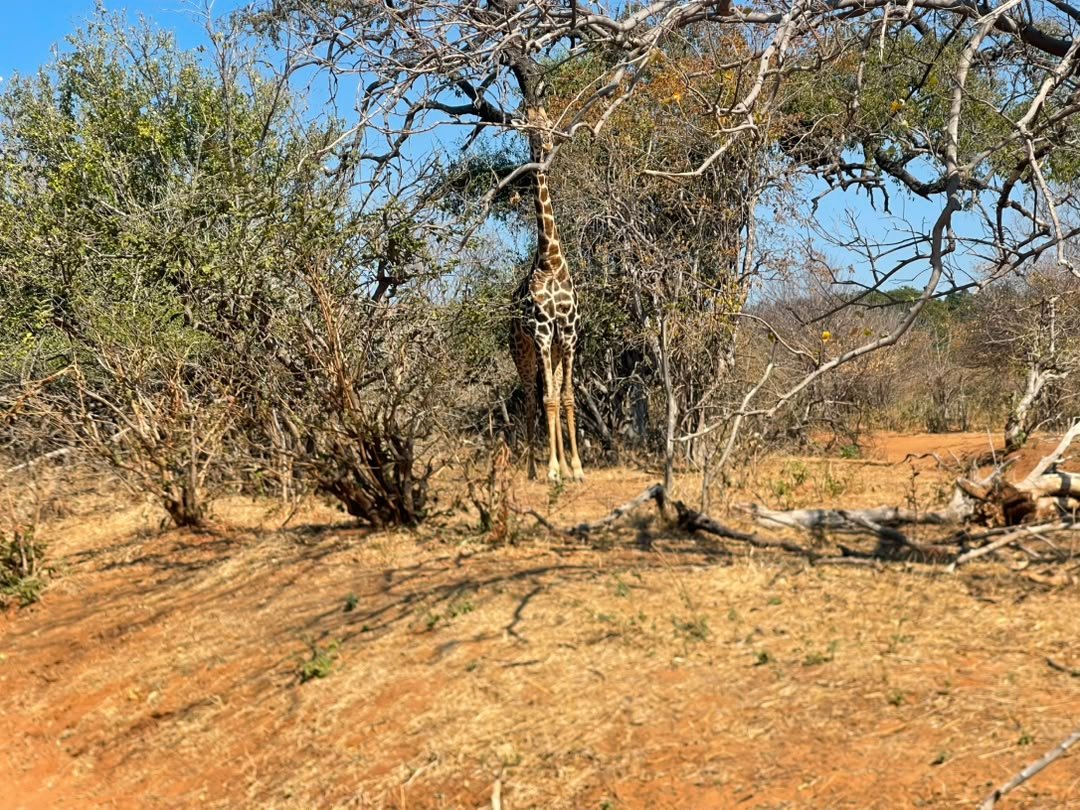
A Chobe National Park safari from Victoria Falls allows travelers to combine two countries and two outstanding experiences within a relatively compact journey. Chobe lies in northern Botswana, with the Kasane area providing the most practical gateway for visitors arriving from Victoria Falls or Livingstone.
Chobe’s greatest attraction is its extraordinary wildlife around the Chobe Riverfront. Botswana Tourism lists giraffe, kudu, roan and sable antelope, impala, waterbuck, lechwe, puku, warthog and bushbuck among commonly encountered species, together with predators including lions, leopards, hyenas and jackals.
Elephants are perhaps the animals most closely associated with Chobe. Large herds frequently use the river and surrounding floodplains, especially as dry-season conditions increase dependence on permanent water.
One of the biggest reasons to choose Chobe is the ability to combine game drives and boat safaris. A morning drive explores the tracks and woodland beside the river, while a boat cruise provides an entirely different angle on animals using the banks, islands and shallow water.
From a boat, travelers may watch elephants approach the river to drink, see hippos resting in quieter channels, observe crocodiles along the banks and photograph waterbirds at close range. The lower viewing position and open sightlines create very different photographic opportunities from those available inside a safari vehicle.
Game drives, meanwhile, are better suited to exploring inland sections and searching for predators and other terrestrial wildlife. Combining both activities creates a more complete picture of the Chobe ecosystem.
This is one reason the Victoria Falls to Chobe day trip has become such a logical addition to short itineraries. Travelers can leave Victoria Falls early, complete border formalities, enjoy wildlife activities around Chobe and return later in the day.
However, travelers who have enough time should consider spending at least one or two nights around Chobe rather than limiting the experience to a single day. Staying overnight creates opportunities for multiple game drives and cruises, reduces the sense of rushing and allows visitors to experience early mornings and evenings when wildlife activity can be particularly rewarding.
The dry season is especially popular for Chobe wildlife viewing because animals become increasingly concentrated around the river. Yet the greener period also has strong advantages, including lush scenery, abundant birdlife and a different photographic atmosphere.
For photographers, Chobe can be exceptional. Boat safaris provide low-angle views of elephants and other wildlife, while sunsets over the river can create dramatic silhouettes and reflections.
A longer Southern African itinerary can combine Victoria Falls, Chobe and Hwange, giving travelers three very different experiences. Victoria Falls provides the natural spectacle of the waterfall and the Zambezi River, Hwange offers extensive Zimbabwean wilderness, and Chobe contributes its riverfront wildlife and boat-based safari experience.
For travelers deciding which wildlife destination to add to Victoria Falls, the choice can be simplified according to time and priorities. Zambezi National Park is ideal for convenient game drives close to Victoria Falls. The Victoria Falls Private Game Reserve is particularly interesting for travelers wanting a conservation-focused black rhino experience. Mosi-oa-Tunya National Park is the easiest safari option from Livingstone and is especially notable for protected white rhinos. Hwange National Park is the stronger choice for travelers seeking a multi-day traditional Zimbabwe safari, while Chobe National Park is outstanding for elephants and the combination of vehicle game drives with wildlife viewing from the river.
Ultimately, wildlife should not be treated as an optional extra when planning a safari to Victoria Falls. The waterfall sits within one of Southern Africa’s most exciting cross-border conservation landscapes. With careful itinerary planning, travelers can experience the thunder of Victoria Falls, cruise the Zambezi, track rhinos, watch elephants beside the Chobe River and spend several nights searching for predators in Hwange—all within one connected safari journey.
Victoria Falls and Chobe Safari
A Victoria Falls and Chobe Safari is one of the most rewarding short safari combinations in Southern Africa, bringing together the dramatic scenery of Victoria Falls with the wildlife-rich landscapes of northern Botswana. The two destinations are close enough to combine within a single holiday, yet they offer completely different experiences. Victoria Falls is centered on the immense Zambezi River, rainforest viewpoints, scenic flights and adventure activities, while Chobe National Park is famous for classic game drives, river safaris and exceptional opportunities to observe elephants and other African wildlife.
This combination works especially well for travelers who want to experience both a world-famous natural attraction and a traditional African safari without spending several days moving between distant destinations. Visitors can base themselves around Victoria Falls and make a day trip into Botswana, or they can spend several nights in the Chobe region for a more complete wildlife experience. A Victoria Falls and Chobe Safari can therefore suit short holidays, family trips, honeymoon journeys, photographic safaris and longer Southern African itineraries that continue toward Hwange, the Okavango Delta or other parts of Botswana.
Victoria Falls to Chobe Day Trip
A Victoria Falls to Chobe day trip is one of the easiest ways to add a genuine wildlife safari to a stay at Victoria Falls. The journey normally begins early in the morning, with travelers collected from their hotel in Victoria Falls, Zimbabwe, or Livingstone, Zambia, before traveling toward the Botswana border and continuing to the Kasane area, which serves as the main gateway to Chobe National Park.
Because the journey involves crossing an international border, passports and the appropriate travel documents are essential. Border processing times can vary depending on visitor numbers and immigration procedures, which is why well-organized transfers are important. Safari operators normally structure the day to allow enough time for both border formalities and the wildlife activities inside Chobe.
A typical day trip combines two different safari experiences: a Chobe game drive and a Chobe River boat safari. This combination is particularly valuable because each activity reveals a different side of the national park. Vehicle safaris explore woodland, floodplains and tracks away from the river, while the boat safari allows travelers to observe wildlife approaching the water to drink, cool down or feed.
Depending on the operator and order of activities, travelers may begin with a morning boat cruise before having lunch and continuing with an afternoon game drive, or they may experience the two activities in the opposite order. The exact program can vary according to season, park conditions and local operations.
The greatest advantage of a day trip is efficiency. Travelers who have only two or three nights around Victoria Falls can still cross into Botswana and experience one of Africa’s most famous national parks without adding several extra travel days.
However, a Chobe day trip should be understood as an introduction rather than a complete exploration of the park. A single day provides an excellent opportunity to see wildlife, but travelers interested in photography, predators or slower-paced safari experiences will normally benefit from spending at least one or two nights in the Chobe region.
For visitors with limited time, though, adding a Chobe excursion can dramatically improve a Victoria Falls and Chobe Safari, giving them the opportunity to experience the waterfall one day and search for elephants, buffaloes and predators in Botswana the next.
Chobe Game Drive
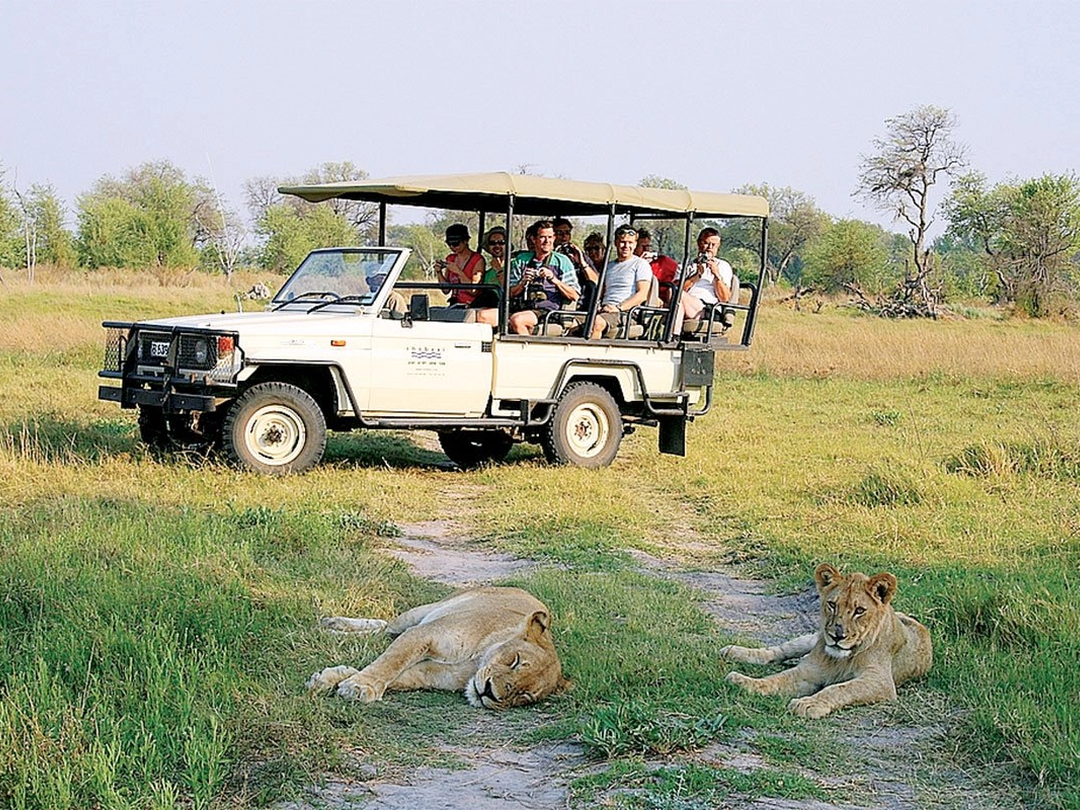
A Chobe game drive is one of the central experiences of visiting Chobe National Park. Safari vehicles explore tracks around the riverfront and surrounding woodland, allowing travelers to search for wildlife that may be difficult or impossible to observe from a boat.
The Chobe Riverfront is particularly productive because permanent water attracts animals throughout the year, with wildlife concentrations often becoming especially impressive as the dry season progresses. Elephants may be encountered moving between woodland and the river, while buffaloes frequently form substantial herds around productive feeding areas.
Giraffes, zebras, impalas, kudus and numerous other antelope species may also be encountered during a Chobe game drive. Warthogs move through the open areas, while baboons and vervet monkeys are frequently seen around woodland and riverine habitats.
Predators add another level of excitement. Lions occur throughout the Chobe ecosystem and may sometimes be found resting near game-rich areas or moving through woodland. Leopards are more secretive and require patience and good fortune, while spotted hyenas and jackals can also be encountered.
An experienced safari guide is particularly valuable because game viewing involves much more than simply driving through the park. Guides look for tracks, alarm calls, animal movements and behavior that may indicate the presence of predators or large herds nearby.
Morning and late-afternoon game drives are often especially rewarding because temperatures are cooler and many animals are more active. Early morning light can also provide excellent conditions for photography, while evening drives can reveal dramatic golden light across the riverfront.
The dry season can produce particularly concentrated wildlife viewing around the Chobe River because water becomes increasingly important to animals. During greener months, the environment changes substantially, with lush vegetation, migrant birds and seasonal wildlife activity creating a different but equally interesting safari atmosphere.
A game drive also allows travelers to appreciate how diverse Chobe National Park is. Although the riverfront receives much of the attention, woodland, floodplains and open areas each support different wildlife communities.
For anyone planning a Victoria Falls and Chobe Safari, the game drive is an essential activity because it provides the classic overland wildlife experience that contrasts beautifully with both Victoria Falls and the river-based safari.
Chobe River Boat Safari
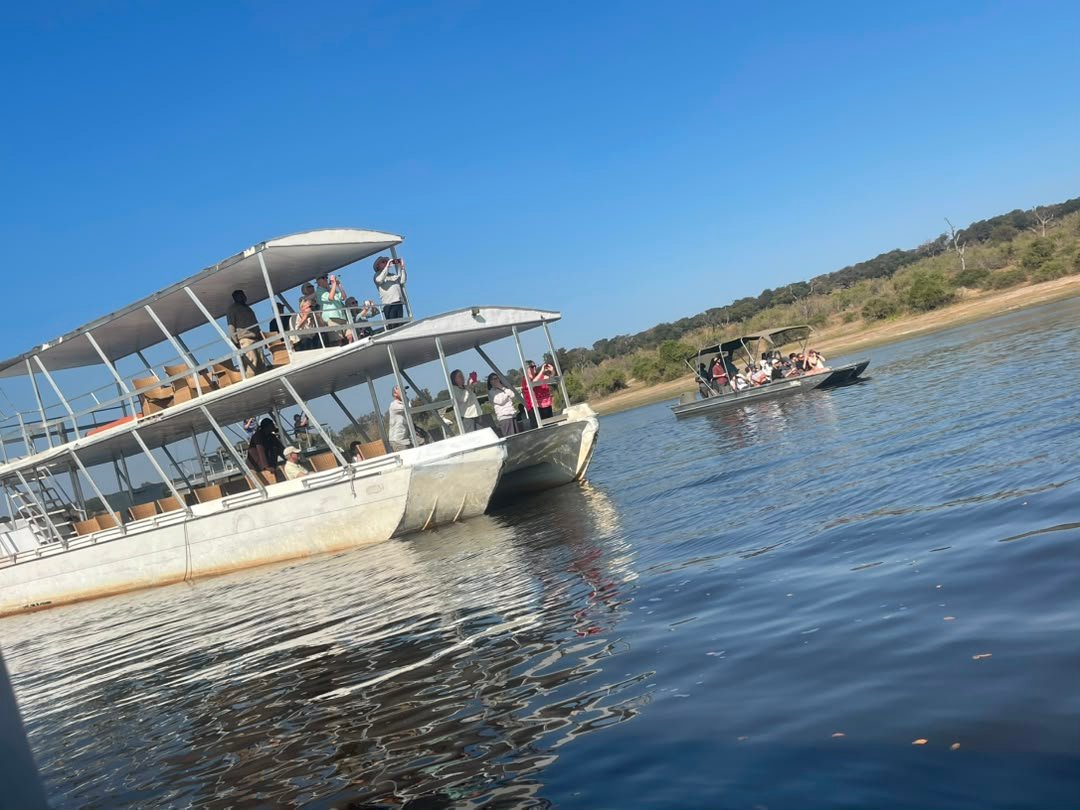
A Chobe River boat safari is one of the experiences that makes Chobe National Park particularly distinctive. While many African national parks are explored primarily by safari vehicle, Chobe allows travelers to observe wildlife directly from the river, often at remarkably close range.
The Chobe River forms a vital water source for wildlife, particularly during the dry season. Elephants frequently approach the riverbanks to drink, bathe and cool themselves, and travelers may sometimes watch entire family groups moving toward the water together.
One of the most memorable sights is watching elephants enter shallow sections of the river. Depending on conditions, individuals may wade through the water or swim between islands and riverbanks while using their trunks above the surface. These moments can create some of the most distinctive wildlife photographs of a Southern African safari.
Hippos are another major attraction of the Chobe River. They can often be seen partly submerged in the water during the daytime, while crocodiles may rest along exposed banks or move silently through the shallows.
Buffaloes frequently gather close to the river, while antelopes, giraffes and other animals may approach the shoreline to drink. The open visibility from a boat often makes it easier to watch these interactions without vegetation blocking the view.
Birdlife is exceptional along the river. Fish eagles, kingfishers, herons, egrets, cormorants and many other water-associated species can be encountered, making the boat safari particularly rewarding for birdwatchers and photographers.
Photography is one of the strongest advantages of a Chobe River cruise. Boats provide relatively low viewing angles, allowing photographers to capture wildlife almost at eye level. Reflections, sunsets and wide river landscapes add another dimension that is difficult to reproduce during a vehicle safari.
For couples and honeymoon travelers, a private or smaller boat can create a more intimate experience. Families and groups may prefer larger shared vessels, depending on budget and travel style.
Combining a river safari with a game drive gives visitors a broader understanding of Chobe because the two experiences rarely produce exactly the same sightings. This variety is one of the reasons a Victoria Falls and Chobe Safari can feel so complete even when the itinerary lasts only a few days.
Wildlife to See in Chobe
Chobe National Park is renowned for its wildlife diversity, but elephants are unquestionably its most famous residents. The wider Chobe ecosystem supports extremely large elephant populations, and the riverfront provides some of Southern Africa’s most memorable opportunities to observe them interacting naturally around water.
Visitors may see solitary bulls, small family groups or substantial herds depending on season and location. Watching elephants drink, feed, communicate and care for young calves can easily become one of the highlights of a safari.
African buffaloes are also frequently encountered, sometimes forming impressive herds near the river and surrounding floodplains. Their presence can attract predators, particularly lions, creating opportunities for fascinating wildlife interactions.
Lions are among Chobe’s most sought-after predators. Sightings may occur around the riverfront, woodland or areas where prey is concentrated. Guides often look for tracks, animal alarm calls and unusual movements among herbivores when searching for lions.
Leopards are present but more elusive. Their solitary habits and preference for cover make sightings less predictable, which means encountering one can become a particularly memorable moment.
Other predators include spotted hyenas, jackals and smaller carnivores. African wild dogs occur within the wider northern Botswana ecosystem but are highly mobile and cannot be expected on every visit.
Large herbivores include giraffes, zebras, wildebeest and numerous antelopes, including kudu, impala, waterbuck and other species adapted to the park’s varied habitats.
Along the river, travelers can watch hippos and Nile crocodiles, while troops of baboons and vervet monkeys are frequently encountered along riverine woodland.
Birdwatchers can enjoy an impressive range of species. African fish eagles are particularly characteristic of the river, while kingfishers, bee-eaters, herons, storks, egrets, raptors and many smaller species contribute to Chobe’s outstanding birding experience.
Wildlife sightings naturally vary according to season, weather and animal movements. No responsible safari can guarantee every species, which is one reason repeated game drives and boat trips are valuable.
The concentration and variety of animals make Chobe an outstanding wildlife extension to Victoria Falls, especially for travelers who want elephants and river-based game viewing to form a major part of their Victoria Falls and Chobe Safari.
Victoria Falls and Chobe Multi-Day Safari
Travelers with more time should strongly consider a multi-day Victoria Falls and Chobe itinerary rather than restricting Chobe to a single day trip. Spending several nights between the two destinations allows the journey to develop at a more relaxed pace and provides substantially more opportunities for wildlife encounters.
A short itinerary might begin with two nights in Victoria Falls. On the first day, travelers can arrive and enjoy an afternoon or evening Zambezi River cruise. The following day can be devoted to a guided walking tour of Victoria Falls, followed by a helicopter flight or another optional activity.
The safari can then continue overland to Chobe, with one or more nights near Kasane or inside the wider safari area. An afternoon river cruise provides an excellent introduction to the park before a morning game drive the following day.
A four-day itinerary can work well for travelers with limited time, while five or six days provide a more comfortable pace. An example might include two nights at Victoria Falls and two or three nights in Chobe.
Staying overnight in Chobe provides several advantages over a day trip. Guests can begin activities early without first completing a border crossing that morning, giving them access to cooler temperatures and early wildlife activity. They can also experience sunset on the river and return for additional drives the following day.
Multiple safari activities increase the probability of varied sightings. One game drive might produce elephants and buffaloes, while another could reveal lions or other predators. Similarly, river cruises on different afternoons can produce completely different wildlife encounters.
Multi-day safaris are also better suited to photography. Photographers benefit from repeated opportunities to work with morning and evening light rather than being limited to whatever conditions occur during a single visit.
Accommodation can be adapted to different budgets. Travelers may choose comfortable hotels around Kasane, safari lodges near the Chobe River or higher-end properties offering more exclusive experiences.
Couples and honeymooners can create a particularly romantic combination by pairing a luxury lodge overlooking the Zambezi near Victoria Falls with a riverside safari property in Botswana. Families can choose lodges with family rooms and activities appropriate to children’s ages.
Travelers with a week or more can extend the journey farther into Botswana, including destinations such as the Okavango Delta, or add Hwange National Park in Zimbabwe to create an even more comprehensive wildlife circuit.
The strongest advantage of a multi-day itinerary is balance. Victoria Falls provides spectacular scenery, history, river activities and adventure, while Chobe provides intensive wildlife viewing. Neither destination needs to be rushed, and each contributes something completely different to the journey.
For first-time visitors to Southern Africa, a well-planned Victoria Falls and Chobe Safari is particularly appealing because it delivers two of the region’s defining experiences within one relatively compact route: standing beside the immense Victoria Falls and watching African wildlife along the Chobe River.
Victoria Falls and Hwange Safari
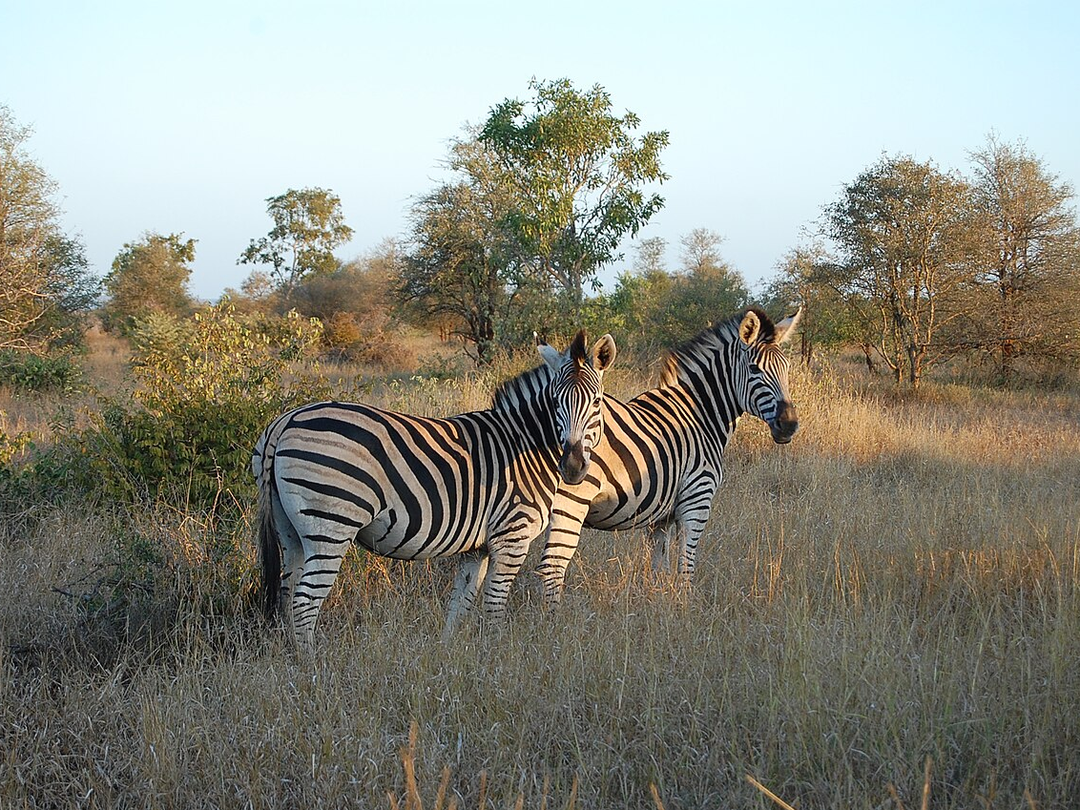
Combining Victoria Falls with Hwange National Park creates one of Zimbabwe’s strongest safari itineraries, bringing together a world-famous natural wonder and one of Southern Africa’s most important wildlife areas. For travelers planning a safari to Victoria Falls, adding Hwange transforms the journey from a waterfall-focused holiday into a complete African safari with game drives, wilderness landscapes, large elephant populations, predators, birdlife and memorable evenings in the bush.
Victoria Falls and Hwange complement each other particularly well because they offer completely different experiences without requiring complicated international border crossings. Victoria Falls is dominated by the Zambezi River, dramatic viewpoints, rainforest walks, sunset cruises and adventure activities, while Hwange delivers the quieter rhythm of traditional safari travel through woodland, open plains, waterholes and vast protected landscapes.
A well-planned Victoria Falls and Hwange itinerary can work for couples, honeymooners, families, photographers, first-time visitors to Africa and experienced safari travelers. Those beginning with a safari to Victoria Falls can spend two or three nights exploring the waterfall before continuing into Hwange for several days of wildlife viewing, creating an itinerary that balances scenery, relaxation and serious game viewing.
Why Combine Victoria Falls with Hwange?
One of the biggest advantages of combining Victoria Falls with Hwange is convenience. Both destinations are located in Zimbabwe, meaning travelers can move between them without the additional immigration procedures required for a cross-border extension into Botswana or Zambia. This makes Hwange particularly attractive for visitors who want a straightforward wildlife extension after a safari to Victoria Falls.
The two destinations also complement each other naturally. Victoria Falls provides one of Africa’s most dramatic landscape experiences, while Hwange offers extensive wilderness and the chance to spend several days searching for wildlife. Instead of repeating similar activities, travelers experience two distinctly different sides of Zimbabwe.
Victoria Falls days may involve walking through the rainforest beside the waterfall, cruising the upper Zambezi River at sunset, taking a scenic helicopter flight or visiting cultural attractions. Once in Hwange, the focus shifts almost completely toward nature. Early mornings begin with game drives, afternoons may be spent watching wildlife around waterholes, and evenings are characterized by the sounds of the African bush.
Hwange is especially famous for elephants. During the dry season, large numbers of elephants depend on permanent and pumped water sources across the park, sometimes producing impressive concentrations around individual waterholes. Watching elephant families approach water, drink, bathe and interact is one of the experiences most closely associated with a Hwange safari.
The park is not only about elephants. Lions, leopards, African wild dogs, spotted hyenas, buffaloes, giraffes, zebras and numerous antelope species inhabit its varied landscapes. Repeated game drives allow travelers to observe a much broader range of wildlife behavior than would normally be possible during a short excursion close to Victoria Falls.
Adding Hwange is also valuable for travelers interested in photography. Victoria Falls provides dramatic landscape photography, while Hwange creates opportunities for wildlife portraits, predator encounters, elephant herds, waterhole scenes and golden-hour safari landscapes.
For this reason, travelers who want both scenery and wildlife often find that combining Hwange with a safari to Victoria Falls provides a far more complete Zimbabwe experience than visiting either destination alone.
Getting from Victoria Falls to Hwange
Traveling from Victoria Falls to Hwange National Park is relatively straightforward, which is one reason this combination works so well. Hwange lies south of Victoria Falls, and travelers can reach different sections of the park by road, rail arrangements or selected air transfers depending on budget, lodge location and preferred travel style.
Road transfers are among the most common options. A professional safari driver can collect guests from their Victoria Falls hotel and transfer them directly toward Hwange. The journey allows travelers to see more of the Zimbabwean countryside while moving naturally from the tourism center of Victoria Falls into increasingly wild landscapes.
Travel time depends strongly on the particular lodge or camp being visited. Hwange is an enormous national park, and properties are located in different sectors. A lodge near the northern approaches will naturally require less driving than a remote camp situated deeper inside the park.
For this reason, travelers should not evaluate a Victoria Falls–Hwange journey only by the distance to the park entrance. The final lodge location is more important when estimating the actual transfer time.
Some luxury travelers may prefer light-aircraft transfers where available. Flying reduces road time and can provide impressive aerial perspectives over the landscape. This option is particularly useful for travelers staying at remote camps or incorporating several safari destinations within a limited number of days.
Road transfers, however, often offer better value and work well for many mid-range and private safari itineraries. They also allow the journey to become part of the safari rather than simply a connection between two hotels.
The route can be planned in either direction. Travelers may begin with a safari to Victoria Falls and then continue to Hwange, or start their Zimbabwe journey with several wilderness nights before finishing at Victoria Falls. Ending at the falls can be particularly attractive for travelers who want a more relaxed conclusion after several early-morning safari activities.
The best transport option depends on the lodge, overall itinerary, number of travelers and budget. A properly designed safari should coordinate the transfer so that valuable game-viewing time is not lost unnecessarily.
Game Drives in Hwange National Park
Game drives are the heart of a Hwange National Park safari. The park’s huge size and varied habitats mean every drive can produce a different experience, from quiet woodland filled with antelope to busy waterholes surrounded by elephants, buffaloes and other animals.
Morning game drives usually begin early, when temperatures are cooler and wildlife activity can be high. Predators may still be moving after the night, while herbivores begin feeding in the softer morning light. Early hours are also excellent for photographers because the low-angle sunlight creates attractive conditions for both wildlife and landscapes.
Guides use knowledge of animal behavior, tracks, calls and recent sightings to determine where to search. Instead of driving randomly through the park, experienced guides interpret signs in the environment to increase the chances of meaningful wildlife encounters.
Waterholes play an especially important role during the dry season. As natural water becomes less widely available, elephants and other animals increasingly depend on reliable water sources. Some game drives therefore spend significant time around productive waterholes, where visitors can observe interactions between multiple species.
Afternoon drives offer a different experience. As the hottest part of the day passes, animals may become more active again. The late-afternoon light can be spectacular, particularly when elephants, giraffes or antelopes move across open areas against the warm African sunset.
Repeated game drives are important because no two safaris are identical. One morning might produce large elephant herds, while the following afternoon could bring lions, wild dogs or a leopard. Wildlife movements remain natural and unpredictable, which is part of the appeal.
Travelers combining Hwange with a safari to Victoria Falls should ideally avoid treating the park as a rushed one-night stop. The true value of Hwange becomes clearer when visitors have enough time for several drives and can experience different areas, times of day and wildlife conditions.
Wildlife in Hwange
Hwange National Park is one of Zimbabwe’s most important wildlife destinations and supports an impressive diversity of mammals and birds. Elephants are its most famous residents, and the park is particularly well known for the large numbers that congregate around water sources during the dry season.
Watching elephants in Hwange can be remarkably varied. Visitors may encounter large breeding herds with calves, solitary bulls, groups approaching waterholes or individuals feeding quietly in woodland. Their behavior around water often produces some of the most memorable safari moments.
Lions are another major attraction. Prides occur across the park, and their movements often follow concentrations of prey. Early mornings can provide good opportunities to search for tracks or locate lions before they retreat into shade during warmer periods.
Leopards are also present but are considerably more secretive. Their camouflage, solitary behavior and preference for cover make sightings less predictable. Encountering one therefore becomes particularly rewarding.
Hwange is also an important habitat for African wild dogs, one of Africa’s most endangered and fascinating predators. Wild dogs are highly mobile and sightings can never be guaranteed, but finding a pack interacting, resting or hunting can become a highlight of an entire safari.
Spotted hyenas contribute another dimension to predator viewing, particularly around areas with significant prey concentrations. Their complex social behavior and nighttime activity make them much more interesting than the scavenger stereotype often associated with them.
Large herbivores include buffaloes, giraffes, zebras and numerous antelope species. Kudu, impala, sable and other species may be encountered depending on the area and season. Warthogs, baboons and smaller mammals add even more variety.
Birdlife is exceptional, with hundreds of recorded species occupying woodland, grassland, waterhole and seasonal wetland environments. Raptors, hornbills, rollers, waterbirds and many smaller species make Hwange rewarding even between major mammal sightings.
Season has an important influence on wildlife viewing. During the dry period, animals become increasingly concentrated around water and vegetation is generally thinner. During greener months, the landscape becomes lush, birdlife can be outstanding and young animals may add interest to game drives.
This wildlife diversity is what makes Hwange such a strong continuation of a safari to Victoria Falls, particularly for travelers who want their Zimbabwe journey to include several days of genuine wilderness rather than only short wildlife excursions.
Recommended Number of Days
The ideal number of days for a Victoria Falls and Hwange safari depends on available travel time, but travelers should allow enough time for both destinations to feel meaningful rather than rushed.
For Victoria Falls itself, two to three nights generally provide a comfortable introduction. This allows time for a guided waterfall tour, a Zambezi sunset cruise and at least one additional experience such as a helicopter flight, cultural excursion or nearby game drive.
For Hwange National Park, at least two to three nights are strongly recommended. Two nights provide a basic introduction with several game drives, but three nights offer a noticeably better safari experience because travelers gain additional morning and afternoon wildlife sessions.
A five-day trip can therefore work as a relatively short combination, although it will be fairly active. Travelers may spend two nights around Victoria Falls and two nights in Hwange, with transfer time incorporated between them.
A six- or seven-day itinerary is more comfortable. Three nights around Victoria Falls combined with three nights in Hwange gives travelers enough time to experience both destinations properly without feeling that every day is dominated by transfers.
Travelers focused heavily on wildlife photography may prefer four or more nights in Hwange. More game drives create more opportunities to work with changing light, animal behavior and unpredictable predator sightings.
Families may also benefit from a slightly slower itinerary. Instead of scheduling long activities every day, additional nights make it possible to include downtime at the lodge between game drives.
Honeymooners and luxury travelers can comfortably spend seven or eight days combining high-end lodges around Victoria Falls with an exclusive safari camp in Hwange. Private activities, scenic flights and slower transitions can make the journey feel more relaxed and personalized.
For most first-time visitors, six to seven days provides an excellent balance. This allows enough time for the waterfall and Zambezi experiences while still dedicating several full wildlife sessions to Hwange.
A traveler planning a safari to Victoria Falls should therefore consider Hwange not merely as an optional excursion, but as one of the strongest ways to turn a Victoria Falls holiday into a complete Zimbabwe safari. With convenient connections, outstanding elephant viewing, diverse predators, productive waterholes and extensive wilderness, Victoria Falls and Hwange together create one of Southern Africa’s most rewarding safari combinations.
Best Safari Itineraries to Victoria Falls
The best Victoria Falls itinerary depends on how much time you have and whether your priority is the waterfall itself, wildlife viewing, adventure activities or a wider Southern African journey. Travelers can experience the essential highlights in two or three days, but adding Chobe National Park, Hwange National Park or both creates a much richer safari experience. For travelers planning a safari to Victoria Falls, the most successful itineraries balance waterfall sightseeing with the Zambezi River, game drives, boat safaris and enough time to enjoy each destination without rushing between borders and lodges.
Short itineraries are ideal for travelers adding Victoria Falls to a larger African holiday, while five- to seven-day trips provide enough time to combine the waterfall with serious wildlife viewing. A ten-day itinerary allows Victoria Falls to become part of a broader Southern African safari incorporating Zimbabwe and Botswana, with opportunities to experience several different ecosystems.
2-Day Victoria Falls Safari
A 2-day Victoria Falls safari is the shortest practical itinerary for travelers who want to experience the waterfall and at least one of the major activities surrounding the Zambezi River. It works particularly well for travelers passing through Zimbabwe or Zambia, visitors combining Victoria Falls with another established safari itinerary or travelers whose international flight schedule allows only a brief stay.
For travelers beginning a safari to Victoria Falls, the first day can start with arrival at Victoria Falls International Airport in Zimbabwe or Livingstone Airport in Zambia. After a private transfer and hotel check-in, the afternoon can be kept relatively relaxed. One of the best ways to begin is with a Zambezi River sunset cruise, allowing travelers to settle into the destination while watching the river, birdlife and possibly elephants, hippos or crocodiles along the banks.
The second day should focus primarily on Victoria Falls itself. An early guided walking tour provides enough time to explore the main viewpoints before the day becomes busier. Travelers staying on the Zimbabwe side can follow the rainforest trail overlooking the different sections of the waterfall, while those based in Zambia can explore the viewpoints around Mosi-oa-Tunya and Knife-Edge Bridge.
If time permits, a helicopter flight can follow the walking tour. Seeing Victoria Falls from the air provides a completely different perspective and reveals the full width of the waterfall, the upper Zambezi and the succession of gorges downstream.
A typical two-day itinerary may therefore include:
Day 1: Arrival – Transfer to hotel – Afternoon at leisure – Zambezi sunset cruise.
Day 2: Guided Victoria Falls walking tour – Optional helicopter flight – Transfer to airport or onward destination.
The limitation of a two-day safari is that there is little time for substantial wildlife viewing. Travelers wanting a game drive can replace the helicopter flight or sunset cruise with a visit to Zambezi National Park or Mosi-oa-Tunya National Park, but this makes the schedule considerably tighter.
For travelers interested primarily in Victoria Falls itself, however, two days can provide an excellent introduction and can easily be incorporated before continuing to Chobe, Hwange, Cape Town or another Southern African destination.
3-Day Victoria Falls Safari
A 3-day Victoria Falls safari provides a much better balance between sightseeing, the Zambezi River and optional wildlife or adventure activities. The additional night gives travelers enough flexibility to enjoy the waterfall without trying to fit everything into a single full day.
A three-day safari to Victoria Falls itinerary can begin with airport collection and transfer to a hotel in Victoria Falls town or Livingstone. After settling in, travelers can enjoy an afternoon sunset cruise on the upper Zambezi. This relaxed activity is an excellent introduction because it contrasts sharply with the dramatic waterfall experienced the following morning.
Day two should be devoted to Victoria Falls. An early guided walk allows travelers to visit the most important viewpoints while learning about the geology, history and ecology of the waterfall. Those interested in photography can spend additional time along the trails, particularly when sunlight and spray create rainbow effects.
The afternoon can then be used for a scenic helicopter flight, cultural experience or a second perspective of the falls from the neighboring country. Travelers based in Zimbabwe may cross into Zambia, while those staying in Livingstone can explore the Zimbabwean viewpoints, subject to visa and immigration requirements.
Day three provides flexibility for wildlife or adventure. Travelers interested in game viewing can choose a morning safari in Zambezi National Park, a rhino-focused experience in a nearby private reserve or a wildlife activity in Mosi-oa-Tunya National Park. Adventurous visitors may instead choose white-water rafting, gorge activities or seasonal experiences such as Livingstone Island.
A possible itinerary is:
Day 1: Arrival – Hotel transfer – Zambezi sunset cruise.
Day 2: Guided Victoria Falls tour – Lunch – Helicopter flight or visit to the opposite side of the falls.
Day 3: Morning game drive, nature experience or adventure activity – Departure.
Three days are especially suitable for couples, honeymooners and first-time travelers who want to experience the main attractions without committing to a longer wildlife circuit.
4-Day Victoria Falls and Chobe Safari
A 4-day Victoria Falls and Chobe safari is one of the strongest short multi-country itineraries available in Southern Africa. It combines the natural spectacle of Victoria Falls with the wildlife-rich Chobe Riverfront in Botswana, allowing travelers to experience both waterfall sightseeing and traditional African game viewing within only a few days.
For someone planning a safari to Victoria Falls, spending the first two nights near the waterfall provides time for a guided tour, sunset cruise and optional helicopter flight. The itinerary can then continue by road to the Kasane and Chobe region.
Day one can begin with arrival in Victoria Falls and a late-afternoon Zambezi cruise. Day two is dedicated to the waterfall, with a guided walk followed by an optional scenic flight.
On day three, travelers transfer toward Botswana, complete border formalities and continue to Chobe. Depending on arrival time, the afternoon can include a Chobe River boat safari. This activity is particularly rewarding because elephants, buffaloes, hippos, crocodiles and numerous bird species may be encountered around the river.
Day four can begin with an early Chobe game drive. Cooler morning temperatures often provide excellent wildlife activity, and the vehicle safari creates opportunities to search for lions, leopards, giraffes, zebras and other species away from the river.
A possible itinerary is:
Day 1: Arrival in Victoria Falls – Zambezi sunset cruise.
Day 2: Guided Victoria Falls walking tour – Optional helicopter flight.
Day 3: Transfer to Botswana – Chobe River boat safari – Overnight near Chobe.
Day 4: Morning Chobe game drive – Transfer to Kasane Airport, Victoria Falls or onward destination.
Four days is relatively compact, so travelers who have more time should consider adding another night in Chobe. However, this itinerary works exceptionally well for visitors wanting a short combination of a world-famous natural wonder and one of Botswana’s leading wildlife destinations.
5-Day Victoria Falls and Hwange Safari
A 5-day Victoria Falls and Hwange safari creates an excellent Zimbabwe-only itinerary for travelers who want to avoid additional international border crossings while still combining Victoria Falls with a serious wildlife destination.
Travelers beginning a safari to Victoria Falls can spend the first two days exploring the waterfall before continuing south toward Hwange National Park. Because both destinations are in Zimbabwe, the transition is straightforward and can be organized by private road transfer or, for selected lodge locations, light aircraft.
Day one begins with arrival and a Zambezi sunset cruise. Day two focuses on the waterfall, with a guided walk and optional helicopter flight.
On day three, travelers transfer to Hwange National Park. Depending on the lodge and arrival time, an afternoon game drive may be possible. This first safari introduces the park’s woodland, waterholes and large wildlife populations.
Day four is dedicated entirely to Hwange. Morning and afternoon game drives provide opportunities to search for elephants, lions, buffaloes, giraffes, zebras, African wild dogs, hyenas and numerous antelope species. During the dry season, waterholes can become especially productive as animals gather around permanent water.
Day five can include a final morning drive before transferring back toward Victoria Falls, another regional airport or the next safari destination.
A possible itinerary is:
Day 1: Arrival in Victoria Falls – Sunset cruise.
Day 2: Guided Victoria Falls tour – Scenic helicopter flight.
Day 3: Transfer to Hwange – Afternoon game drive.
Day 4: Full-day Hwange safari with morning and afternoon game drives.
Day 5: Morning game drive – Departure or transfer onward.
This itinerary is particularly attractive to travelers whose priority is wildlife but who still want Victoria Falls to form a major part of their journey. Two nights in Hwange provides an introduction, although three or four nights would be preferable for travelers with additional time.
7-Day Victoria Falls, Chobe and Hwange Safari
A 7-day Victoria Falls, Chobe and Hwange safari offers one of the best-balanced itineraries for travelers wanting to experience three major Southern African highlights within one journey. It combines the waterfall and Zambezi River with the extensive wilderness of Hwange National Park and the river-based wildlife experiences of Chobe National Park.
For travelers seeking more than a short a safari to Victoria Falls, seven days provides enough time to slow the journey down and experience repeated wildlife activities rather than simply passing through each destination.
The journey can begin with two nights at Victoria Falls. The first afternoon is ideal for a Zambezi sunset cruise, while day two can include a guided waterfall tour and scenic helicopter flight.
On day three, travelers transfer to Hwange National Park. An afternoon safari may provide the first opportunity to encounter elephants, giraffes, buffaloes or predators.
Day four is devoted to Hwange with morning and afternoon game drives. Spending a full day in the park is important because wildlife activity changes according to time, temperature and water availability.
On day five, the safari returns toward Victoria Falls before continuing toward Botswana and the Chobe region, depending on the chosen routing. After border formalities, travelers settle into a lodge near Kasane or the Chobe River.
Day six can provide the classic Chobe combination: a morning game drive and afternoon boat safari. These two activities complement one another because the vehicle explores woodland and riverfront tracks while the boat provides close perspectives of wildlife using the Chobe River.
Day seven allows for a final morning activity or transfer to Kasane Airport, Victoria Falls or another onward destination.
A suggested itinerary is:
Day 1: Arrival at Victoria Falls – Zambezi sunset cruise.
Day 2: Guided Victoria Falls tour – Optional helicopter flight.
Day 3: Transfer to Hwange – Afternoon safari.
Day 4: Full-day Hwange wildlife experience.
Day 5: Transfer from Hwange through Victoria Falls toward Chobe – Overnight in Botswana.
Day 6: Chobe game drive – Chobe River boat safari.
Day 7: Optional morning activity – Departure.
The route can also be operated in reverse depending on flights and accommodation availability.
Seven days gives travelers enough time to see elephants in very different environments. Hwange offers classic waterhole and woodland encounters, while Chobe provides the memorable experience of watching elephants beside or inside the river.
10-Day Southern Africa Safari with Victoria Falls
A 10-day Southern Africa safari with Victoria Falls is ideal for travelers who want Victoria Falls to form part of a more comprehensive journey rather than functioning as a standalone attraction. Ten days provide enough time to combine several nights at Victoria Falls with both Hwange and Chobe while maintaining a relaxed safari rhythm.
A longer safari to Victoria Falls itinerary should avoid the temptation to add too many destinations. Spending two or three nights in each major area generally produces a better experience than visiting numerous parks for only a single night.
The safari can begin with three days around Victoria Falls. After arrival, travelers enjoy an afternoon Zambezi sunset cruise. The following day includes a guided tour of the falls and optional scenic flight. A third day provides time for a local wildlife experience, cultural excursion, rafting adventure or exploration of the opposite side of the waterfall.
Days four through six can be dedicated to Hwange National Park. A three-night stay significantly improves the wildlife experience because guests can participate in repeated game drives and explore different sections of the park. Early mornings may focus on predators while afternoon drives can concentrate on productive waterholes and elephant activity.
On day seven, travelers transfer toward Chobe National Park in Botswana. After entering Botswana and reaching the Kasane area, the afternoon can be spent relaxing at the lodge or enjoying an introductory river activity.
Days eight and nine provide comprehensive Chobe wildlife viewing. A combination of game drives and boat safaris allows travelers to explore both land and water environments. Spending more than one night also gives photographers multiple opportunities to experience different light and wildlife behavior.
Day ten can include a final safari activity before departure from Kasane or a return transfer to Victoria Falls or Livingstone for an international connection.
A sample itinerary is:
Day 1: Arrival in Victoria Falls – Transfer to lodge – Sunset cruise.
Day 2: Guided Victoria Falls walking tour – Helicopter flight.
Day 3: Zambezi National Park game drive, cultural experience or adventure activity.
Day 4: Transfer to Hwange National Park – Afternoon safari.
Day 5: Morning and afternoon Hwange game drives.
Day 6: Full day in Hwange – Wildlife viewing and waterhole experiences.
Day 7: Transfer from Hwange toward Chobe National Park – Overnight Botswana.
Day 8: Morning Chobe game drive – Afternoon Chobe River boat safari.
Day 9: Additional Chobe safari activities – Relaxation at the lodge.
Day 10: Final morning activity – Transfer to airport – Departure.
This itinerary provides a particularly strong progression. Victoria Falls introduces travelers to the Zambezi landscape and one of the world’s great natural attractions. Hwange then moves the journey into a much larger wilderness environment focused on predators, elephants and traditional game drives. Chobe concludes the safari with spectacular river-based wildlife viewing and another opportunity to experience large concentrations of elephants.
For travelers with additional time, the itinerary can continue into the Okavango Delta, adding mokoro excursions and wetland landscapes. Alternatively, Victoria Falls can be combined with destinations such as Cape Town, Kruger National Park or Namibia to create an even broader Southern African journey.
Ultimately, the ideal itinerary depends on the traveler’s priorities. Two or three days are sufficient for visitors primarily interested in Victoria Falls itself. Four or five days allow the waterfall to be combined with either Chobe or Hwange. Seven days creates an excellent three-destination circuit, while ten days provides enough time to experience Victoria Falls, Zimbabwean wilderness and Botswana’s Chobe River without turning the journey into a race between destinations.
Victoria Falls Safari Packages
Victoria Falls safari packages can be designed around very different budgets, travel styles and lengths of stay, making the destination suitable for everyone from first-time African safari travelers to families, honeymooners and luxury guests. A well-designed package normally combines accommodation, airport or road transfers, guided sightseeing at Victoria Falls and selected activities such as Zambezi River cruises, game drives, scenic flights or extensions into nearby national parks.
Travelers planning a safari to Victoria Falls can choose a short two- or three-night waterfall-focused trip or a longer itinerary that combines Victoria Falls with Hwange National Park in Zimbabwe, Chobe National Park in Botswana or wildlife experiences around Livingstone in Zambia. The final price depends on accommodation category, season, number of travelers, private or shared transport, included meals, park fees and the activities selected.
One of the biggest advantages of Victoria Falls is flexibility. Budget travelers can keep costs controlled by using comfortable guesthouses and shared excursions, while luxury travelers can stay in exclusive river lodges, use private transfers and add helicopter flights or private wildlife activities. Families may need larger rooms and a slower itinerary, whereas honeymooners often prefer secluded accommodation and private experiences.
For this reason, travelers should compare Victoria Falls safari packages according to what is included rather than looking at price alone. A cheaper package may exclude park entrance fees, airport transfers or major activities, while a higher-priced itinerary may already include most of the trip’s essential costs.
Budget Victoria Falls Safaris
A budget Victoria Falls safari is ideal for travelers who want to experience the waterfall, the Zambezi River and selected wildlife activities while keeping accommodation and transport costs under control. Budget does not necessarily mean sacrificing the main experience. Instead, the itinerary concentrates spending on important activities while choosing simpler accommodation and shared services.
Travelers arranging a safari to Victoria Falls on a lower budget can stay in guesthouses, hostels, simple lodges or affordable hotels in Victoria Falls town or Livingstone. Properties located slightly farther from the waterfall are sometimes less expensive, although travelers should consider whether additional transport costs offset the savings.
Shared airport transfers and group excursions can also reduce costs. Rather than paying for a private vehicle for every activity, visitors can join scheduled waterfall tours, Zambezi cruises or Chobe day trips with other travelers.
A basic budget package might include two or three nights of accommodation, breakfast, airport transfers, a guided Victoria Falls tour and a sunset cruise. Travelers can then add activities individually according to their interests and available budget.
Budget-conscious visitors interested in wildlife can include a game drive in Zambezi National Park or Mosi-oa-Tunya National Park instead of immediately booking a longer and more expensive safari extension. Those who want to visit Botswana can consider a Chobe day trip rather than staying several nights inside or near the park.
Travel season can also influence cost. Peak safari periods and major holiday dates may attract higher accommodation rates, while selected shoulder-season dates can sometimes provide better value.
Another way to control costs is to avoid changing hotels too frequently. Staying in one base around Victoria Falls and taking day activities reduces repeated transfers and minimizes the logistical expense associated with multi-stop itineraries.
Budget travelers should still make sure that park fees, border costs, visas, meals and optional activities are clearly stated before booking. A seemingly inexpensive package can become much more costly when essential items are excluded.
A well-planned budget safari therefore focuses on value rather than simply finding the lowest possible price. Travelers can still stand beside Victoria Falls, cruise the Zambezi and enjoy African wildlife while using simpler accommodation and shared transport to keep the journey affordable.
Mid-Range Victoria Falls Safaris
A mid-range Victoria Falls safari offers one of the best combinations of comfort, value and included experiences. This category is particularly suitable for travelers who want good-quality accommodation, organized transport and a well-paced itinerary without paying for the highly exclusive services associated with luxury travel.
For many visitors, a safari to Victoria Falls in the mid-range category includes comfortable hotels or safari lodges with private rooms, en-suite bathrooms, reliable service and convenient access to the waterfall or Zambezi River. Meals may include breakfast only, half board or full board depending on the particular property and itinerary.
Private or semi-private transfers are often included, making movement between the airport, hotel and activities much easier. Travelers may also receive more personalized guiding than is typically available in entry-level packages.
A three- or four-day mid-range package can include Victoria Falls sightseeing, a sunset cruise, a game drive and an optional helicopter flight. Travelers with additional time can extend the trip to Chobe or Hwange for several nights.
Mid-range Chobe extensions are particularly attractive because travelers can combine a comfortable lodge around Kasane with both a game drive and Chobe River boat safari. Similarly, Hwange offers numerous comfortable safari lodges that provide excellent wildlife experiences without requiring ultra-luxury accommodation.
The greatest strength of the mid-range category is balance. Guests have enough comfort to relax after long days of sightseeing or game viewing, while overall safari costs remain more manageable than top-end itineraries.
Couples, small groups and mature travelers often find this category especially appropriate. It provides comfortable transport, quality accommodation and organized activities while retaining enough flexibility to personalize the trip.
For many first-time visitors, a mid-range Victoria Falls package provides the strongest overall value because most of the important logistics are already handled while the traveler can still choose selected premium activities.
Luxury Victoria Falls Safaris
A luxury Victoria Falls safari places greater emphasis on exclusivity, location, personalized service and exceptional accommodation. Luxury packages can include riverfront lodges, historic hotels, private safari properties, premium dining and individually tailored activities.
Travelers choosing a safari to Victoria Falls at the luxury level may stay at properties overlooking the Zambezi, close to the waterfall or within private wildlife areas. These lodges often provide spacious suites, high-quality dining, swimming pools, spa facilities and personalized service.
Private transfers are an important part of the luxury experience. Rather than waiting for group departures, travelers can move according to a schedule designed around their own interests. This can be particularly valuable when crossing international borders or connecting with private safari lodges.
Scenic helicopter flights are commonly added to luxury itineraries because they provide one of the most impressive perspectives of Victoria Falls. Travelers may also include private sunset cruises, exclusive dinners, private game drives and specialized photographic experiences.
Luxury packages can easily extend to Hwange National Park, where travelers can stay in intimate safari camps with highly personalized guiding. A longer itinerary may continue into Chobe or the Okavango Delta in Botswana.
The quality of guiding also becomes particularly important at this level. Experienced private guides can adapt game drives around photography, birding or specific wildlife interests rather than following a fixed group schedule.
Honeymooners and anniversary travelers often prefer luxury Victoria Falls packages because accommodation and activities can be arranged around privacy and special occasions. Private dining, upgraded rooms and romantic river experiences can be incorporated into the journey.
Luxury does not simply mean expensive accommodation. The strongest luxury itineraries focus on minimizing unnecessary waiting, improving access to exceptional experiences and allowing guests to travel at a comfortable pace.
Private Victoria Falls Safaris
A private Victoria Falls safari gives travelers much greater control over the itinerary, pace and daily schedule. Instead of joining a fixed group departure, guests travel with dedicated transport and, depending on the package, a private guide.
Choosing a safari to Victoria Falls privately is particularly useful for travelers with specific interests such as photography, birdwatching, wildlife, culture or adventure. A private itinerary can spend more time on the experiences that matter most while reducing time devoted to activities that are less relevant.
Private safaris also work extremely well for couples and small groups. Airport pickups can be coordinated around actual flight times, activities can be scheduled according to preference and stops can be adjusted during road transfers where practical.
Families also benefit from private arrangements because children may require a slower pace, earlier meal times or additional rest periods. A private vehicle makes these adjustments considerably easier than traveling within a large group.
Private trips are especially valuable when combining Victoria Falls with Hwange or Chobe. Cross-border transport, lodge transfers and safari activities can be coordinated as one continuous journey rather than requiring travelers to organize each section separately.
Photographers often prefer private safaris because a dedicated vehicle may allow more time at sightings and greater flexibility around morning and afternoon light. The guide can also prioritize wildlife behavior rather than rushing through a fixed checklist of animals.
Although private safaris normally cost more than shared departures, the difference can become smaller when several people travel together and divide transport costs.
Family Victoria Falls Safaris
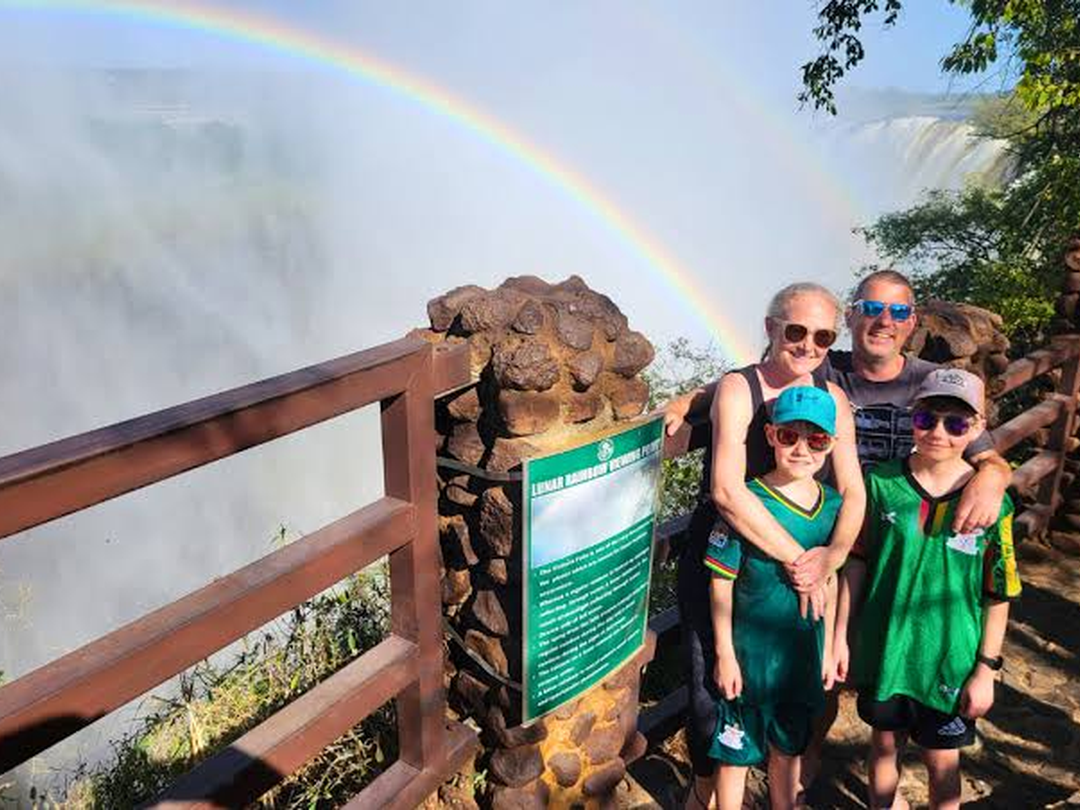
A family Victoria Falls safari can combine education, wildlife, scenery and adventure in a way that keeps both adults and children interested. Victoria Falls is particularly suitable for families because activities are varied rather than being limited to long game drives every day.
Families considering a safari to Victoria Falls can begin with an easy guided waterfall walk, where children can experience the spray, rainforest and dramatic views of the gorge. A sunset cruise provides another relatively relaxed activity and may introduce younger travelers to hippos, crocodiles, birds and other wildlife.
The best family itineraries avoid overloading every day. Children often benefit from shorter activities followed by time at the lodge or swimming pool rather than a continuous program from morning until evening.
Accommodation selection is especially important. Families should look for properties offering family rooms, interconnecting rooms or larger suites. Location can also matter because reducing long transfers makes the safari considerably easier with younger children.
Wildlife activities should be selected according to age restrictions and children’s comfort. A shorter game drive around Victoria Falls may be more appropriate for young children, while older children and teenagers may enjoy Chobe or Hwange extensions.
Chobe can work particularly well for families because boat safaris provide a different style of game viewing from vehicle drives. Watching elephants near the river can be exciting even for children who might struggle with several hours in a safari vehicle.
Adventure activities around Victoria Falls have strict age, height or safety requirements in many cases, so families should confirm these conditions before promising specific experiences to children.
A well-paced family itinerary can therefore combine the waterfall, river activities, wildlife viewing and cultural experiences without making the journey physically exhausting.
Honeymoon Victoria Falls Safaris
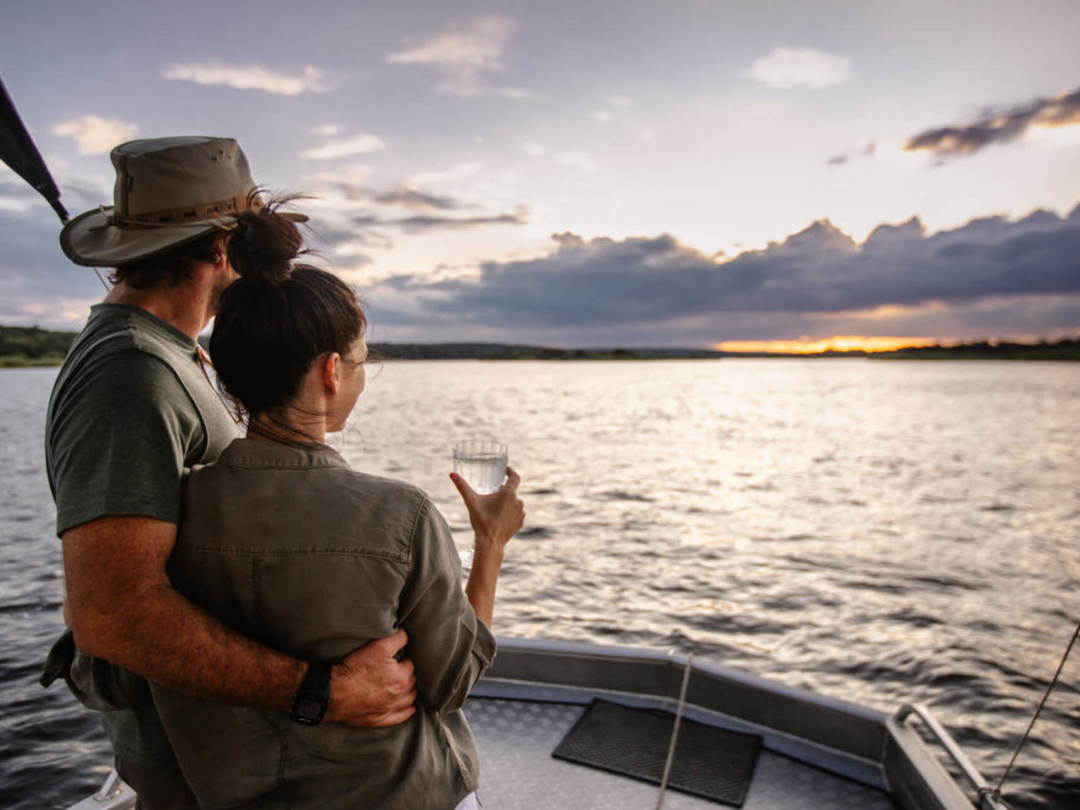
A honeymoon Victoria Falls safari combines some of Southern Africa’s most romantic scenery with intimate lodges, river experiences and wildlife adventures. Victoria Falls works particularly well for honeymooners because couples can combine active sightseeing with quiet moments beside the Zambezi and private safari experiences.
Travelers planning a safari to Victoria Falls for their honeymoon may choose a riverfront lodge, luxury suite or boutique hotel where privacy is emphasized. Properties with balconies, river views, private plunge pools or secluded dining areas can add significantly to the atmosphere of the journey.
A sunset cruise is one of the most natural honeymoon activities. Couples can relax on the Zambezi as the afternoon light changes, enjoying river scenery and possible wildlife sightings before returning to their lodge for dinner.
A helicopter flight over Victoria Falls can also become one of the standout experiences of a honeymoon. The aerial view creates a memorable shared experience and provides exceptional opportunities for photographs.
Couples with more time can extend the journey to Hwange for private game drives and intimate safari camps. Chobe is another excellent addition, particularly for travelers interested in boat safaris and large elephant herds.
Private dinners can be incorporated into selected honeymoon packages, whether on a lodge deck, beside the river or within a safari property. Anniversary surprises, room decorations and other special arrangements may also be possible when organized in advance.
Honeymoon itineraries should avoid excessive movement between hotels. Spending at least two or three nights in each destination usually creates a more romantic and relaxed journey than changing accommodation every night.
Whether travelers choose budget, mid-range, luxury, private, family or honeymoon arrangements, the best Victoria Falls safari packages are those designed around individual priorities rather than a rigid template. Accommodation level, transport, wildlife extensions and activities can all be adjusted according to budget and travel style, allowing Victoria Falls to work equally well as a short getaway or the centerpiece of a longer Southern African safari.
Where to Stay During a Safari to Victoria Falls
Choosing where to stay is an important part of planning a safari to Victoria Falls because accommodation influences how easily you can reach the waterfall, join Zambezi River activities, connect with airport transfers and continue to wildlife destinations such as Hwange National Park or Chobe National Park. Travelers can base themselves in Victoria Falls town on the Zimbabwean side, Livingstone on the Zambian side, or choose a safari lodge farther from the towns for a quieter wilderness atmosphere.
Accommodation around Victoria Falls ranges from backpacker-style properties and affordable guesthouses to comfortable mid-range hotels, historic properties, riverfront lodges and exclusive safari camps. Zimbabwe Tourism officially lists numerous registered hotels in Victoria Falls, including Palm River Hotel, Victoria Falls Safari Lodge, Ilala Lodge, A’Zambezi River Lodge and several other properties, while Zambia Tourism describes Livingstone’s accommodation as ranging from economical B&Bs and guesthouses to sophisticated riverside lodges and villas.
The right choice therefore depends less on finding one universally “best” hotel and more on matching the location to the itinerary. Travelers who want easy access to Victoria Falls may prefer a town hotel, while those prioritizing tranquility, wildlife and river views may enjoy a lodge along the Zambezi. Visitors extending the journey to Botswana or Hwange can also divide their accommodation between Victoria Falls and dedicated safari lodges.
Hotels in Victoria Falls, Zimbabwe
Staying in Victoria Falls, Zimbabwe is one of the most convenient options for travelers whose primary objective is exploring the waterfall. The town has a well-established tourism infrastructure and offers accommodation across several price categories, including hotels, boutique properties, safari-style lodges and affordable establishments. Zimbabwe Tourism’s current registered-operator directory lists properties such as Palm River Hotel, Victoria Falls Safari Lodge, Ilala Lodge, A’Zambezi River Lodge, Rainbow Hotel and N1 Hotel among the accommodation options in Victoria Falls.
For visitors planning a safari to Victoria Falls, staying in town can be particularly practical because many activities begin from or around Victoria Falls itself. Guided waterfall tours, scenic flights, Zambezi cruises, cultural experiences and transfers to nearby wildlife areas can be organized without requiring travelers to move accommodation every day.
Location should be one of the first considerations. Some travelers prefer hotels close enough to the central tourism area that restaurants, shops and activity departure points are easily accessible. Others prefer properties farther from the center where there is more space, greater tranquility and a stronger safari atmosphere.
Travelers wanting a river setting can consider properties positioned around the upper Zambezi. A’Zambezi River Lodge, for example, is officially listed by Zimbabwe Tourism as a four-star Victoria Falls property, demonstrating that visitors do not necessarily need to choose between staying near Victoria Falls and enjoying a more nature-oriented lodge environment.
Another advantage of staying on the Zimbabwean side is the ease of combining Victoria Falls with Zambezi National Park. Zimbabwe Tourism describes the park as lying next to Victoria Falls and notes that several lodges overlook the Zambezi River within the park, creating opportunities for visitors seeking a genuine bush atmosphere without traveling immediately to Hwange.
Couples might prefer boutique-style properties offering quieter surroundings and personalized service, while families may prioritize swimming pools, family rooms and convenient access to meals. Photographers may place greater importance on early transfers to the falls, while travelers planning several excursions might benefit from a centrally located property.
The Zimbabwean side also works particularly well for itineraries continuing to Hwange National Park. Because both destinations are in Zimbabwe, travelers can move from Victoria Falls accommodation to a safari lodge in Hwange without an international border crossing.
Lodges in Livingstone, Zambia
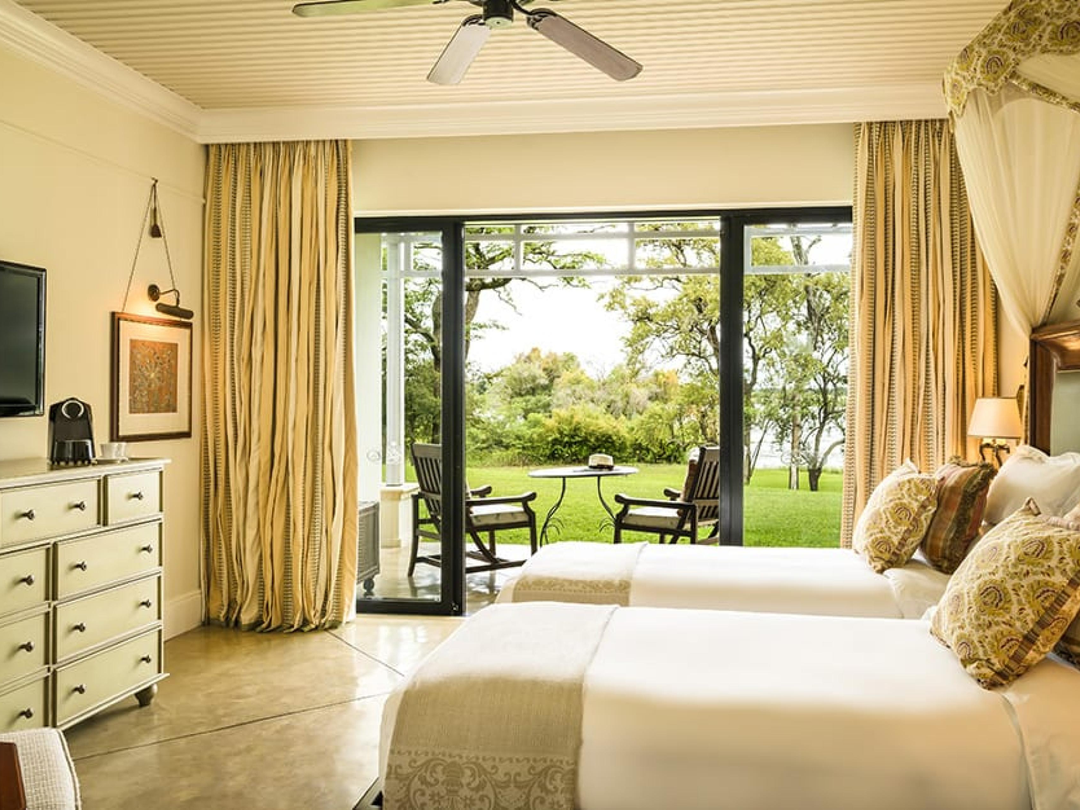
Livingstone, Zambia provides an equally attractive but noticeably different accommodation experience. The city lies close to the Zambian side of Victoria Falls, while many of the area’s most appealing lodges stretch along the upper Zambezi River. Zambia Tourism notes that Livingstone itself is around 10–11 kilometers from the falls and that much of the accommodation on the Zambian side is located along the Zambezi.
Travelers considering a safari to Victoria Falls through Zambia can choose between town hotels, guesthouses, boutique accommodation, safari-style lodges and secluded river properties. Zambia Tourism describes the range as extending from luxury suites and romantic river villas to simple chalets and rustic accommodation, making Livingstone suitable for very different travel budgets.
A riverside lodge can be particularly attractive for guests who want the Zambezi to remain part of the experience even when they are not sightseeing. Mornings may begin with views over the water, while afternoons can be spent on cruises, nature activities or simply relaxing at the lodge.
One current example is The River Club, which Zambia Tourism lists approximately 18 kilometers upstream from Victoria Falls. Its suites overlook the Zambezi, illustrating the type of accommodation available for travelers who value river scenery and a quieter setting away from the center of Livingstone.
Livingstone also provides useful choices for families. Some river lodges combine spacious accommodation with on-site activities, while properties in town can offer greater convenience for families wanting easy access to restaurants, shops and shorter transfers.
Travelers should remember that staying farther upstream on the Zambezi may increase transfer time to Victoria Falls. The trade-off is greater tranquility and a stronger lodge experience. Guests staying close to town may find access to the waterfall and urban facilities easier but may sacrifice some of the peaceful river atmosphere.
Livingstone is especially useful for travelers interested in the Zambian experiences around Mosi-oa-Tunya, Livingstone Island and the upper Zambezi. It also provides convenient onward access toward Botswana for travelers combining Victoria Falls with Chobe.
Luxury Safari Lodges Near Victoria Falls
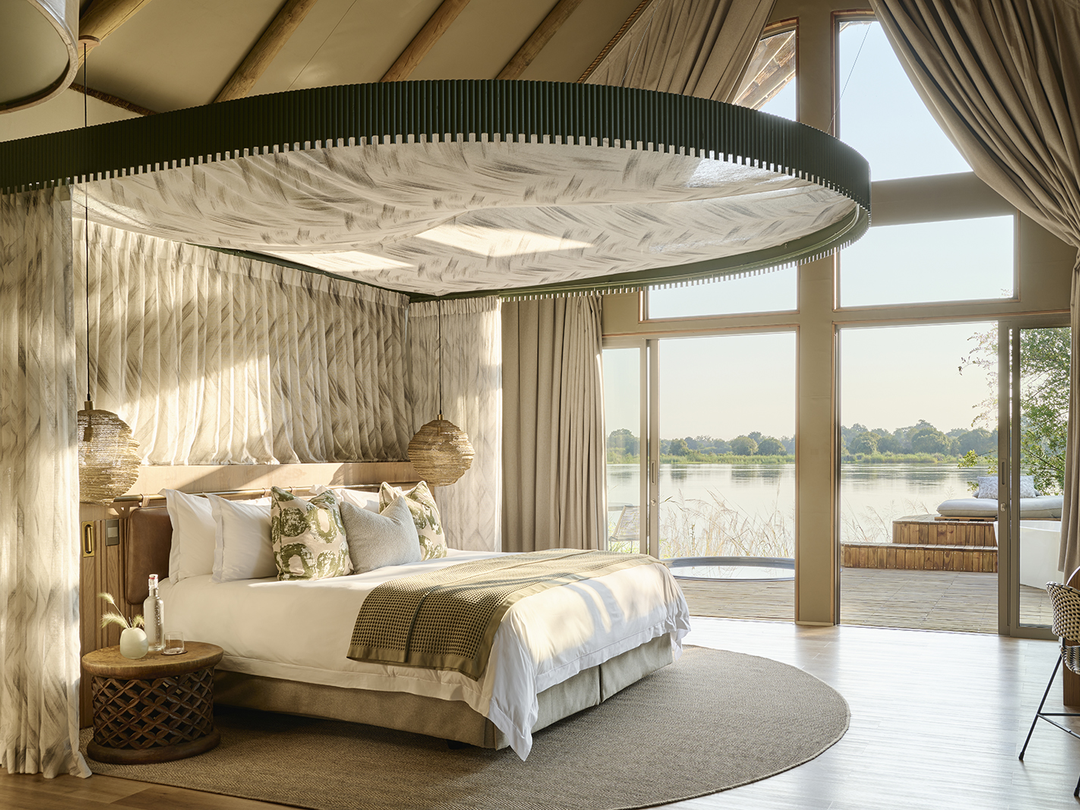
Luxury accommodation can transform a safari to Victoria Falls from a conventional sightseeing stay into a much more immersive Southern African experience. Rather than simply providing an upscale bedroom, the strongest luxury properties combine exceptional locations, private guiding, high-quality dining, river views and carefully designed activities.
Travelers can choose between luxury hotels close to Victoria Falls, Zambezi riverfront lodges and more secluded safari properties. Zimbabwe Tourism highlights properties around Victoria Falls ranging from established hotels to secluded luxury accommodation, including The Elephant Camp and Victoria Falls River Lodge, which is situated in a private reserve within reach of Victoria Falls and offers views toward the surrounding landscape.
Location becomes particularly important at the luxury level. A property overlooking the Zambezi may provide quieter mornings and sunsets, while a lodge within or adjacent to a wildlife area can create a stronger bush experience. Some travelers may therefore choose two different properties—one close to Victoria Falls and another in Hwange or Chobe—instead of remaining in the same hotel throughout the safari.
Luxury travelers may also prioritize private transfers. Having a dedicated vehicle can make airport pickups, international border crossings and lodge connections easier, particularly when traveling between Zimbabwe, Zambia and Botswana.
Honeymooners can benefit from secluded suites, private decks and river views, while families may prefer larger villas or interconnected accommodation. Serious photographers might prioritize lodges that provide private vehicles or more flexible safari schedules.
Luxury should therefore be evaluated according to the entire experience rather than star rating alone. A smaller lodge with excellent guiding and an exceptional location may provide a more memorable safari than a larger hotel offering more conventional facilities.
Budget Accommodation
Budget travelers have plenty of opportunities to experience Victoria Falls without directing most of their holiday budget toward accommodation. Both Victoria Falls and Livingstone provide economical options, including guesthouses, B&Bs, basic hotels, hostels, permanent tents and camping-style accommodation.
For someone planning a safari to Victoria Falls on a controlled budget, the goal should be to reduce accommodation costs without sacrificing safety, cleanliness or convenient access to the activities that matter most. Saving money on the room can leave more of the budget available for experiences such as the waterfall entrance, a Zambezi cruise, Chobe excursion or wildlife game drive.
Livingstone has a particularly broad lower-cost accommodation market. Zambia Tourism specifically notes the availability of economical bed-and-breakfasts, guesthouses, camping sites and backpacker hostels in addition to more expensive lodges.
The Victoria Falls Waterfront illustrates how some properties can provide several accommodation categories within one location. Zambia Tourism currently describes the property as offering en-suite chalets as well as permanent tents with shared facilities, giving travelers different price levels while maintaining access to the same general destination.
Zimbabwe also offers budget-oriented accommodation. The country’s official tourism directory lists properties at different levels, including N1 Hotel Victoria Falls and other centrally located options alongside higher-category lodges and hotels.
Budget travelers should pay particular attention to location. A very inexpensive property far from activity departure points can become less economical if repeated taxi or private-transfer costs are required. A slightly more expensive room in a convenient location may therefore provide better overall value.
Travelers should also compare whether breakfast, airport transfers or other services are included. Accommodation prices alone do not always provide an accurate comparison of total safari cost.
Camping and basic accommodation can work particularly well for younger travelers, overland safari guests and people who spend most of the day participating in activities. Couples or families who value more downtime at the property may prefer spending slightly more for a comfortable mid-range hotel.
Safari Lodges Near Chobe and Hwange
Travelers who want a substantial wildlife component should consider dividing their accommodation between Victoria Falls and dedicated safari lodges in Chobe National Park or Hwange National Park. This is often much more rewarding than trying to experience every wildlife destination as a rushed day trip.
Adding Chobe or Hwange to a safari to Victoria Falls allows travelers to move from waterfall sightseeing into a genuine safari environment where days revolve around early game drives, river safaris, wildlife sightings and evenings in the bush.
Staying Near Chobe National Park
Kasane is the main gateway to Chobe National Park and offers a wide selection of hotels, guesthouses, riverfront lodges and safari accommodation. Botswana Tourism describes Kasane as the gateway to Chobe and notes that accommodation extends along the Chobe River, including hotels, guesthouses and campsites, with some properties positioned for river and wildlife views.
Travelers prioritizing convenience can stay around Kasane, making it easy to join game drives and Chobe River boat safaris. This option is particularly suitable for guests spending one or two nights in Botswana.
Visitors wanting a more immersive experience may prefer accommodation within or closer to the national park. Botswana Tourism currently identifies Chobe Game Lodge as being located on the Chobe Riverfront inside Chobe National Park, around 23 kilometers west of Kasane.
Staying in the Chobe region rather than visiting only for the day has several advantages. Guests can join early-morning game drives before completing any border crossing, enjoy sunset river cruises and participate in multiple wildlife activities. More time also increases the chances of seeing a broader variety of animals.
Chobe accommodation ranges from relatively simple properties to highly luxurious riverfront lodges, meaning the extension can be tailored to budget as easily as the Victoria Falls portion of the journey. Botswana Tourism’s accommodation information confirms that the country offers everything from budget guesthouses and campsites to luxury safari camps and lodges.
Staying Near Hwange National Park
Hwange offers a very different accommodation experience. Whereas Kasane combines a town with easy access to the park, many Hwange itineraries place travelers directly within or close to wilderness areas where wildlife and game drives become the primary focus of the stay.
Zimbabwe Parks describes Hwange as Zimbabwe’s largest national park and currently provides accommodation categories that include lodges, chalets, cottages and campsites through its reservation system.
Private safari camps and lodges are also found around different parts of the wider Hwange ecosystem. Because Hwange is extremely large, travelers should choose accommodation according to the particular section of the park they want to explore rather than simply selecting a lodge based on price.
Waterhole access can be especially important. Some safari properties are positioned near productive wildlife areas, meaning guests may continue watching elephants, antelopes and other animals even between organized game drives.
Two nights provide a basic introduction to Hwange, while three or four nights allow a much deeper safari experience. Travelers can participate in several morning and afternoon game drives instead of relying on a single wildlife outing.
When combining Victoria Falls with either Chobe or Hwange, accommodation should therefore be treated as part of the safari itself. Staying close to wildlife reduces unnecessary transfers, creates opportunities for early and late activities and allows travelers to experience the atmosphere of the African bush after day visitors have departed.
For many travelers, the strongest accommodation plan for a safari to Victoria Falls is a combination rather than a single hotel. Two or three nights in Victoria Falls or Livingstone can provide easy access to the waterfall, Zambezi cruises and adventure activities, followed by two or more nights in Chobe or Hwange for dedicated wildlife viewing. This approach creates a more complete safari experience while allowing each destination to be enjoyed for what it does best.
How Many Days Do You Need at Victoria Falls?
Most travelers need 2 to 3 days at Victoria Falls to experience the waterfall itself, enjoy a Zambezi River activity and include at least one additional adventure or wildlife experience. However, travelers who want to combine Victoria Falls with major safari destinations such as Chobe National Park or Hwange National Park should normally allow 5 to 7 days, while a broader Southern Africa itinerary can easily extend to 10 days, two weeks or longer.
The ideal duration for a safari to Victoria Falls therefore depends on whether Victoria Falls is your only destination or the starting point for a wider wildlife journey. A short stay can cover the essential highlights, but additional days create opportunities for game drives, boat safaris, cultural experiences, helicopter flights and cross-border travel between Zimbabwe, Zambia and Botswana.
Victoria Falls is also a destination where adding one extra night can make a noticeable difference. Travelers staying only one night often spend much of their available time arriving and departing, while two or three nights allow them to experience the area at a more comfortable pace. Those interested in serious wildlife viewing should extend farther into the surrounding safari circuit rather than trying to fit everything into a short stay.
Is 2 Days Enough?
Yes, two days can be enough for Victoria Falls if the primary objective is seeing the waterfall and experiencing one or two of its signature activities. A carefully planned two-day itinerary works particularly well for travelers who are combining Victoria Falls with another safari destination or have limited vacation time.
On the first day, travelers can arrive at Victoria Falls International Airport in Zimbabwe or Livingstone Airport in Zambia and transfer to their hotel. If the flight arrives early enough, the afternoon can include a guided waterfall tour or a relaxed Zambezi River sunset cruise.
The sunset cruise is an excellent first activity because it introduces visitors to the peaceful upper Zambezi before they experience the dramatic waterfall. Depending on conditions and wildlife movements, travelers may see hippos, crocodiles, elephants, antelopes and numerous bird species along the river.
The second morning can be dedicated to exploring Victoria Falls. A guided walking tour allows visitors to move between several viewpoints while learning about the geology, history and ecology of the waterfall.
Travelers staying on the Zimbabwean side generally have access to a longer sequence of panoramic viewpoints, while those visiting from Zambia can explore the dramatic Knife-Edge Bridge area and other perspectives from Mosi-oa-Tunya National Park.
If time allows, a helicopter flight can be added after the walking tour. Seeing Victoria Falls from the air provides an exceptional overview of the Zambezi River, waterfall and Batoka Gorge.
A typical two-day safari to Victoria Falls might therefore include:
Day 1: Arrival – Hotel transfer – Zambezi River sunset cruise.
Day 2: Guided Victoria Falls tour – Optional helicopter flight – Departure or onward transfer.
The main disadvantage of a two-day trip is the limited time available for wildlife. A game drive in Zambezi National Park can sometimes be incorporated, but doing so may require removing another activity.
Two days are therefore best for travelers primarily interested in seeing Victoria Falls rather than experiencing an extensive wildlife safari.
3-Day Victoria Falls Safari
For most first-time visitors, three days at Victoria Falls provides an excellent balance. It allows enough time to experience the waterfall, the Zambezi River and an additional wildlife, adventure or cultural activity without making the itinerary feel excessively rushed.
The first day can begin with arrival and hotel check-in before a late-afternoon Zambezi sunset cruise. This gives travelers time to recover from their journey while beginning the holiday with a relaxing river experience.
Day two can focus on Victoria Falls itself. An early guided walking tour provides opportunities to explore the major viewpoints, photograph the waterfall and learn about the natural processes that created the dramatic gorge system.
The afternoon can include a helicopter flight over Victoria Falls, cultural village visit or time exploring the opposite side of the waterfall. Travelers based in Zimbabwe can cross into Zambia, while guests staying in Livingstone can visit the Zimbabwean viewpoints, subject to applicable immigration and visa requirements.
Day three can then focus on wildlife or adventure. Travelers interested in animals can visit Zambezi National Park, Mosi-oa-Tunya National Park or a nearby private reserve. Adventurous visitors might instead choose white-water rafting, gorge activities or a seasonal Livingstone Island experience.
A possible itinerary is:
Day 1: Arrival – Check-in – Zambezi sunset cruise.
Day 2: Victoria Falls walking tour – Scenic helicopter flight – Leisure afternoon.
Day 3: Game drive, cultural activity or adventure experience – Departure.
Three days also work well for couples and honeymooners because the schedule provides enough space for relaxation. Rather than moving directly from one excursion to another, travelers can enjoy their hotel, spa, swimming pool or river views between activities.
For families, a three-day itinerary provides flexibility to shorten activities when necessary and avoid long consecutive travel days.
Anyone planning a safari to Victoria Falls without extending to Chobe or Hwange will generally find that three days provide enough time to experience the main character of the destination.
5–7 Day Victoria Falls Safari
Travelers interested in both Victoria Falls and African wildlife should strongly consider spending five to seven days in the region. This provides enough time to explore the waterfall before continuing into Chobe National Park, Hwange National Park or both.
A five-day itinerary can comfortably combine Victoria Falls with one major wildlife destination. For example, travelers can spend two nights around Victoria Falls before transferring to Hwange for two or three nights of game drives.
Another option is combining Victoria Falls with Botswana’s Chobe National Park. Two nights around the falls can be followed by two or three nights near Chobe, where travelers can enjoy vehicle game drives and boat safaris along the Chobe River.
A typical five-day itinerary might include:
Day 1: Arrival in Victoria Falls – Sunset cruise.
Day 2: Guided Victoria Falls tour – Helicopter flight.
Day 3: Transfer to Chobe or Hwange – Afternoon safari.
Day 4: Morning and afternoon wildlife activities.
Day 5: Final safari activity – Departure.
With six or seven days available, the pace becomes considerably more comfortable. Travelers can spend three nights at Victoria Falls and three nights at a wildlife destination, or combine Victoria Falls with shorter stays in both Chobe and Hwange.
For wildlife enthusiasts, additional nights are extremely valuable. Safari sightings are unpredictable, and every game drive produces different possibilities. A single drive might reveal elephants, giraffes and buffaloes, while another could produce lions, African wild dogs or a leopard.
Photography travelers also benefit from longer stays because they have repeated opportunities to experience early morning and late-afternoon light.
A 5–7 day safari to Victoria Falls can therefore become a genuine wildlife journey rather than simply a waterfall holiday.
A particularly strong seven-day combination could include:
Days 1–2: Victoria Falls – Waterfall tour, Zambezi cruise and optional helicopter flight.
Days 3–4: Hwange National Park – Game drives and waterhole wildlife viewing.
Days 5–6: Chobe National Park – Game drive and Chobe River boat safari.
Day 7: Final activity and departure.
This itinerary allows travelers to experience three remarkably different environments within one journey: the immense waterfall, Hwange’s terrestrial wilderness and Chobe’s wildlife-rich river ecosystem.
Longer Southern Africa Safari Combinations
Travelers with 10 days, two weeks or longer can use Victoria Falls as one component of a much broader Southern African safari. Its location near Zimbabwe, Zambia, Botswana and the wider regional flight network makes it an excellent connecting point between several internationally renowned destinations.
A longer safari to Victoria Falls might begin with two or three nights around the waterfall before continuing into Hwange National Park. Three nights in Hwange provide enough time for repeated game drives and opportunities to search for elephants, lions, buffaloes, leopards, African wild dogs and other wildlife.
The safari can then continue to Chobe National Park, where the landscape and safari style change completely. Here, travelers can combine conventional vehicle game drives with boat safaris on the Chobe River.
Those with additional time can continue deeper into Botswana toward the Okavango Delta. This produces an exceptional itinerary combining waterfall landscapes, terrestrial wildlife, river-based safaris and one of Africa’s most remarkable wetland ecosystems.
Another possibility is combining Victoria Falls with Cape Town and Kruger National Park in South Africa. Travelers might begin or finish in Cape Town before flying through Johannesburg to Victoria Falls and continuing into another wildlife destination.
Zimbabwe-focused travelers can construct a longer itinerary incorporating Victoria Falls, Hwange and additional areas elsewhere in the country. Zambia-focused journeys can use Livingstone as the starting point before continuing toward other Zambian safari regions.
A longer Southern African itinerary might look like:
Days 1–3: Victoria Falls – Waterfall, Zambezi River and adventure activities.
Days 4–6: Hwange National Park – Multi-day wildlife safari.
Days 7–9: Chobe National Park – Game drives and boat safaris.
Days 10–12: Okavango Delta – Wetland safari experience.
Days 13–14: Relaxation and departure.
Longer itineraries have another significant advantage: they reduce pressure to see everything in a single day. Travelers can spend afternoons relaxing at safari lodges, repeat particularly rewarding activities and adjust schedules according to wildlife conditions.
For honeymooners, longer trips also make it possible to combine active safari days with slower luxury stays. Families can incorporate rest days, while photographers gain additional morning and evening sessions when wildlife and light conditions are often at their best.
Ultimately, the right number of days depends on what the traveler expects from a safari to Victoria Falls. Two days are sufficient for the essential waterfall experience. Three days provide the best short-stay balance. Five to seven days allow Victoria Falls to be combined properly with Chobe or Hwange, while 10 days or more can transform the journey into a comprehensive Southern African safari.
For travelers visiting Africa for the first time, a safari to Victoria Falls of around six or seven days is particularly rewarding because it combines one of the continent’s greatest natural landmarks with enough wildlife viewing to provide a genuine safari experience rather than simply a short sightseeing stop.
How Much Does a Safari to Victoria Falls Cost?
The cost of a safari to Victoria Falls varies considerably according to accommodation level, number of travel days, season, private or shared transport and whether the itinerary remains around Victoria Falls or continues to destinations such as Chobe National Park and Hwange National Park. A short budget-oriented trip may cost only a few hundred dollars per person, while a multi-day luxury safari using exclusive lodges, private guides and charter flights can cost several thousand dollars per traveler.
As a practical planning guide, budget travelers can often work with approximately US$120–250 per person per day, mid-range travelers around US$250–500 per person per day, and luxury travelers from approximately US$600 to US$1,200+ per person per day. These are planning estimates rather than fixed tariffs. Current 2026 published packages demonstrate the wide range: one three-day Victoria Falls and Chobe itinerary is advertised from about US$560 plus stated park fees, while a six-day Victoria Falls and Hwange itinerary is advertised from roughly US$1,988 in its comfort category and more than US$6,000 in its deluxe category during some seasons.
International flights, visas, premium drinks, gratuities and some optional activities are frequently priced separately. Travelers should therefore compare what is included rather than selecting a safari solely according to the headline price.
Estimated Victoria Falls Safari Costs
| Safari Style | Estimated Cost Per Person Per Day | Typical 3-Day Cost | Typical 5–7 Day Cost | Usually Includes |
|---|---|---|---|---|
| Budget | US$120–250 | US$360–750 | US$600–1,750 | Simple accommodation, some meals, shared transfers and selected activities |
| Mid-Range | US$250–500 | US$750–1,500 | US$1,250–3,500 | Comfortable lodge/hotel, transfers, meals, guided tours and safari activities |
| Luxury | US$600–1,200+ | US$1,800–3,600+ | US$3,000–8,400+ | Luxury lodge, premium meals, private/shared safari activities and higher service level |
| Private Luxury Safari | US$900–1,500+ | US$2,700–4,500+ | US$4,500–10,500+ | Private vehicle/guide, upscale lodge, personalized transfers and exclusive experiences |
| Victoria Falls + Chobe | Approx. US$200–500+ | — | US$1,000–3,500+ | Falls experiences, Botswana transfers, Chobe game drive and boat safari |
| Victoria Falls + Hwange | Approx. US$300–1,000+ | — | US$1,500–6,000+ | Victoria Falls activities, transfers, safari accommodation and Hwange game drives |
Important: These figures are useful planning estimates rather than guaranteed package prices. Safari costs change according to season, exchange rates, lodge choice, number of travelers and inclusions. Current published Victoria Falls–Hwange packages alone range from roughly US$1,988 per person for a six-day comfort option to over US$6,000 for some deluxe options, showing how dramatically accommodation standard can change the final cost.
Budget Safari Costs
A budget Victoria Falls safari is suitable for travelers whose priority is experiencing the waterfall and surrounding attractions rather than staying in expensive hotels. Budget packages generally use guesthouses, simple hotels or affordable lodges, together with shared excursions and scheduled transfers.
Travelers planning a safari to Victoria Falls on a controlled budget can reduce costs by staying in Victoria Falls town or Livingstone, joining shared waterfall tours and choosing a standard Zambezi sunset cruise instead of premium private activities.
Accommodation is usually one of the largest expenses. Choosing a simple but well-located guesthouse can significantly reduce the total cost while keeping travelers close to activity pickup points.
Another effective strategy is choosing only two or three major paid activities. A traveler might combine a guided waterfall visit, sunset cruise and Zambezi National Park game drive instead of booking every helicopter, rafting and adventure experience available.
For wildlife enthusiasts, a Chobe day trip can also provide excellent value compared with adding several nights in Botswana. One current 2026 activity guide lists a full-day Chobe excursion at approximately US$249 per person, including lunch and Chobe National Park fees in that particular package.
Budget travelers should nevertheless allow additional money for visas where required, meals not included in accommodation, tips, drinks, border expenses and personal purchases.
Mid-Range Safari Costs
Mid-range safaris provide the strongest balance between comfort and affordability for many travelers. Accommodation normally consists of comfortable hotels or safari lodges with private bathrooms, restaurants, swimming pools and reliable service.
For a safari to Victoria Falls in the mid-range category, travelers should generally plan around US$250–500 per person per day, depending particularly on whether the itinerary includes Chobe or Hwange.
Packages may include airport transfers, accommodation, breakfast or full-board meals, guided Victoria Falls tours, river cruises and selected wildlife activities. Longer safari extensions often include game drives and park fees as part of the package.
Traveling as a couple can also reduce the per-person cost compared with solo travel because private vehicle and transfer costs are divided between two people.
A five- or six-day mid-range itinerary combining Victoria Falls with Hwange or Chobe can provide excellent value because travelers experience both the natural wonder and several days of genuine wildlife viewing without needing ultra-luxury accommodation.
Travelers should check whether park entrance fees are included. On the Zimbabwean side, the 2026 daytime entrance fee to the Victoria Falls rainforest is currently US$58 per international visitor per entry, meaning repeated visits can add significantly to the trip cost.
Luxury Safari Costs
Luxury Victoria Falls safaris can range from sophisticated riverside stays to multi-country journeys incorporating private guides, high-end safari camps and light-aircraft transfers.
Travelers considering a safari to Victoria Falls at this level should generally budget from around US$600 per person per day, with exclusive itineraries easily exceeding US$1,000 per person per day.
Luxury pricing is influenced heavily by accommodation. High-end safari lodges may include meals, premium drinks, game drives, laundry, private transfers and selected activities, making direct price comparisons with ordinary hotels misleading.
The advantage is convenience. Instead of organizing each activity individually, guests may have nearly the entire experience coordinated through one lodge or safari operator.
Private game vehicles and private guides increase costs but allow activities to be adjusted around wildlife, photography, family needs or preferred departure times.
Luxury Victoria Falls itineraries can also include helicopter flights, premium sunset cruises, private dinners and extensions to exclusive camps in Hwange or Botswana.
For reference, a current six-day Victoria Falls and Hwange package lists comfort, superior and deluxe options beginning around US$1,988, US$3,075 and US$6,380 per person respectively for part of the 2026 season.
Victoria Falls Activity Costs
Activity costs deserve particular attention because travelers can easily spend several hundred additional dollars once helicopter flights, cruises, safaris and adventure activities are added.
For a safari to Victoria Falls, the table below provides a practical guide based on currently published 2026 prices. Exact rates can change, and some activities attract additional park, river, conservation or fuel fees.
| Victoria Falls Activity | Approximate 2026 Price Per Person | Possible Additional Fees |
| Victoria Falls entrance – Zimbabwe side | US$58 international visitor | Charged per entry |
| Guided Victoria Falls tour | About US$31 | Falls entrance fee around US$58 additional |
| Standard Zambezi sunset cruise | About US$59 | Around US$12 river/park fee |
| Premium sunset cruise | About US$100–110 | River fees may apply |
| 12–13 minute helicopter flight | About US$173 | Approx. US$18 park fee + fuel surcharge |
| 22-minute helicopter scenic flight | About US$271 | Park fee + fuel surcharge |
| 25-minute Zambezi helicopter flight | About US$328 | Park fee + fuel surcharge |
| Zambezi National Park game drive | About US$79 | Around US$18 park fee |
| Half-day walking safari | About US$112 | Around US$18 park fee |
| Victoria Falls Private Game Reserve drive | About US$150 | Conservation fee may be additional |
| Chobe full-day safari | About US$249 | Some packages include lunch and park fee |
| Livingstone Island morning experience | About US$149 | Transfers may be additional |
| Livingstone Island lunch experience | About US$199 | Transfers may be additional |
| Gorge swing | About US$134 | Around US$6 park fee |
| Zip line | About US$107 | Around US$6 park fee |
| Canopy tour | About US$80 | Check current levies |
| Boma dinner | About US$60–78 | Drinks may be excluded |
| Traditional village tour | About US$74 | Depends on group size/operator |
Current 2026 published activity rates list a standard sunset cruise at about US$59 before a US$12 park/river fee, the short “Flight of the Angels” helicopter experience at about US$173 before applicable park and fuel charges, a Zambezi National Park game drive around US$79 plus park fee, and Livingstone Island experiences beginning around US$149.
Travelers should always ask whether advertised activity prices already include park fees, conservation fees, fuel surcharges, transfers and meals. These additional charges can materially alter the final price.
Factors Affecting Safari Prices
Several factors determine the cost of a safari to Victoria Falls, and understanding them can help travelers obtain better value.
Travel season is one of the biggest influences. Dry-season wildlife months and major holiday periods can command higher accommodation rates, particularly in safari destinations such as Hwange and Chobe. Some current Chobe multi-day rates specifically note high-season supplements from June through September.
Accommodation level can change the total cost more than almost any other factor. A guesthouse in Livingstone and an exclusive safari suite beside the Zambezi provide completely different experiences and price structures.
Number of travelers also matters. Private transport becomes more economical per person when shared between two, four or six travelers, while solo travelers may face single supplements.
Private versus shared activities influence costs as well. Shared game drives and transfers are usually more economical, while private vehicles provide greater flexibility but cost more.
Length of safari naturally increases total spending, although longer lodge stays sometimes attract package rates or added-value offers.
Park and conservation fees must also be considered. These can be charged separately from the activity itself. For example, the current Zimbabwe-side Victoria Falls daytime entry fee is US$58 for international visitors, and some helicopter, river and wildlife activities list additional park charges.
Cross-border travel can add visa and transfer costs when an itinerary moves among Zimbabwe, Zambia and Botswana.
Finally, the number of optional activities has a major impact. A traveler adding a helicopter flight, premium cruise, Chobe day safari and Livingstone Island visit can easily add several hundred dollars to the cost of a relatively short stay.
What Wildlife Can You See Near Victoria Falls?
Wildlife is one of the strongest reasons to turn a safari to Victoria Falls into a broader Southern African journey. Victoria Falls lies within reach of several important conservation areas, including Zambezi National Park in Zimbabwe, Mosi-oa-Tunya National Park in Zambia, Hwange National Park farther south in Zimbabwe and Chobe National Park across the border in Botswana.
Zambezi National Park officially lists elephant, lion, buffalo and leopard among its major species. Hwange supports around 100 mammal species and nearly 400 bird species, while Chobe is especially renowned for elephant-rich riverfront wildlife and has more than 460 recorded bird species.
Wildlife sightings are never guaranteed because these are wild ecosystems rather than zoos. Season, rainfall, water availability, time of day and the skill of the guide all influence what travelers encounter.
Elephants
Elephants are among the most characteristic animals of the Victoria Falls safari region. They occur in Zambezi National Park, Hwange National Park and the wider Chobe ecosystem and may occasionally be encountered moving through areas around the Zambezi.
Hwange is particularly famous for elephant viewing, especially during the dry season when animals concentrate around waterholes. Zimbabwe Parks lists elephants among the park’s major wildlife and places Hwange among the country’s richest large-mammal destinations.
Chobe provides an entirely different elephant experience because travelers can observe them from both safari vehicles and boats. Herds may approach the river to drink, bathe or cross shallow channels.
Watching elephants from a boat can be especially memorable because the low viewing angle allows visitors to see social interactions between family members around the water.
Lions
Lions occur in several wildlife areas accessible from Victoria Falls, with Hwange and Chobe offering some of the strongest opportunities.
Zimbabwe Parks lists lions among the four Big Five species found in both Zambezi and Hwange national parks.
In Hwange, guides may search around waterholes, open areas and concentrations of prey. Lions frequently rest during the heat of the day, making early morning and late afternoon particularly valuable periods for searching.
Chobe’s wider ecosystem also supports lions, particularly around areas where buffaloes, antelopes and other prey gather.
Sightings can never be guaranteed, so travelers spending several nights on safari generally have a better chance than those relying on one short game drive.
Buffaloes
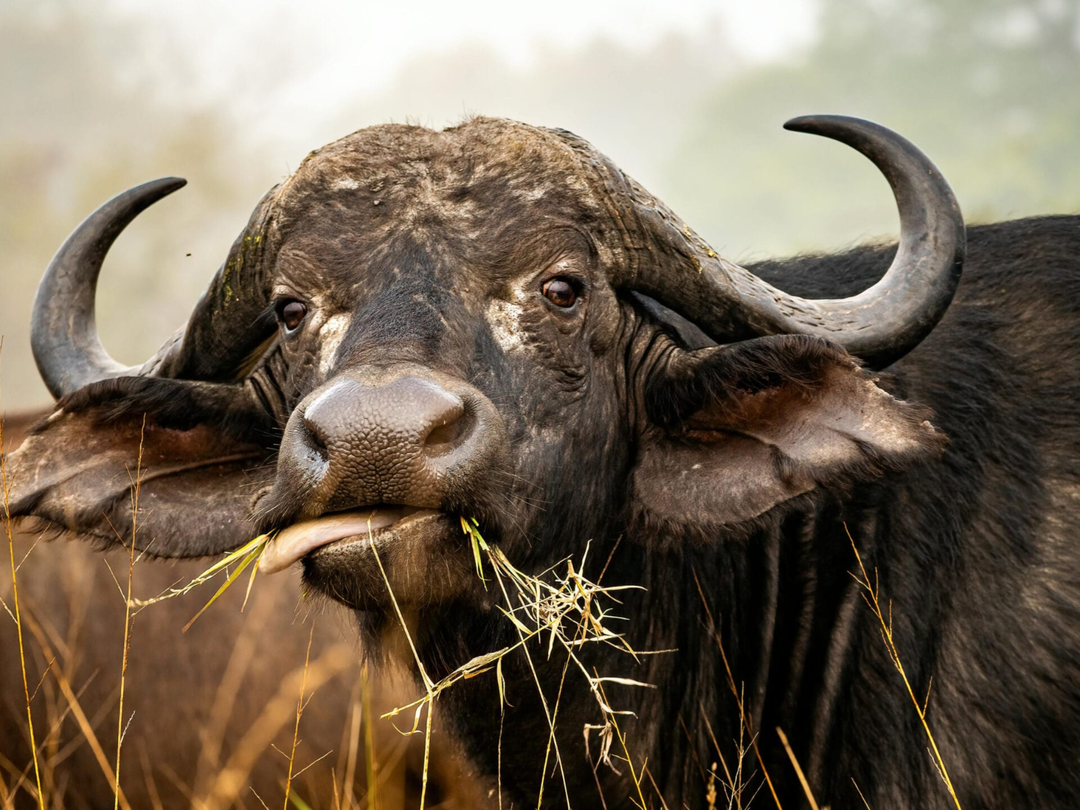
African buffaloes occur widely across the safari destinations surrounding Victoria Falls. They are listed among the major species in both Zambezi National Park and Hwange National Park.
Buffaloes are strongly dependent on water and can form substantial herds, particularly during dry conditions.
Chobe is another excellent region for observing buffaloes near the riverfront and surrounding floodplains. Herds moving toward water can create dramatic wildlife scenes, especially when elephants and antelopes are present simultaneously.
Buffaloes also attract the attention of predators, making areas occupied by large herds important places for guides searching for lions.
Giraffes
Giraffes are among the most recognizable animals travelers may encounter around Victoria Falls. They inhabit woodland and savanna environments where their height allows them to browse on vegetation unavailable to many smaller herbivores.
Mosi-oa-Tunya National Park officially lists giraffes among its year-round resident wildlife, alongside buffalo, zebra, waterbuck and other species.
Giraffes are also encountered in Hwange and Chobe, where open woodland can provide particularly attractive opportunities for photography.
Their slow movements and distinctive silhouettes make giraffes excellent photographic subjects, especially during early morning and late-afternoon light.
Hippos and Crocodiles
The Zambezi and Chobe river systems provide excellent habitat for hippos and Nile crocodiles.
Mosi-oa-Tunya National Park lists both hippos and crocodiles among its year-round wildlife along the Zambezi River.
Sunset cruises upstream from Victoria Falls can provide opportunities to see hippos resting in quieter sections of the Zambezi, while crocodiles may be observed along banks and exposed areas.
Chobe River boat safaris offer even stronger opportunities because travelers spend substantial time moving through productive river habitat.
Hippos may spend much of the daytime partially submerged before leaving the water to feed after dark. Visitors should always maintain a safe distance because hippos are powerful wild animals and can be extremely dangerous when approached carelessly.
Leopards
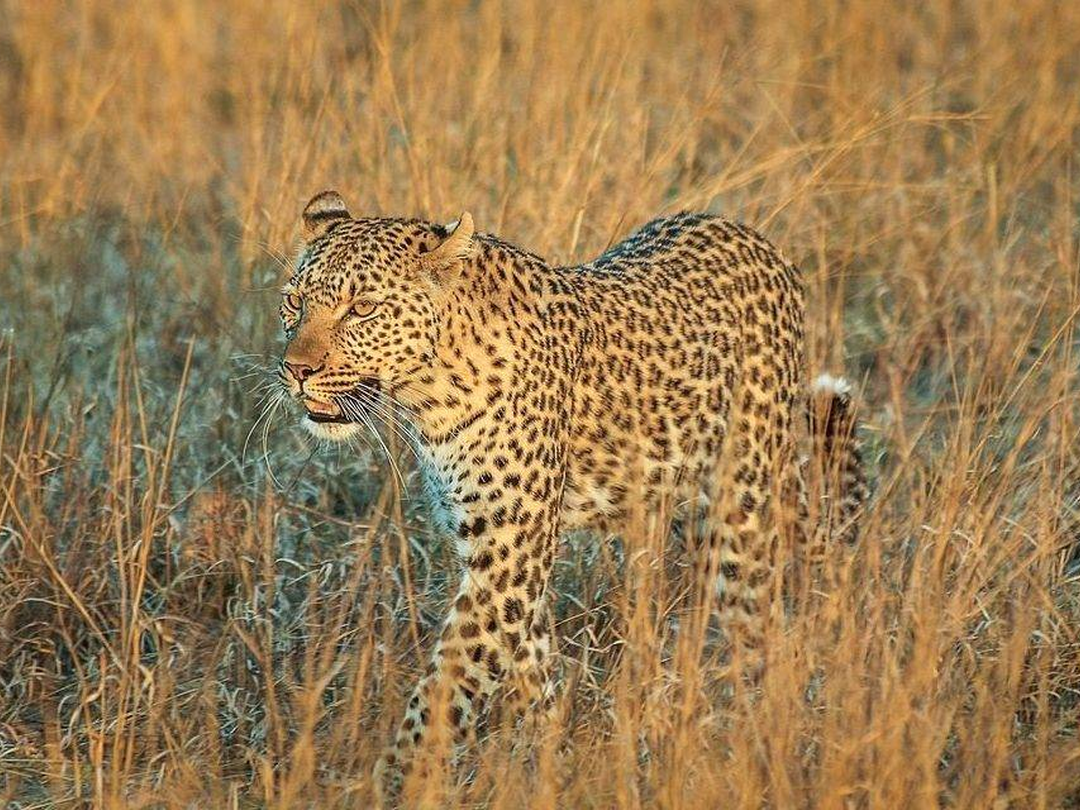
Leopards are present within the larger Victoria Falls safari ecosystem but are considerably more elusive than elephants, buffaloes or giraffes.
Zimbabwe Parks officially lists leopards in both Zambezi National Park and Hwange National Park.
Their solitary behavior, camouflage and preference for cover mean sightings require patience and often a significant amount of luck.
Early mornings and late afternoons can be productive times to search because leopards may be moving before temperatures rise or after the hottest period of the day.
Spending several nights in a major wildlife destination such as Hwange generally provides a better opportunity than relying solely on a short game drive around Victoria Falls.
African Wild Dogs
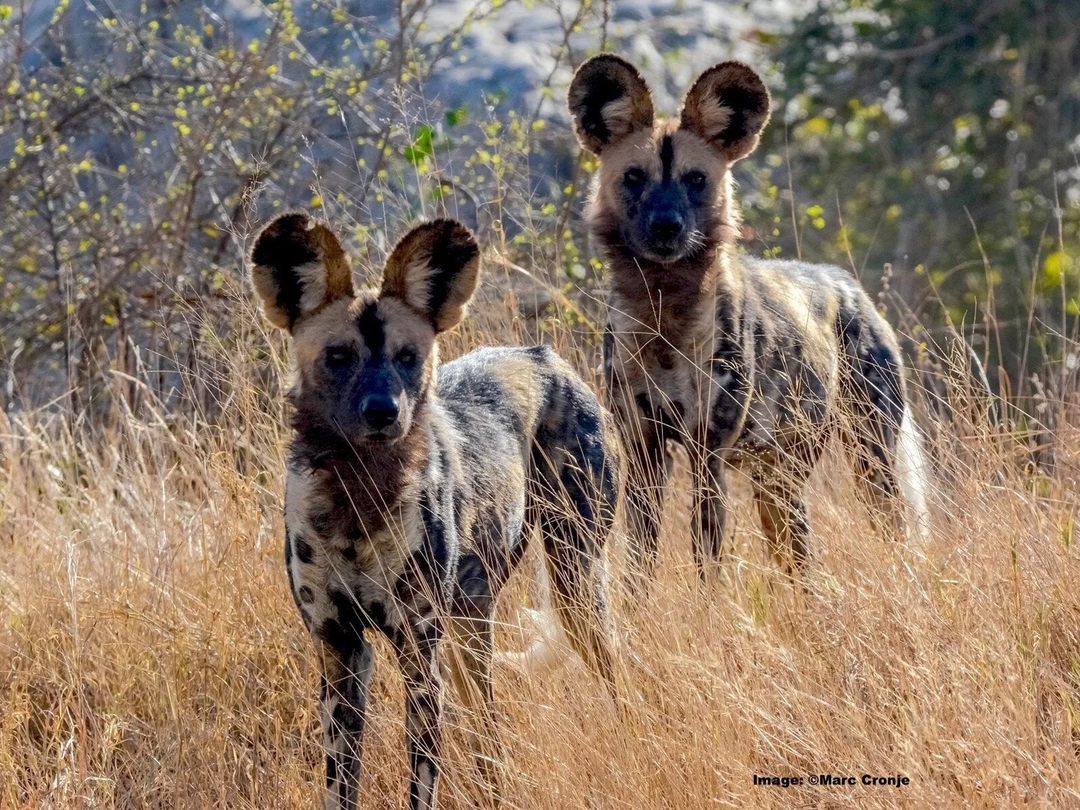
African wild dogs, also known as painted dogs, are among the most exciting predators travelers may encounter on a broader Victoria Falls safari.
Hwange is an important landscape for wild-dog conservation and research. Zimbabwe Parks’ wildlife research program specifically includes work relating to African wild-dog habitat in Hwange National Park.
Wild dogs live in highly social packs and can travel substantial distances, making their movements less predictable than many territorial predators.
An encounter may involve a pack resting together, greeting one another or moving rapidly through the landscape in preparation for hunting.
Because wild dogs are highly mobile, visitors should never book a short safari expecting a guaranteed sighting. Instead, they should consider them one of the exceptional possibilities of spending several days in a wilderness such as Hwange.
Birdlife
Birdwatching around Victoria Falls is outstanding because the region combines rivers, rainforest, woodland, wetlands, floodplains and open safari landscapes.
Hwange National Park supports nearly 400 bird species, according to Zimbabwe Parks, while Botswana Tourism reports more than 460 recorded bird species in Chobe National Park.
Around the Zambezi and Chobe rivers, travelers can look for African fish eagles, kingfishers, herons, egrets and other water-associated birds.
Woodland areas provide opportunities for hornbills, rollers, bee-eaters and numerous smaller species, while raptors are often encountered above open landscapes.
Birding is rewarding throughout the year, although the greener months can bring additional migrant species and breeding activity.
The diversity of wildlife around Victoria Falls is one reason travelers should consider adding at least one dedicated safari destination to their waterfall itinerary. Victoria Falls itself provides the dramatic landscape, while Zambezi, Hwange, Mosi-oa-Tunya and Chobe introduce elephants, predators, river wildlife and exceptional birdlife, turning the journey into a far more complete Southern African experience.
Safari to Victoria Falls from Different Destinations
Victoria Falls occupies one of the most strategic locations in Southern Africa, making it relatively easy to combine with wildlife destinations in South Africa, Botswana, Namibia, Zambia and Zimbabwe. Travelers can reach the falls by regional flights, scheduled road transfers, private safari vehicles or multi-country overland itineraries. This accessibility makes a safari to Victoria Falls particularly attractive for travelers who want to combine the waterfall with several different landscapes and wildlife areas during one African journey.
The most suitable route depends on where the safari begins. Travelers arriving through South Africa commonly connect through Johannesburg, while visitors already exploring Botswana can travel from Kasane and Chobe National Park. Zambia provides direct access through Livingstone, and travelers already in Zimbabwe can connect Victoria Falls naturally with Hwange National Park and other destinations. Namibia can also be incorporated through the country’s northeastern Zambezi Region and onward through Botswana.
Instead of treating Victoria Falls as an isolated destination, travelers can use it as an important link within a wider Southern African safari circuit.
Safari to Victoria Falls from South Africa
South Africa is one of the most practical starting points for travelers heading to Victoria Falls because Johannesburg functions as one of Southern Africa’s principal international aviation hubs. Travelers arriving from Europe, North America, Asia, Australia or other parts of Africa commonly enter the region through Johannesburg before continuing north toward Zimbabwe or Zambia.
For travelers planning a safari to Victoria Falls from South Africa, flying is normally the most efficient option. Regional connections can link Johannesburg with either Victoria Falls Airport in Zimbabwe or Livingstone on the Zambian side, depending on flight schedules and the structure of the itinerary.
Choosing between Victoria Falls Airport and Livingstone Airport should depend on where the traveler intends to stay. Visitors concentrating on the Zimbabwean side, Zambezi National Park or an extension into Hwange will generally find arriving in Victoria Falls particularly convenient. Travelers interested primarily in Zambia may prefer to start through Livingstone.
A South Africa and Victoria Falls itinerary also allows travelers to combine very different experiences. One popular concept is to begin with several days in Cape Town, enjoying Table Mountain, the Cape Peninsula, vineyards and the city’s coastal scenery before flying north to Victoria Falls.
Another possibility is combining Kruger National Park and Victoria Falls. This gives travelers a classic Big Five safari in South Africa followed by waterfall sightseeing, Zambezi River activities and potentially additional wildlife viewing around Zimbabwe or Botswana.
A longer route could include:
Cape Town → Kruger National Park → Johannesburg → Victoria Falls → Chobe National Park
This type of itinerary works particularly well for first-time visitors because it includes a major African city, traditional wildlife safari experiences and one of the continent’s greatest natural attractions.
Private luxury itineraries can incorporate premium airport transfers and carefully timed regional flights, while budget-conscious travelers can use scheduled services and affordable accommodation around Victoria Falls or Livingstone.
Overland journeys from South Africa are possible but involve substantial distances. Unless the road journey itself forms part of a longer safari, flying generally preserves more time for activities at the destination.
Safari to Victoria Falls from Botswana
Botswana provides one of the easiest and most rewarding connections with Victoria Falls. In particular, Kasane and Chobe National Park lie close enough to the Victoria Falls region for travelers to transfer between the destinations by road.
This makes a safari to Victoria Falls from Botswana especially attractive for wildlife enthusiasts. Travelers can spend several days in Chobe observing elephants, buffaloes, predators and river wildlife before crossing into Zimbabwe or Zambia to experience Victoria Falls.
Kasane acts as the primary gateway to Chobe National Park and is strategically positioned near the international borders of Botswana, Zimbabwe, Zambia and Namibia. From the Kasane area, organized transfers can take travelers toward Victoria Falls town in Zimbabwe or Livingstone in Zambia.
A popular itinerary begins with two or three nights in Chobe. Travelers can enjoy early morning game drives and afternoon boat safaris on the Chobe River before continuing to Victoria Falls.
A simple route could include:
Day 1–3: Chobe National Park
Day 4: Transfer from Kasane to Victoria Falls
Day 5: Guided Victoria Falls tour and helicopter flight
Day 6: Zambezi River activity and departure
Travelers arriving from the Okavango Delta can also connect Victoria Falls with Chobe. A longer Botswana safari might begin in the Okavango, continue through Chobe and finish beside Victoria Falls.
This creates one of Southern Africa’s strongest combinations because the experiences are completely different. The Okavango offers wetlands and remote safari camps, Chobe is famous for riverfront wildlife and Victoria Falls provides dramatic scenery and adventure activities.
Travelers should allow sufficient time for international border procedures when moving between Botswana and either Zimbabwe or Zambia. Passports, visas where applicable and any required entry documentation should be prepared before reaching the border.
Safari to Victoria Falls from Namibia
Namibia can also be combined effectively with Victoria Falls, particularly for travelers exploring the country’s northeastern Zambezi Region, historically known as the Caprivi Strip. This narrow extension of Namibia reaches toward Botswana and Zambia and creates a natural wildlife corridor connecting several important rivers and conservation areas.
Travelers planning a safari to Victoria Falls from Namibia can build an overland journey through the Zambezi Region before continuing toward Botswana and eventually Victoria Falls. This route is especially appealing to travelers who enjoy road safaris and want to experience several different Southern African environments.
A longer Namibia itinerary might begin around Windhoek before exploring destinations such as Etosha National Park and then moving east toward the Zambezi Region. From there, travelers can continue toward Kasane and Chobe National Park before reaching Victoria Falls.
A possible route is:
Windhoek → Etosha National Park → Zambezi Region → Kasane → Chobe National Park → Victoria Falls
The journey showcases remarkable contrasts. Namibia provides desert landscapes and dry-country wildlife, while the northeastern Zambezi Region becomes greener and increasingly influenced by rivers. Chobe introduces extensive river-based wildlife viewing before Victoria Falls delivers one of Africa’s greatest natural spectacles.
Travelers with limited time may choose air connections rather than completing the entire route overland. Flight schedules can change, however, and itineraries should be designed according to available regional connections at the time of travel.
Self-driving can also form part of a Namibia–Botswana journey, but international vehicle paperwork, border procedures, insurance and road conditions require careful planning. Travelers who prefer a simpler experience can use professional safari transfers or an organized multi-country itinerary.
For photographers, Namibia combined with Victoria Falls can be particularly rewarding because it brings together desert scenery, wildlife, rivers and waterfall landscapes within the same journey.
Safari to Victoria Falls from Zambia
Zambia provides direct access to Victoria Falls through Livingstone, the main tourism center on the northern side of the Zambezi River. Travelers staying in Livingstone can reach the Zambian viewpoints relatively easily while also enjoying river activities, wildlife excursions and seasonal experiences associated with Livingstone Island.
For visitors already traveling through Zambia, a safari to Victoria Falls can be incorporated naturally at the beginning or end of a wider Zambian itinerary. Livingstone has road and air connections with other parts of the country, allowing Victoria Falls to be combined with additional national parks and safari regions.
The Zambian side offers distinctive perspectives of the waterfall. During periods of stronger water flow, areas around Knife-Edge Bridge can provide an exceptionally dramatic experience, with heavy spray surrounding visitors as they walk through the viewing area.
Livingstone is also associated with seasonal activities such as Livingstone Island and Devil’s Pool, which operate only when river levels and safety conditions permit.
Wildlife can be incorporated through Mosi-oa-Tunya National Park, where visitors can combine game viewing with the waterfall during a short stay.
Travelers wanting a larger wildlife experience can continue toward Botswana and Chobe National Park. Livingstone therefore works extremely well as part of a Zambia–Zimbabwe–Botswana itinerary.
Visitors can also cross from Livingstone to the Zimbabwean side of Victoria Falls. Seeing both sides can be worthwhile because the perspectives are significantly different, particularly according to seasonal water levels.
A comfortable short itinerary might include two or three nights in Livingstone, incorporating the falls, a Zambezi cruise and a wildlife activity before either continuing into Botswana or crossing into Zimbabwe.
Safari to Victoria Falls from Zimbabwe
Zimbabwe provides one of the most natural ways to reach Victoria Falls because the falls form one of the country’s principal tourism destinations. Travelers exploring Zimbabwe can combine Victoria Falls with wildlife destinations, cultural attractions and other natural areas without repeatedly crossing international borders.
For visitors beginning a safari to Victoria Falls elsewhere in Zimbabwe, Hwange National Park is one of the most important destinations to combine with the falls. Hwange lies within practical reach by road and provides an extensive wildlife experience centered on elephants, predators, game drives and productive waterholes.
A classic Zimbabwe route might include:
Victoria Falls → Hwange National Park → Matobo National Park → Bulawayo
Alternatively, travelers can reverse the journey and finish at Victoria Falls, which can provide a relaxing and visually dramatic conclusion after several days of early-morning game drives.
Visitors arriving through Harare can connect toward Victoria Falls by domestic aviation or longer road journeys depending on the itinerary. Travelers already exploring western Zimbabwe may find road-based combinations particularly practical.
Starting in Zimbabwe also makes it easy to use Victoria Falls as a gateway to neighboring countries. After visiting the waterfall, travelers can continue into Botswana for Chobe or cross into Zambia to explore Livingstone.
Zimbabwe-based travelers can also include Zambezi National Park without traveling far from Victoria Falls town. This is useful for guests who want wildlife viewing but do not have enough time for several nights in Hwange.
The overall advantage is efficiency: travelers can combine waterfall sightseeing and one of Zimbabwe’s strongest safari parks while minimizing international border formalities.
Victoria Falls Safari for Families
Victoria Falls can be an excellent destination for families because it provides far more activity variety than a safari itinerary built entirely around long vehicle game drives. Parents can combine waterfall sightseeing, gentle river activities, wildlife encounters, cultural experiences and hotel relaxation, keeping children engaged while allowing enough downtime between excursions.
A family planning a safari to Victoria Falls should focus particularly on pacing. Children, especially younger ones, may enjoy a two-hour wildlife drive immensely but become restless during a full day in a vehicle. Building shorter experiences into the itinerary usually creates a much more enjoyable family holiday.
Victoria Falls also works well for multi-generational travel. Grandparents, parents and children can participate in many of the same activities while more adventurous family members choose optional experiences separately.
Best Family-Friendly Activities
A guided Victoria Falls walking tour is one of the best activities for families. The constantly changing viewpoints, rainforest vegetation, rainbows and heavy spray provide enough visual variety to keep children interested. Parents should bring waterproof clothing during periods of strong spray and use suitable footwear because pathways can become wet.
A Zambezi River sunset cruise can also work extremely well for families. The pace is relaxed, yet children can remain engaged by searching for hippos, crocodiles, birds and elephants along the riverbanks.
Short wildlife drives in Zambezi National Park or Mosi-oa-Tunya National Park can introduce children to African animals without requiring several full days on safari. Older children may also enjoy a multi-day Chobe or Hwange extension.
Chobe is particularly interesting for families because the experience can be divided between vehicle safaris and boat cruises. Children who become tired of sitting inside a safari vehicle often find the boat experience refreshing and exciting.
A helicopter flight over Victoria Falls can become an unforgettable family experience for older children who are comfortable flying. From the air, the family can see the entire waterfall and understand its enormous scale.
Cultural experiences can also be educational. A responsibly organized community visit can introduce children to local traditions, food, crafts and everyday life beyond the safari lodges.
Families should choose adventure activities carefully. Bungee jumping, rafting, gorge activities and certain river experiences have specific minimum ages, height restrictions, medical requirements or seasonal limitations. These should always be confirmed before booking.
Family-Friendly Safari Lodges
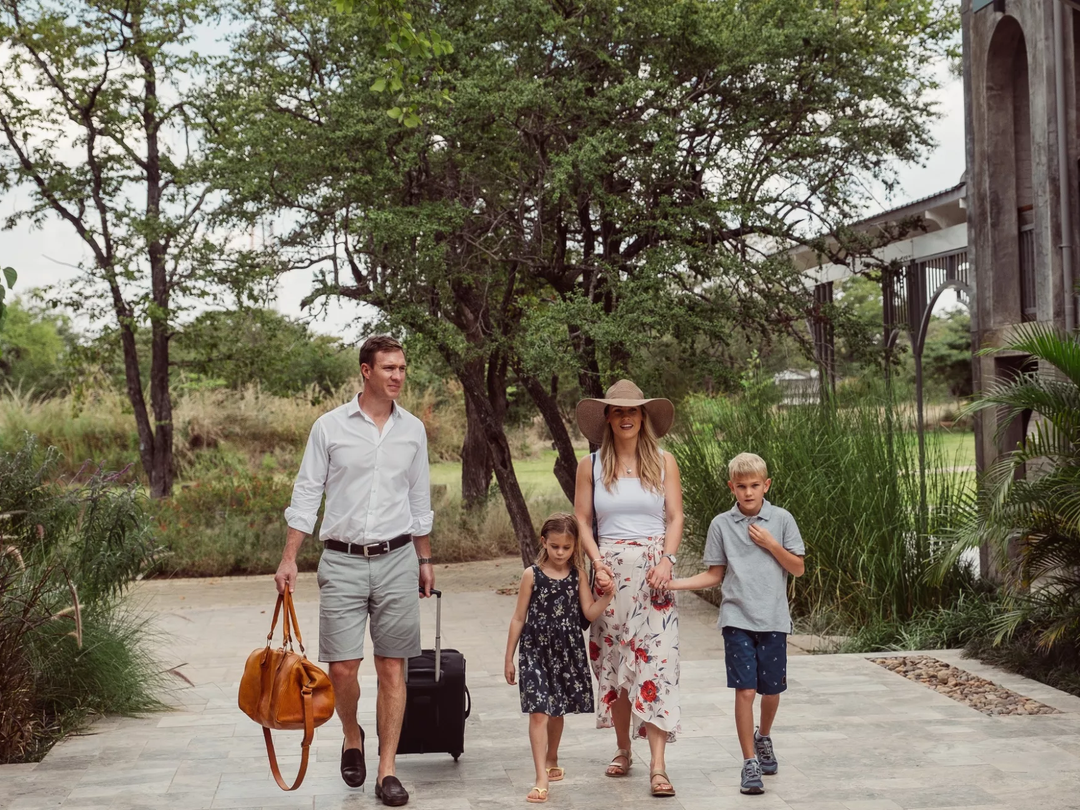
Choosing the right lodge can make a significant difference to a family safari. Families should prioritize accommodation that provides enough space, child-friendly meals, safe outdoor areas and opportunities to relax between activities.
Family rooms, adjoining rooms and multi-bedroom suites are often preferable to booking children in completely separate accommodation. This is particularly important when staying in wildlife environments.
A swimming pool can be extremely valuable during warm afternoons, providing children with something enjoyable to do between morning and evening excursions.
Location also matters. For younger families, a centrally located property near Victoria Falls can reduce long transfers. Families with older children may prefer a more secluded river lodge or dedicated safari camp where wildlife forms part of the overall accommodation experience.
In Chobe and Hwange, parents should check the lodge’s minimum age requirements for game drives and other activities. Some properties accept children of all ages but restrict younger guests from certain open-vehicle or walking safari activities.
Private vehicles can be particularly useful for families. Instead of following a fixed shared safari schedule, parents can return to the lodge earlier if children become tired or spend longer watching animals that particularly interest them.
Meal flexibility should also be considered. Lodges capable of providing earlier dinners or simpler children’s meals can make evenings considerably easier.
The best family accommodation is not necessarily the most luxurious. A comfortable lodge with generous space, flexible staff and suitable activities can often work better than an ultra-exclusive property designed primarily for adult couples.
Safari Safety with Children
Family safari safety begins with choosing age-appropriate activities and following the instructions of professional guides. Wildlife around Victoria Falls, Chobe and Hwange is genuinely wild, and parents should make sure children understand that animals must never be approached, chased or fed.
Children should remain inside the safari vehicle unless the guide specifically states that it is safe to leave. Even apparently peaceful animals such as elephants, buffaloes and hippos can be dangerous when approached incorrectly.
At safari lodges located in wildlife areas, children should not wander independently, particularly after dark. Many properties require guests to be escorted between rooms and communal areas in the evening because wildlife can move through unfenced grounds.
River safety is equally important. Parents should supervise children carefully around the Zambezi and Chobe rivers because crocodiles and hippos are present in these ecosystems.
Sun exposure is another consideration. Lightweight clothing, hats, sunscreen and regular hydration are important, especially during hotter months.
Families should carry insect repellent and seek appropriate professional health advice before traveling to malaria-risk areas. Travel insurance that covers planned safari and adventure activities is also strongly recommended.
Parents should also allow enough time for rest. Overloading a family itinerary with early departures, border crossings and afternoon activities can make children exhausted. A slower itinerary with two or three nights in each destination is generally more enjoyable.
With sensible planning and appropriate guiding, Victoria Falls can provide children with an extraordinary introduction to African landscapes, wildlife and conservation.
Victoria Falls Honeymoon Safari
A Victoria Falls honeymoon safari combines dramatic scenery, wildlife, river experiences and romantic accommodation, making the destination particularly suitable for newlyweds who want more than a conventional beach honeymoon. Couples can spend their days exploring the waterfall, cruising the Zambezi and searching for wildlife before returning to secluded lodges, private decks and intimate dinners in the evening.
For couples choosing a safari to Victoria Falls as part of their honeymoon, two or three nights near the waterfall can be combined with several nights in Hwange, Chobe or another luxury safari destination. This creates a journey with enough variety to feel adventurous while still providing time for privacy and relaxation.
A romantic Victoria Falls itinerary can begin with a sunset cruise on the Zambezi River. Smaller premium boats and private cruises provide an intimate atmosphere as the sun drops over the river and wildlife moves along the banks.
A scenic helicopter flight is another excellent honeymoon experience. Seeing Victoria Falls from above gives couples a dramatic shared memory and provides a completely different perspective from the walking trails.
Luxury riverfront accommodation can also play an important role. Suites overlooking the Zambezi, private balconies, plunge pools and secluded dining areas allow couples to enjoy the landscape even when they are not participating in scheduled activities.
A honeymoon can then continue into Hwange National Park, where intimate safari camps provide game drives, wildlife viewing and evenings in the African bush. Chobe offers another excellent option, particularly for couples who enjoy river landscapes and boat-based safaris.
Private safari vehicles can make the journey more personal. Couples can spend longer photographing wildlife, adjust departure times where permitted and enjoy a quieter experience than on larger shared excursions.
Special dinners can often be arranged in advance, depending on the lodge. These may include private deck dinners, bush dining or romantic meals overlooking the river.
Honeymooners should avoid trying to include too many destinations. Spending only one night in each lodge creates constant packing and transfers, leaving little time to enjoy the accommodation. Two or preferably three nights in each major destination provides a much better rhythm.
A strong honeymoon itinerary could include:
Days 1–3: Victoria Falls – Waterfall tour, helicopter flight, sunset cruise and relaxation.
Days 4–6: Hwange National Park – Private or small-group game drives and luxury safari camp.
Days 7–9: Chobe National Park – River safari, wildlife viewing and romantic lodge stay.
Couples with additional time can extend the journey into Botswana’s Okavango Delta or finish with several relaxing days in Cape Town or another Southern African destination.
The overall strength of a Victoria Falls honeymoon is its balance. Couples do not have to choose between adventure and comfort. They can experience the power of Victoria Falls, watch elephants beside the Chobe River, enjoy private safari moments and still have enough time to relax together in exceptional surroundings.
Victoria Falls Honeymoon Safari
A Victoria Falls honeymoon safari combines one of Africa’s most spectacular natural landmarks with romantic Zambezi River experiences, luxury safari accommodation and wildlife adventures across Zimbabwe, Zambia and Botswana. Couples planning a safari to Victoria Falls can enjoy the excitement of seeing the waterfall, then balance active sightseeing with private cruises, secluded lodges, candlelit dinners, spa treatments and intimate wildlife experiences. Zambia Tourism specifically highlights Victoria Falls as a honeymoon destination where riverfront lodges, adventure experiences and romantic downtime can be combined within a single journey.
Victoria Falls works particularly well for honeymooners because the itinerary does not have to revolve entirely around game drives. Couples can spend one morning exploring rainforest viewpoints beside the falls, enjoy a relaxed afternoon at their lodge, take a helicopter flight over the Zambezi and end the day watching the sunset from the river. Those wanting a stronger wildlife component can extend the honeymoon to Chobe National Park, Hwange National Park or another Southern African safari destination.
For most couples, the strongest honeymoon itinerary avoids changing lodges every night. Spending two or three nights around Victoria Falls followed by two or three nights in a dedicated safari area creates a much more relaxed journey. The additional time allows couples to enjoy their accommodation, private experiences and each other’s company rather than spending most of the honeymoon packing and transferring between destinations.
Romantic Zambezi Cruises
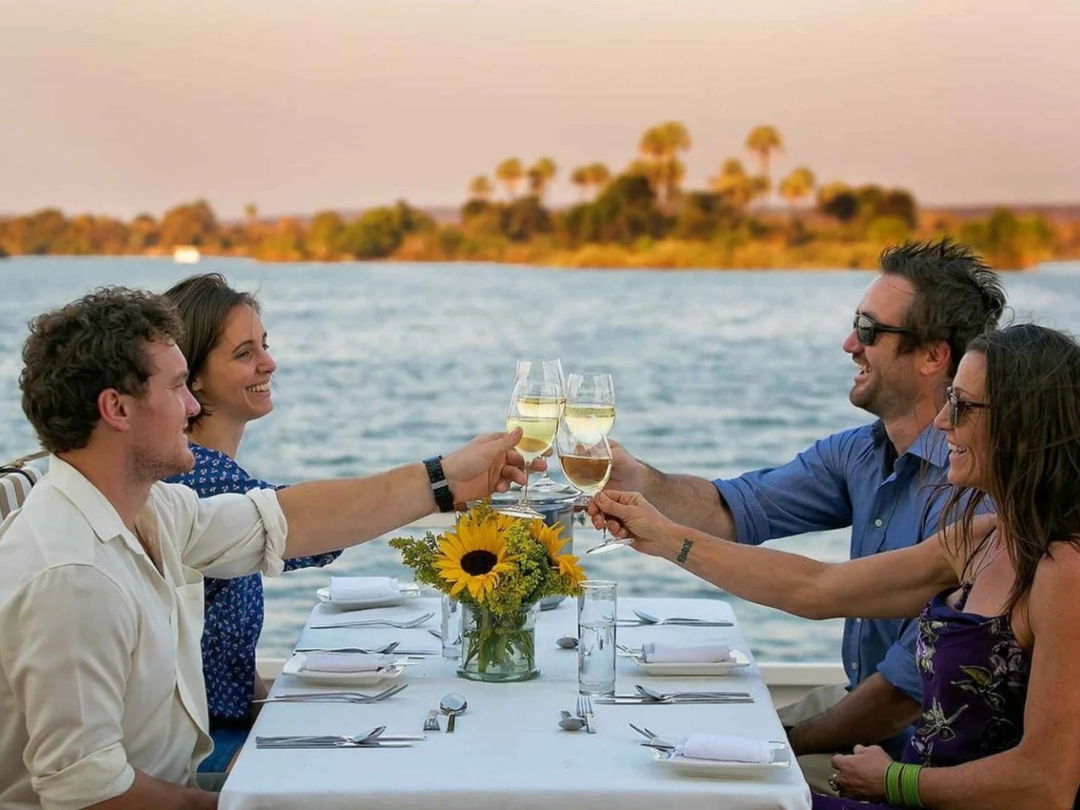
A romantic Zambezi River cruise is one of the most memorable experiences for couples visiting Victoria Falls. Upstream from the waterfall, the Zambezi broadens into a peaceful river surrounded by islands, woodland and wildlife habitat. This calm environment is very different from the immense power of the waterfall only a relatively short distance downstream.
Sunset cruises generally take place during the late afternoon when temperatures begin to cool and the river becomes particularly atmospheric. Couples can relax on board while watching the changing colors of the sky reflected across the Zambezi. Depending on wildlife movements, elephants, hippos, crocodiles and numerous bird species may be encountered along the riverbanks.
For honeymooners, smaller boats or premium cruises can provide a more intimate atmosphere than larger shared vessels. Some experiences emphasize personalized service, comfortable seating, drinks and light refreshments, allowing couples to enjoy the scenery without the activity feeling rushed.
A private cruise can make a safari to Victoria Falls particularly special for couples celebrating their honeymoon, wedding anniversary or another important occasion. Instead of following a larger group schedule, couples can enjoy a quieter journey focused on scenery, photography and time together.
The Zambezi is also excellent for honeymoon photography. The warm light before sunset can create beautiful silhouettes of trees, boats and wildlife, while reflections across the river provide a very different photographic setting from the waterfall itself.
A sunset cruise fits easily into a honeymoon itinerary because it does not require an entire day. Couples can explore Victoria Falls in the morning, relax at the lodge during the afternoon and then return to the river shortly before sunset.
For many newlyweds, this combination of wildlife, scenery and relaxation becomes one of the defining moments of their Victoria Falls honeymoon.
Luxury Safari Lodges
Choosing the right accommodation can transform a Victoria Falls honeymoon from a conventional holiday into an intimate safari experience. The region offers luxury lodges along the Zambezi River, boutique hotels close to the falls and exclusive safari properties surrounded by natural landscapes.
Couples booking a safari to Victoria Falls should look beyond room size and star rating when choosing accommodation. Location, privacy, river views, private decks, dining options and personalized service can make a much greater difference to the honeymoon experience.
Zambia Tourism specifically notes the appeal of Zambezi lodges for honeymooners, highlighting river views and suites designed around privacy and the surrounding natural environment. Properties farther upstream may provide additional tranquility, while hotels closer to Victoria Falls can reduce transfer times for sightseeing.
Luxury lodges may offer spacious suites with balconies overlooking the river or bush, outdoor seating areas, plunge pools, spa treatments and private dining arrangements. Honeymooners should mention their celebration when booking because selected properties may be able to arrange special meals, room preparations or other romantic touches.
A safari lodge can also provide experiences that extend beyond the room. Guests may enjoy river cruises, nature activities, wildlife drives or guided excursions directly through the lodge, reducing the amount of separate planning required.
Couples continuing to Hwange or Chobe can select a second lodge with a stronger wildlife focus. This creates an attractive contrast: several nights beside Victoria Falls followed by several nights immersed in the African bush.
A luxury honeymoon does not need to involve a different premium activity every hour. In fact, one of the advantages of a beautiful lodge is having enough time to enjoy it. A free afternoon beside the Zambezi, a leisurely lunch overlooking the river or an evening on a private deck can be every bit as memorable as another scheduled excursion.
Private Game Drives
Private game drives are an excellent addition for honeymooners who want wildlife encounters without sacrificing privacy and flexibility. Instead of sharing a vehicle with unrelated travelers, a couple can explore with their own professional safari guide and, where available, a dedicated vehicle.
Adding private wildlife activities to a safari to Victoria Falls allows the schedule to be shaped around the couple’s interests. Wildlife photographers may want to remain longer at an elephant herd, while birdwatchers may prefer slower drives focused on smaller species. Couples interested primarily in predators can ask the guide to concentrate on tracking areas where lions, leopards or other carnivores have recently been active.
Zambezi National Park provides one of the closest game-viewing opportunities to Victoria Falls. Couples with additional time can continue to Hwange National Park for a much deeper wilderness experience or cross into Botswana for Chobe.
Private vehicles can be particularly valuable for honeymoon photography because the couple has greater flexibility when positioning for wildlife and can spend longer at interesting sightings where conditions permit.
Morning drives provide cool temperatures and attractive light, while late-afternoon drives can finish with dramatic golden-hour scenery. Depending on the safari destination and lodge, couples may also be able to combine game viewing with drinks or a scenic stop before returning to camp.
Wildlife remains completely unpredictable, which is one of the reasons private game drives are so rewarding. There is no guarantee of finding a particular animal, but having more control over the pace can make every encounter feel more personal.
Victoria Falls and Chobe Honeymoon Combination
A Victoria Falls and Chobe honeymoon safari is one of the strongest romantic safari combinations in Southern Africa. Victoria Falls provides the natural spectacle, Zambezi cruises and adventure experiences, while Chobe National Park adds intensive wildlife viewing and one of Africa’s best-known river safari environments.
Couples can begin a safari to Victoria Falls with two or three nights in Zimbabwe or Zambia. A typical stay might include a guided waterfall tour, helicopter flight, romantic sunset cruise and a free afternoon at a luxury lodge.
The honeymoon can then continue by road toward Kasane in Botswana. After completing the necessary border formalities, couples can check into a lodge close to the Chobe River and spend the following days experiencing both vehicle and boat safaris.
A Chobe River boat safari is especially appropriate for honeymooners. The river setting is peaceful, and couples may watch elephants coming down to drink, hippos resting in the water, crocodiles along the banks and numerous birds around the floodplain.
Morning game drives provide another perspective, allowing visitors to search for lions, leopards, buffaloes, giraffes, zebras and other species away from the main river channels.
A comfortable honeymoon itinerary could include:
Days 1–3: Victoria Falls – Guided waterfall tour, sunset cruise, scenic flight and lodge relaxation.
Days 4–6: Chobe National Park – River cruise, morning and afternoon wildlife activities and time at the lodge.
Day 7: Final breakfast or short activity followed by departure.
Couples with additional time can extend the journey into the Okavango Delta or add Hwange National Park. However, avoiding too many one-night stops usually results in a more romantic and less exhausting honeymoon.
The attraction of the Victoria Falls and Chobe combination is its variety. Within one trip, newlyweds can experience one of the world’s great waterfalls, spectacular sunsets over two major rivers and close encounters with African wildlife.
What to Pack for a Safari to Victoria Falls
Packing correctly for a safari to Victoria Falls can make a significant difference to comfort because travelers may experience waterfall spray, hot afternoons, cool early-morning game drives, dusty safari roads and river activities during the same journey. The ideal luggage should therefore be practical, lightweight and suitable for layering rather than filled with heavy clothing that is only useful in one situation.
The exact packing list should also reflect the season. Zambia Tourism advises visitors to check weather conditions before traveling to Livingstone because temperatures vary through the year, while its health guidance recommends lightweight long clothing during higher mosquito-risk periods, particularly around evening hours.
Travelers combining Victoria Falls with Chobe or Hwange should pack as they would for a traditional African safari, while visitors staying primarily around the waterfall can travel slightly lighter. Regardless of itinerary, comfortable footwear, sun protection, rain protection and secure travel documents should be considered essentials.
Safari Clothing
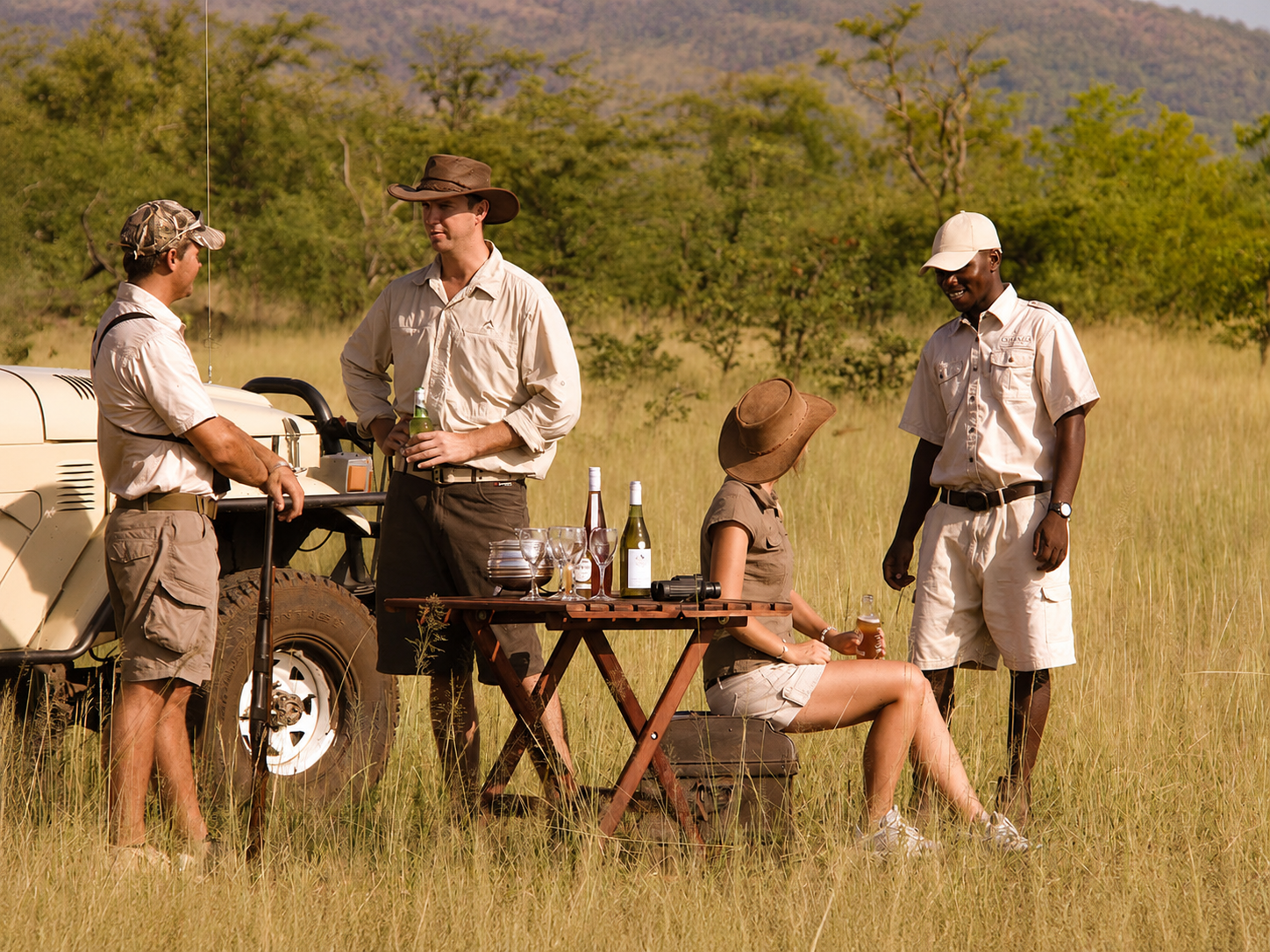
Safari clothing should be lightweight, comfortable and easy to layer. Neutral shades such as khaki, beige, brown, olive and other muted colors work particularly well for wildlife activities because they blend naturally into safari environments.
Lightweight shirts and T-shirts are useful during warmer daytime conditions. Long-sleeved shirts can provide additional protection from strong sunshine, dust and insects without requiring heavy clothing.
Comfortable safari trousers or lightweight travel pants are particularly useful for game drives, walking excursions and cooler evenings. Shorts can also be packed for time around the hotel or lodge, although longer trousers may be preferable during early morning, evening and bush activities.
Travelers joining morning game drives should pack at least one warm layer such as a fleece, sweater or light jacket. Open safari vehicles can feel surprisingly cold before sunrise, especially during the cooler dry-season months.
A safari hat with a reasonably secure brim provides valuable protection from the sun. Sunglasses with good UV protection are also useful because sunlight reflecting from water and pale landscapes can be intense.
Swimwear should be included when staying at properties with pools, spas or other water facilities.
Couples on honeymoon may also want one or two smarter casual outfits for dinners at luxury lodges or hotels. Formal clothing is rarely necessary, but comfortable evening wear can be useful for special dinners.
Visitors should avoid overpacking. Many safari lodges provide laundry services, particularly on longer itineraries, meaning a relatively small selection of interchangeable clothing can be sufficient.
Footwear
Footwear for a safari to Victoria Falls should prioritize comfort and grip rather than fashion. Most travelers do not require heavy mountaineering boots unless their wider itinerary includes demanding hiking.
A comfortable pair of closed walking shoes or lightweight hiking shoes works well for the Victoria Falls trails, safari activities and general sightseeing. Shoes with good traction are particularly helpful near the waterfall because heavy spray can make sections of the walking paths wet and slippery.
Lightweight trainers can also work for travelers who are not participating in longer walking safaris.
Sandals or comfortable casual shoes are useful around the lodge, swimming pool and during relaxed evenings. Travelers staying at luxury properties may appreciate having a second pair of clean shoes for dinner.
Anyone joining a guided bush walk should wear closed footwear and follow the guide’s advice regarding appropriate clothing.
During the rainy season, quick-drying footwear can be particularly useful. Heavy shoes that remain wet for several days can become uncomfortable during longer safaris.
Travelers should wear new walking shoes several times before leaving home rather than breaking them in during the safari.
Camera and Photography Equipment
Victoria Falls and the surrounding national parks provide exceptional photography opportunities, so travelers interested in photography should plan their equipment carefully.
A smartphone with a strong camera is sufficient for many casual travelers, particularly for wide views of the waterfall, sunsets and lodge photography. More serious photographers may prefer a mirrorless or DSLR camera with several lens options.
A wide-angle lens is particularly useful for Victoria Falls because the waterfall is enormous and difficult to capture within a single frame from some viewpoints.
A telephoto lens becomes much more valuable when the itinerary includes Chobe, Hwange or another wildlife destination. Something capable of bringing distant animals closer allows photographers to capture elephants, lions, birds and other wildlife without approaching them.
Extra batteries are essential because long safari days can provide limited opportunities for charging. Travelers should also carry sufficient memory cards rather than depending on one card for the entire holiday.
A small camera bag or daypack helps protect equipment from dust while traveling between activities.
Lens cloths are extremely important at Victoria Falls. During high-water periods, heavy spray can quickly cover camera lenses with droplets, making clear photographs difficult.
A waterproof camera cover, dry bag or protective pouch can also be valuable close to the waterfall.
Binoculars deserve a place in the luggage even for travelers who are not serious photographers. They significantly improve birdwatching and allow distant wildlife to be observed without disturbing animals.
Travelers should also pack suitable charging cables and power accessories compatible with their equipment.
Rain Protection
Rain protection is important around Victoria Falls even when the weather forecast shows sunshine. During high-water periods, enormous amounts of spray rise from the gorge and can soak visitors walking through the rainforest viewpoints.
A lightweight waterproof jacket or reusable poncho is one of the most useful items to pack. Quick-drying clothing also makes the walking experience much more comfortable.
Small waterproof pouches can protect passports, phones, wallets and other items carried close to the falls.
Photographers should pay particular attention to protecting cameras. A waterproof cover or dry bag allows equipment to be stored quickly when spray becomes excessive.
During the wetter months, a compact umbrella may be useful around town or at the lodge, although it is generally less practical along heavily sprayed waterfall trails than a rain jacket or poncho.
Travelers should also consider a waterproof or water-resistant daypack cover if carrying electronics.
Even during lower-water months, conditions can change around particular sections of the waterfall, so some form of basic rain protection remains useful throughout the year.
Travel Documents
Travel documents should be checked carefully before departure, particularly because many Victoria Falls itineraries involve crossing international borders between Zimbabwe, Zambia and Botswana.
The most important document is a valid passport. Travelers should check the passport-validity and blank-page requirements for every country in their itinerary rather than assuming the rules are identical. Zambia’s Department of Immigration currently states that visitors obtaining visas on arrival must have passports valid for at least six months from entry with at least three full blank pages.
Visa requirements depend on nationality and itinerary. Zimbabwe currently operates an official electronic visa platform, while Zambia maintains its own immigration and eVisa system. Travelers should verify their individual eligibility directly with immigration authorities before departure.
Eligible travelers visiting both Zimbabwe and Zambia may find the KAZA UNIVISA useful. Zambia’s Department of Immigration currently states that it permits multiple visits between Zambia and Zimbabwe within its validity and also covers qualifying Botswana day trips through the Kazungula borders. Eligibility and availability should always be reconfirmed before travel because immigration regulations can change.
Travelers should also carry:
- Passport and any required visas.
- Copies of passport identification pages.
- Travel insurance documentation.
- International and regional flight confirmations.
- Hotel and safari booking confirmations.
- Emergency contact details.
- Required health or vaccination documentation for the countries being visited.
- Copies of important documents stored separately from the originals.
- A secure digital backup accessible from a phone or email account.
Travel insurance is particularly important when the itinerary includes adventure activities such as rafting or other high-adrenaline experiences. Travelers should confirm that their insurance covers the activities they intend to undertake rather than assuming all excursions are automatically included.
Anyone planning a safari to Victoria Falls that continues into Botswana or other neighboring countries should organize the documents for the entire trip before leaving home. Proper preparation allows travelers to spend less time dealing with administrative problems and more time enjoying Victoria Falls, the Zambezi River and the extraordinary wildlife landscapes surrounding one of Southern Africa’s greatest destinations.
Visa and Border Requirements for Victoria Falls
Understanding visa and border requirements is essential when planning a safari to Victoria Falls, particularly because many itineraries involve more than one country. Victoria Falls lies directly between Zimbabwe and Zambia, while Botswana’s Chobe National Park is close enough to visit on a day trip or as part of a longer safari. Travelers may therefore cross two or three international borders within only a few days, making correct passport documentation and visa planning particularly important.
Visa requirements depend primarily on the traveler’s nationality, the countries being visited and whether the itinerary involves single or multiple entries. Zimbabwe currently separates travelers into nationalities that enter without a visa, those that can obtain a visa on arrival and those that must obtain authorization before travel. Zambia similarly divides foreign visitors according to whether they are visa-exempt, eligible for a visa on arrival or required to obtain a visa before travel.
Travelers should therefore check immigration requirements using their actual passport nationality rather than country of residence. This becomes particularly important on itineraries that cross repeatedly between Zimbabwe and Zambia or continue into Botswana for Chobe National Park.
Zimbabwe Visa Requirements
Travelers staying on the Zimbabwean side of Victoria Falls enter Zimbabwe through places such as Victoria Falls International Airport or an authorized land border. Zimbabwe’s official immigration system currently divides visitors into three broad groups: nationalities that do not require a visa, nationalities that can obtain and pay for a visa on arrival, and nationalities required to secure a visa before traveling.
Many commonly visiting nationalities, including travelers from countries such as the United States, United Kingdom, Germany, France, Italy, Australia and Canada, currently fall within Zimbabwe’s visa-on-arrival category. Other nationalities are visa-exempt, while a separate group must arrange visas before departure. Because these categories can change, travelers should verify their current status on Zimbabwe’s official immigration platform rather than relying on an old safari blog or previous visit.
Zimbabwe also operates an eVisa system, allowing eligible travelers to complete the visa process electronically. The official immigration platform advises eVisa applicants to apply at least three weeks before travel. Single-entry eVisas are currently issued with a one-month validity period, double-entry visas with three months and eligible multiple-entry visas with six months from issuance.
The type of visa becomes especially important for travelers planning a safari to Victoria Falls that includes Zambia. A traveler who enters Zimbabwe, crosses into Zambia and then returns to Zimbabwe may require permission for more than one entry unless covered by an appropriate regional visa arrangement such as the KAZA UniVisa.
Travelers should therefore avoid automatically purchasing the cheapest single-entry option without examining their complete itinerary. A holiday that appears to be centered entirely on Victoria Falls can still involve multiple international movements—for example, staying in Zimbabwe, visiting the Zambian side of the falls, returning to Zimbabwe, then traveling to Botswana.
Passport details entered on an eVisa application should also match the actual travel document precisely. Zimbabwe’s immigration service states that mismatched eVisa and passport information can invalidate the visa, making careful checking before submission essential.
Yellow-fever documentation may also become relevant depending on the traveler’s route. CDC’s current Zimbabwe guidance states that yellow-fever vaccination is not routinely recommended specifically for Zimbabwe, but proof of vaccination is required for travelers aged nine months or older arriving from countries with a risk of yellow-fever transmission, including qualifying long airport transits through such countries.
Zambia Visa Requirements
Travelers exploring the Zambian side of Victoria Falls normally enter through Livingstone, Harry Mwaanga Nkumbula International Airport or the Victoria Falls land border connecting Zambia with Zimbabwe.
Zambia’s Department of Immigration currently places international visitors into three categories: travelers who do not require visas, travelers who may obtain visas on arrival or through Zambian missions, and travelers who must secure their visas before travel.
For visa-on-arrival travelers, Zambia currently requires a passport with at least six months of validity from the date of entry and at least three full blank pages. Air travelers should also have a valid return ticket, while travelers entering by land or water should be able to demonstrate sufficient means for their stay and departure.
Current standard Zambian visa fees published by the Department of Immigration are US$25 for a single-entry visa, US$40 for a double-entry visa and US$75 for a multiple-entry visa. Zambia also currently offers a US$10 Day Tripper visa at Victoria Falls and Kazungula Border Controls for qualifying visits of less than 24 hours where the traveler exits through the same port.
That day-trip arrangement can be useful for some travelers based in Zimbabwe who want to see the Zambian side of Victoria Falls and return on the same day. However, the correct visa depends on nationality and travel plans, so it should not automatically be assumed to be the best option.
Travelers arranging a safari to Victoria Falls that begins in Livingstone and then moves into Zimbabwe should look carefully at whether they intend to return to Zambia later. A single-entry visa may not be sufficient if the itinerary requires re-entry after visiting Zimbabwe or Botswana.
Zambia also operates an eVisa facility for travelers who require visas. The Department of Immigration states that visa-required foreign nationals can apply electronically, subject to the applicable conditions.
Yellow-fever requirements also depend on the travel route. Current CDC guidance states that Zambia does not require yellow-fever vaccination from travelers arriving directly from countries without yellow-fever risk, but qualifying travelers aged one year or older arriving from a yellow-fever-risk country—including certain airport transits exceeding 12 hours—must carry proof of vaccination.
KAZA UniVisa
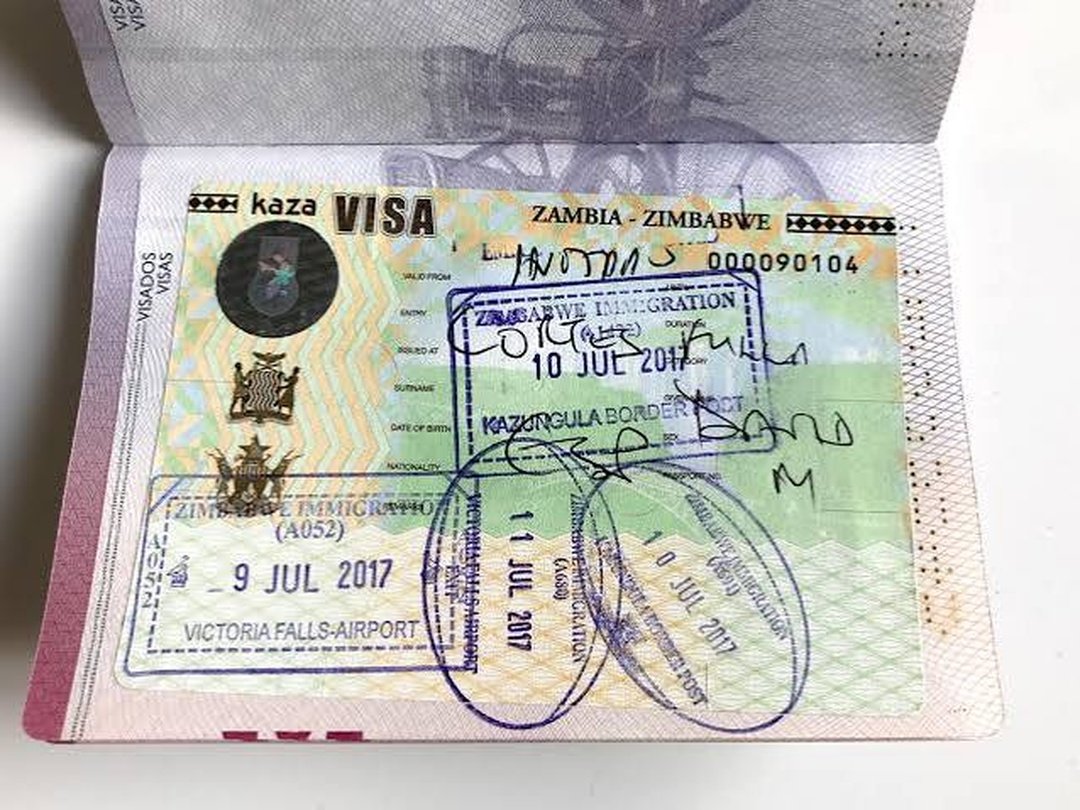
The KAZA UniVisa is one of the most useful visa arrangements for eligible travelers combining Zimbabwe and Zambia. It was designed to simplify tourism within the Kavango-Zambezi region by allowing visitors to travel repeatedly between the two countries under one visa rather than purchasing separate visas each time they cross the border.
Zambia’s Department of Immigration currently states that the KAZA UniVisa costs US$50 and remains valid for up to 30 days, provided the holder remains within Zimbabwe and Zambia under the conditions of the visa. It permits multiple movements between the two countries and also covers qualifying day trips into Botswana through the Kazungula border.
This arrangement can be particularly valuable for a safari to Victoria Falls because travelers frequently want to see both sides of the waterfall. Someone staying in Victoria Falls, Zimbabwe, can cross the Victoria Falls Bridge to Zambia, explore the Zambian viewpoints and then return to Zimbabwe without needing to purchase another separate Zimbabwe visa each time, provided the traveler is eligible and the UniVisa remains valid.
The KAZA UniVisa is currently available through Zambia’s eVisa system and at selected entry points including Harry Mwaanga Nkumbula International Airport, Victoria Falls Border Control and Kazungula Border Control. Travelers obtaining it online through Zambia must enter through a Zambian port of entry.
One important limitation is frequently misunderstood: the Botswana element of the KAZA UniVisa applies to day trips through Kazungula. A traveler planning to stay overnight in Botswana should separately ensure that they satisfy Botswana’s normal immigration requirements rather than assuming the UniVisa provides unrestricted entry throughout Botswana.
Eligibility also depends on nationality. The KAZA UniVisa is not automatically available to every passport holder, so travelers should confirm eligibility before relying on it when designing their itinerary.
For an itinerary involving Victoria Falls, Livingstone and a Chobe day trip, the KAZA arrangement can considerably simplify border logistics when the traveler qualifies.
Botswana Border Requirements for Chobe Trips
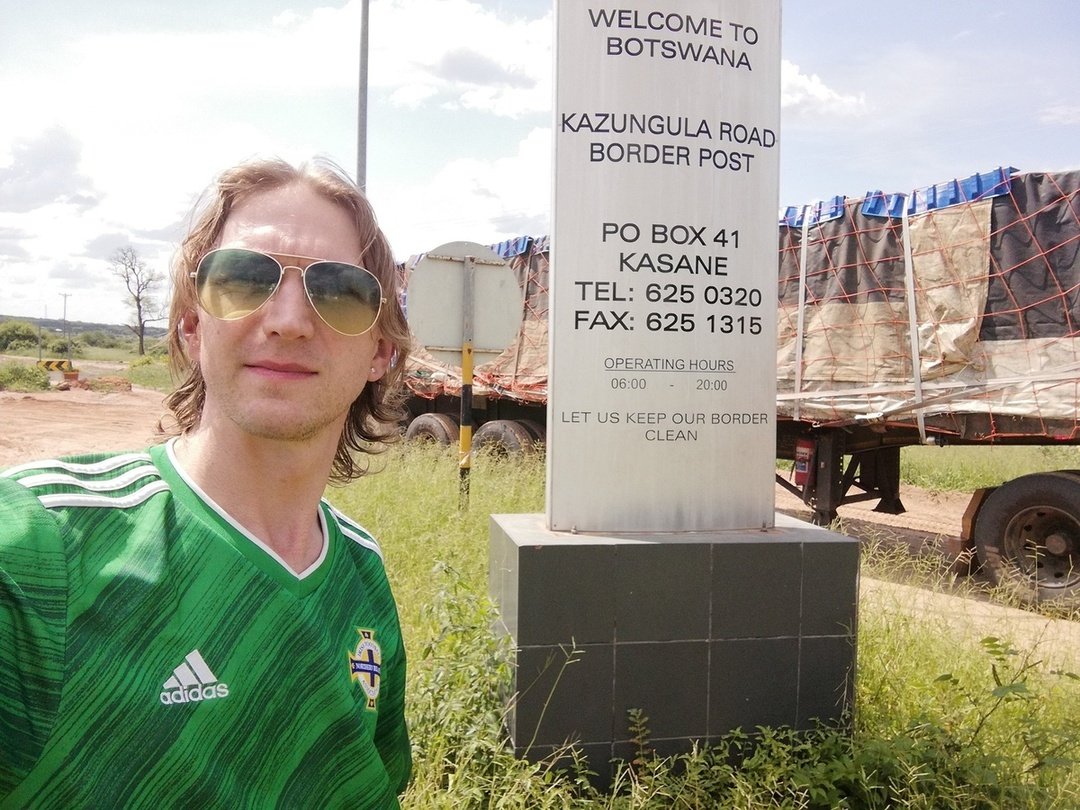
Travelers visiting Chobe National Park from Victoria Falls usually enter Botswana through the Kazungula area near Kasane. Because this is an international border crossing, every traveler must carry a valid passport and satisfy Botswana’s entry requirements even when visiting only for the day.
Botswana visa requirements vary by nationality. Travelers from nationalities requiring tourist visas can apply through Botswana’s official eVisa system or immigration authorities. Botswana’s government currently asks visa applicants for documentation including a passport with at least six months’ validity, accommodation information, a travel itinerary and evidence of an intention to leave Botswana after the trip.
For nationalities enjoying visa-free access, normal passport and immigration requirements still apply. Current Botswana travel guidance states that passports should have sufficient validity and blank pages for immigration stamps. Travelers should verify the specific requirements applicable to their nationality before reaching Kazungula.
For travelers taking a Chobe day excursion during a safari to Victoria Falls, safari operators normally coordinate the road transfers on both sides of the border, but immigration clearance remains the responsibility of the traveler. A tour booking itself does not replace a passport, visa or required health documentation.
Visitors should also remember that crossing into Botswana means they later need lawful re-entry into Zimbabwe or Zambia. This is where the number of entries permitted by the traveler’s Zimbabwe or Zambia visa becomes particularly important. Eligible KAZA UniVisa holders can undertake qualifying Botswana day trips through Kazungula while maintaining their regional visa privileges.
Travelers continuing into Botswana for one or more nights should plan the journey as a true multi-country safari rather than a simple excursion. Their Botswana visa status, Zimbabwe or Zambia re-entry permissions and onward travel documentation should all be checked before departure.
Yellow-fever documentation can again depend on origin and transit history. Current CDC guidance states that Botswana requires proof of yellow-fever vaccination for qualifying travelers aged one year or older entering from a country with a risk of yellow-fever transmission, including certain long transits.
Health and Safety on a Victoria Falls Safari
Health and safety preparation is an important part of a safari to Victoria Falls, particularly for travelers combining Zimbabwe, Zambia and Botswana. Most visits are straightforward when sensible precautions are followed, but safari environments bring specific considerations including malaria, sun and heat exposure, wildlife, remote-area medical access and adventure activities around the Zambezi and Batoka Gorge.
The CDC’s 2026 Yellow Book advises safari travelers to arrange a pre-travel health consultation and ensure that recommended vaccinations and medications are considered according to the exact countries and parks on their itinerary. It also notes that many health and safety issues encountered on African safaris are predictable and largely preventable with suitable preparation.
Malaria Prevention
Victoria Falls and several nearby safari destinations are within malaria-risk areas, making malaria prevention one of the most important health considerations for travelers.
Current CDC guidance recommends prescription malaria-prevention medication for travelers going to Zimbabwe and Zambia. In Botswana, malaria prophylaxis is recommended for several northern areas, specifically including Chobe and Chobe National Park.
Travelers should discuss the appropriate medication with a qualified healthcare professional before departure because the best option depends on medical history, other medicines being taken, pregnancy considerations, length of travel and individual tolerance. CDC currently lists options such as atovaquone-proguanil, doxycycline and mefloquine among the preventive medicines used for these destinations, but the correct choice should be individualized by a clinician.
Medication is only one layer of protection. Travelers should also reduce mosquito bites by using an effective insect repellent, wearing long trousers and long-sleeved clothing during higher-risk periods and sleeping in accommodation with appropriate mosquito protection. CDC specifically recommends combining malaria prophylaxis with protective clothing, insect repellent and suitable mosquito-net protection where necessary.
Mosquito exposure is particularly relevant on safari because many wildlife activities take place around dawn, dusk and water sources, precisely when visitors may be outdoors for extended periods. Sunset cruises and evening lodge activities should therefore not be treated as times when mosquito precautions can be forgotten.
Travelers planning a safari to Victoria Falls should ideally discuss travel health at least several weeks before departure rather than waiting until arrival in Africa. Some malaria medications need to be started before entering the risk area and continued for a specific period after leaving.
Travelers who develop fever during or after visiting a malaria area should seek medical attention promptly and tell the healthcare provider about their recent travel history.
Travel Insurance
Comprehensive travel insurance is strongly recommended for a Victoria Falls safari, especially when an itinerary includes remote safari parks, international border crossings or adventure activities.
A suitable policy should ideally address overseas medical expenses, emergency medical evacuation, trip cancellation or interruption, lost or delayed baggage and the specific activities included in the itinerary. Botswana’s current travel guidance particularly advises visitors to consider medical evacuation insurance because medical resources can be limited in remote parts of the country and evacuation can sometimes be delayed.
Medical evacuation coverage is particularly valuable on itineraries extending into places such as Chobe or remote safari areas. CDC’s safari guidance notes that advanced medical care may not always be available in the destination area and recommends ensuring international health coverage and considering additional medical evacuation insurance.
Travelers should read policy exclusions carefully. Standard insurance may not automatically cover activities such as white-water rafting, bungee jumping, gorge swings or other adventure sports. Someone planning these experiences should ensure that the policy specifically covers them at the required level.
Insurance should be purchased with the full itinerary in mind. If a safari to Victoria Falls combines Zimbabwe, Zambia and Botswana, the policy should provide appropriate geographic coverage for all three countries rather than only the primary destination listed on the booking.
Travelers should keep their policy details, insurer emergency contact numbers and relevant medical information accessible during the journey rather than storing everything in checked luggage.
Wildlife Safety
Victoria Falls lies within a genuine wildlife region, and animals found around surrounding national parks are wild rather than habituated attractions. Elephants, buffaloes, lions, leopards, hippos, crocodiles and other species can be dangerous when approached incorrectly.
The most important rule is to follow the instructions of professional safari guides and park staff at all times. CDC safari guidance emphasizes that wild animals are unpredictable and notes that wildlife injuries often occur when travelers ignore rules or approach animals too closely for photographs or feeding. Visitors should never attempt to feed, pet or handle wild animals.
During vehicle safaris, guests should remain inside the vehicle unless the guide specifically indicates that leaving is permitted. Sudden movements, shouting or attempting to attract an animal’s attention can interfere with wildlife behavior and create unnecessary risk.
Extra care is required around elephants. Their enormous size and generally calm appearance can encourage inexperienced visitors to underestimate them. Guides understand warning behavior and safe distances, so travelers should never pressure a driver to move closer simply to obtain a photograph.
The Zambezi and Chobe rivers require similar respect. Hippos and crocodiles inhabit these waterways, meaning travelers should avoid walking casually along remote riverbanks or entering untreated natural freshwater unless participating in a professionally managed activity where conditions have been assessed.
At unfenced safari lodges, wildlife may move through the property, particularly at night. Guests should follow lodge instructions concerning escorts between accommodation and common areas rather than walking independently after dark.
Wildlife safety is not about being frightened of the bush. It is about respecting distance, listening to trained guides and recognizing that observing animals naturally is one of the reasons safari experiences are so special.
Adventure Activity Safety
Victoria Falls is one of Southern Africa’s leading adventure destinations, with activities that can include white-water rafting, bungee jumping, gorge swings, zip-line experiences, helicopter flights and seasonal activities close to the edge of the falls.
These activities should be booked through established operators that use appropriate safety equipment, trained personnel and clear participant procedures. Travelers should pay close attention to age, weight, fitness and medical restrictions rather than treating them as unnecessary formalities.
White-water rafting deserves particular preparation because the Zambezi below Victoria Falls can involve demanding rapids and physically strenuous conditions. Travelers should disclose relevant medical issues, listen closely during safety briefings and wear the supplied protective equipment throughout the activity.
Activities such as Devil’s Pool and Livingstone Island are controlled by river conditions and should only be undertaken when professionally operated and officially open. Water levels on the Zambezi change significantly throughout the year, meaning an experience that operates safely in one season may be unavailable in another.
Bungee jumping and gorge activities also require travelers to follow operator instructions exactly. Anyone with medical concerns involving the heart, back, joints, pregnancy or other conditions that may be affected by intense physical forces should obtain professional medical advice before participating.
Travel insurance should be checked before booking high-adrenaline activities because adventure-sport exclusions are common. A traveler should know whether evacuation, medical treatment and the actual activity are covered before participating rather than discovering an exclusion after an accident.
CDC’s broader adventure and safari guidance also highlights the importance of preparing for environmental risks such as heat, dehydration and sun exposure. Travelers should use sun protection, remain adequately hydrated and avoid underestimating physical exertion simply because an activity is part of a holiday.
With sensible preparation, reputable operators and respect for local conditions, a safari to Victoria Falls can combine waterfall sightseeing, wildlife safaris and some of Africa’s most exciting adventure activities while maintaining a strong focus on traveler safety.
Because immigration and health rules can change, visa eligibility, yellow-fever requirements and health recommendations should always be reconfirmed shortly before travel using the official immigration authorities for Zimbabwe, Zambia and Botswana and current professional travel-health advice.
Combining Victoria Falls with Other African Destinations
One of the greatest advantages of planning a safari to Victoria Falls is the ease with which the destination can be combined with other major safari regions across Southern Africa. Victoria Falls lies close to Zimbabwe, Zambia, Botswana and Namibia, while regional air connections also make it practical to continue to South Africa. This gives travelers the opportunity to build multi-country itineraries that combine waterfalls, wildlife, rivers, wetlands, dramatic landscapes and vibrant African cities within a single journey.
The best combination depends on the traveler’s interests. Chobe National Park is excellent for elephants and river safaris, Hwange National Park offers classic Zimbabwean wilderness, the Okavango Delta introduces one of Africa’s most remarkable wetland ecosystems, Kruger National Park is ideal for extensive Big Five safari experiences, Cape Town adds scenery and culture, while Namibia brings desert landscapes and some of the continent’s most distinctive natural environments.
Travelers with limited time can combine Victoria Falls with one additional destination, while longer holidays can connect three or more regions. A well-designed itinerary should avoid rushing between locations and should allow at least two or three nights in major safari areas wherever possible.
Victoria Falls and Chobe
Combining Victoria Falls and Chobe National Park is one of the easiest and most rewarding safari combinations in Southern Africa. Chobe lies in northern Botswana near Kasane, making it accessible by road from both Victoria Falls in Zimbabwe and Livingstone in Zambia.
For travelers beginning a safari to Victoria Falls, Chobe is particularly attractive because it adds an entirely different style of wildlife viewing without requiring a long-distance flight. Visitors can travel overland from the Victoria Falls region, complete border formalities and continue directly to Kasane and the Chobe Riverfront.
Chobe is especially famous for elephants. During the dry season, large numbers of elephants gather around the Chobe River, creating remarkable opportunities to observe them drinking, bathing and interacting in family groups.
One of the strongest features of Chobe is the combination of game drives and boat safaris. A morning drive allows travelers to search for lions, buffaloes, giraffes, zebras and antelopes in woodland and open areas, while an afternoon boat safari provides a completely different perspective from the river.
From the boat, travelers may see elephants at the water’s edge, hippos in quieter channels, crocodiles along the banks and numerous birds occupying the floodplains.
A short itinerary can include two nights around Victoria Falls followed by two nights in Chobe. Travelers with more time may spend three nights in each destination for a more relaxed pace.
This combination is suitable for couples, families, photographers and first-time safari travelers because it delivers both a world-famous natural attraction and intensive wildlife viewing within a relatively compact route.
Victoria Falls and Hwange
A Victoria Falls and Hwange itinerary is one of the strongest options for travelers who want to remain within Zimbabwe while combining scenery and wildlife. Hwange National Park is the country’s largest national park and offers a much deeper safari experience than the shorter wildlife excursions available immediately around Victoria Falls.
Adding Hwange to a safari to Victoria Falls allows travelers to move from waterfall sightseeing into a large wilderness environment where game drives, waterholes and wildlife tracking become the main focus of the journey.
Hwange is particularly renowned for elephants, and dry-season waterholes can attract large numbers of animals. Buffaloes, lions, giraffes, zebras, antelopes, hyenas, leopards and African wild dogs may also be encountered.
Because the park is so extensive, repeated game drives are important. One outing may focus on elephants and herbivores around a waterhole, while another may produce lions, wild dogs or other predators.
Travelers can generally connect Victoria Falls and Hwange by road, while selected lodge locations may also be accessed using light aircraft. The best option depends on the lodge, budget and overall itinerary.
A five- or six-day combination works well, with two or three nights at Victoria Falls followed by two or three nights in Hwange. Travelers focused heavily on wildlife photography should consider spending longer inside the park.
The main advantage of this itinerary is simplicity. Because both destinations are in Zimbabwe, travelers avoid additional international border crossings while still experiencing two very different parts of the country.
Victoria Falls and Okavango Delta
The Okavango Delta is one of the most distinctive safari destinations that can be combined with Victoria Falls. Located in northern Botswana, the delta creates an extraordinary inland wetland where channels, floodplains, islands and wildlife habitats form a completely different environment from the Zambezi and Victoria Falls region.
Combining the Okavango with a safari to Victoria Falls is particularly suitable for travelers looking for a premium or longer Southern African safari. Victoria Falls delivers dramatic scenery and river activities, while the Okavango adds remote safari camps, wetland landscapes and intimate wildlife experiences.
Depending on water levels and lodge location, activities in the delta may include traditional game drives, mokoro excursions, boat safaris and guided nature experiences.
Wildlife can include elephants, buffaloes, lions, leopards, antelopes, hippos, crocodiles and numerous bird species. Some areas are also known for African wild dog sightings.
Travel between Victoria Falls and the Okavango often involves regional air connections, sometimes routing through Kasane or other Botswana safari hubs. Travelers may also combine the journey with Chobe, creating a natural progression from Victoria Falls to Chobe and then deeper into Botswana.
A strong itinerary might include three nights at Victoria Falls, two or three nights in Chobe and three or four nights in the Okavango Delta.
This combination is particularly attractive for honeymooners, photographers and travelers seeking a high-quality safari with very different landscapes and activity styles.
Victoria Falls and Kruger National Park
Kruger National Park in South Africa can be combined effectively with Victoria Falls for travelers wanting extensive Big Five game viewing alongside one of Africa’s most dramatic natural landmarks.
A journey combining Kruger with a safari to Victoria Falls creates strong contrast. Kruger offers large-scale wildlife viewing through woodland, river systems and savanna landscapes, while Victoria Falls focuses on the Zambezi River, waterfall viewpoints and adventure experiences.
Kruger and the adjoining private reserves are famous for opportunities to see lions, leopards, elephants, rhinos and buffaloes, together with many other mammal and bird species.
Private reserves around Greater Kruger can provide highly personalized game drives, while the national park itself offers an enormous network of wildlife routes and diverse habitats.
Travel between Kruger and Victoria Falls generally requires regional air connections, often through Johannesburg or another suitable hub depending on current flight schedules.
A longer itinerary may begin with several nights in Kruger, continue through Johannesburg and finish at Victoria Falls. Alternatively, travelers can start at Victoria Falls and end with a traditional safari in South Africa.
This combination works especially well for first-time visitors who want strong Big Five wildlife viewing while still including one of Southern Africa’s most iconic natural attractions.
Victoria Falls and Cape Town
Combining Victoria Falls with Cape Town creates one of the most diverse holiday experiences in Southern Africa. Instead of visiting only safari destinations, travelers can mix wilderness and wildlife with beaches, mountains, food, wine, history and city culture.
Adding Cape Town before or after a safari to Victoria Falls works particularly well for travelers who want a balanced African holiday rather than a safari-only itinerary.
Cape Town attractions can include Table Mountain, the Cape Peninsula, the V&A Waterfront, Robben Island and scenic coastal drives. Travelers with additional time can explore the nearby Cape Winelands around Stellenbosch and Franschhoek.
Victoria Falls then introduces a completely different atmosphere centered on the Zambezi River, dramatic waterfall landscapes and wildlife activities.
A typical itinerary might include four nights in Cape Town followed by three nights at Victoria Falls. Travelers with more time could then continue to Chobe, Hwange or another national park.
The combination is particularly attractive to honeymooners and couples because Cape Town provides excellent restaurants, scenic drives and luxury hotels, while Victoria Falls adds adventure and safari experiences.
Families can also benefit from the variety because not every day revolves around wildlife viewing.
Victoria Falls and Namibia
Namibia provides one of the most dramatic landscape contrasts to Victoria Falls. The country is famous for desert scenery, towering dunes, wildlife areas and vast open spaces, while its northeastern Zambezi Region connects naturally with Botswana and the broader Victoria Falls safari circuit.
Travelers combining Namibia with a safari to Victoria Falls can experience arid desert landscapes before moving toward greener river systems and wildlife-rich environments in the northeast.
A longer itinerary may include Windhoek, Sossusvlei, Etosha National Park and the Zambezi Region before continuing through Botswana toward Victoria Falls.
Etosha provides excellent wildlife viewing around open salt-pan landscapes and waterholes, while Sossusvlei offers some of Africa’s most recognizable desert scenery.
Travelers exploring the northeastern Zambezi Region can continue through Kasane and Chobe National Park before reaching Victoria Falls, creating a logical overland route.
This type of safari is best suited to travelers with at least ten days and preferably two weeks or longer because the distances involved can be substantial.
Photographers may find the combination especially appealing because it includes desert landscapes, wildlife, rivers and waterfalls within one journey.
Why Book Your Safari to Victoria Falls With Pieland Gorilla Safaris?
Choosing the right safari company is important when planning a multi-country journey around Victoria Falls because the trip may involve regional flights, international borders, game drives, accommodation changes and different park regulations. Pieland Gorilla Safaris can design itineraries around the traveler’s preferred budget, pace and interests while coordinating the major elements of the journey.
When travelers book a safari to Victoria Falls with Pieland Gorilla Safaris, the goal is to create a smooth itinerary rather than simply sell a collection of disconnected activities. The journey can combine Victoria Falls with Chobe, Hwange, Zambia, Botswana or other Southern African destinations depending on available time and travel priorities.
Tailor-Made Safari Planning
Every traveler approaches Victoria Falls with different expectations. Some visitors want only a short waterfall experience, while others want a complete wildlife journey incorporating several countries.
Pieland Gorilla Safaris can design tailor-made itineraries around the number of travel days, preferred accommodation category, interests and budget.
A honeymoon itinerary may prioritize privacy, luxury lodges and romantic Zambezi experiences, while a family safari may focus on shorter travel days, child-friendly accommodation and flexible activities.
Wildlife enthusiasts can allocate more time to Chobe or Hwange, while adventure travelers can incorporate rafting, scenic flights and gorge activities.
Tailor-made planning is particularly valuable when organizing a safari to Victoria Falls because the destination can be combined in so many different ways. Rather than forcing travelers into a fixed package, the itinerary can be structured around the experiences that matter most to them.
Private and Flexible Safaris
Private safaris offer a more flexible way to explore Victoria Falls and the surrounding wildlife destinations. Travelers are not tied to the schedule of a large group and can enjoy more control over transfers, sightseeing and game-viewing activities.
With private transport, airport pickups can be coordinated around actual arrival times and overland journeys can be organized around the itinerary rather than a fixed coach schedule.
Couples may appreciate the privacy, while families can adjust the day’s pace according to children’s energy levels.
Photographers can also benefit from private arrangements because wildlife activities may allow more time at sightings where conditions and park regulations permit.
Flexibility becomes particularly valuable during multi-country trips where border delays, weather and wildlife conditions can affect the day’s schedule.
Experienced Local Safari Guides
The quality of a safari guide can significantly influence the overall experience. A knowledgeable guide does more than identify animals; they interpret wildlife behavior, explain landscapes and help travelers understand the relationship between communities, conservation and tourism.
Pieland Gorilla Safaris works to provide experienced safari guiding for travelers visiting Victoria Falls and surrounding safari destinations.
Local knowledge becomes especially valuable in wildlife areas such as Chobe and Hwange, where guides use tracks, alarm calls, animal movements and seasonal conditions to decide where to search.
Guides can also help travelers understand the geology and natural history of Victoria Falls, the importance of the Zambezi River and the role of surrounding national parks within the broader conservation landscape.
For first-time visitors, good guiding can transform a trip from simple sightseeing into a much deeper understanding of Southern Africa.
Comfortable Safari Transfers
Transport is an essential part of any safari itinerary, particularly when the journey includes several destinations. Pieland Gorilla Safaris can coordinate transfers between airports, hotels, border points and safari areas to reduce unnecessary logistical stress.
Comfortable road transfers are especially important when connecting Victoria Falls with Chobe or Hwange.
Travelers heading to Botswana may need coordinated transport through border procedures before continuing toward Kasane, while guests traveling to Hwange require transfers tailored to the location of their lodge.
Private transfers can also provide greater comfort for couples, families and small groups because luggage remains together and departure times can be better coordinated.
Good transport planning helps ensure that valuable safari time is not lost through poorly connected transfers.
Victoria Falls, Chobe and Hwange Expertise
A successful a safari to Victoria Falls often becomes much more rewarding when it includes one or both of the region’s major wildlife destinations: Chobe National Park and Hwange National Park.
Pieland Gorilla Safaris can combine these destinations into one coordinated itinerary, allowing travelers to experience three very different environments.
Victoria Falls provides the waterfall and Zambezi River experiences. Hwange introduces extensive Zimbabwean wilderness, elephants, predators and classic game drives. Chobe adds Botswana’s extraordinary riverfront wildlife and boat safaris.
Understanding the strengths of each destination makes it easier to decide how many nights to allocate to each area.
Travelers with four or five days may choose only one wildlife park, while those with seven or more days can combine both Chobe and Hwange.
This regional approach allows travelers to see much more than a single attraction and creates a safari with greater depth and variety.
24/7 Safari Support
Travel can sometimes involve unexpected changes, particularly during multi-country African journeys. Flight delays, border procedures, weather conditions and changes to activity schedules may require quick adjustments.
Pieland Gorilla Safaris provides safari support throughout the journey so travelers have a point of contact when assistance is needed.
This can be particularly reassuring for first-time visitors to Southern Africa who may be unfamiliar with border crossings, regional transfers or safari logistics.
Support can also help coordinate changes between hotels, guides and transport providers when the itinerary needs to be adjusted.
For travelers booking a safari to Victoria Falls, having one safari company coordinate the overall journey provides greater continuity than organizing each activity separately with different suppliers.
Ultimately, booking with Pieland Gorilla Safaris allows travelers to build a safari to Victoria Falls around their own interests while combining Victoria Falls, Chobe, Hwange and other Southern African destinations into one carefully structured journey. Whether the priority is wildlife, romance, family travel, photography, adventure or a longer multi-country safari, the itinerary can be designed to balance comfort, flexibility and memorable experiences.
Frequently Asked Questions About a Safari to Victoria Falls
Is a safari to Victoria Falls worth it?
Yes. A safari to Victoria Falls is especially worthwhile because it combines one of Africa’s most spectacular natural attractions with excellent opportunities for wildlife viewing, river experiences and adventure activities. Travelers can explore Victoria Falls itself, cruise the Zambezi River and then continue to nearby wildlife areas such as Zambezi National Park, Hwange National Park or Chobe National Park. This makes the destination suitable for visitors who want more than a conventional sightseeing holiday and would like to experience several sides of Southern Africa within one journey.
How many days do I need for a safari to Victoria Falls?
Most travelers should allow at least two to three days for a safari to Victoria Falls if their main priority is experiencing the waterfall and surrounding attractions. Three days provide enough time for a guided waterfall tour, sunset cruise and an additional activity such as a helicopter flight or local game drive. Travelers wanting to add Chobe or Hwange should consider five to seven days, while a journey combining Victoria Falls, Chobe, Hwange and other Southern African destinations may require ten days or longer.
What is the best time of year for a safari to Victoria Falls?
The best time for a safari to Victoria Falls depends on whether your priority is waterfall volume or wildlife viewing. Approximately March through May is particularly impressive for high-water conditions, when the falls can be extremely powerful. June through August provides an excellent balance between waterfall viewing, pleasant temperatures and safari conditions. September and October are particularly good for wildlife viewing in destinations such as Chobe and Hwange, although water levels at Victoria Falls are lower. Each season therefore offers a different experience.
Can I take a safari to Victoria Falls throughout the year?
Yes, a safari to Victoria Falls can be enjoyed throughout the year. The experience changes significantly according to season. High-water months provide dramatic clouds of spray and immense waterfall volume, while lower-water months reveal more of the Batoka Gorge and underlying rock formations. Wildlife viewing also tends to become particularly productive during the dry season as animals gather around rivers and waterholes. Rather than there being one bad season, travelers should choose their dates according to the type of Victoria Falls experience they most want.
Which country should I choose for a safari to Victoria Falls?
You can experience a safari to Victoria Falls from either Zimbabwe or Zambia because the waterfall forms part of the international boundary between the two countries. Zimbabwe generally provides access to a greater number of panoramic viewpoints overlooking the waterfall, while Zambia offers some dramatic close-range perspectives and seasonal access to experiences such as Livingstone Island. Travelers with enough time can visit both sides. Your choice may also depend on accommodation, flights and whether the safari continues to Hwange, Chobe or other destinations.
Is Zimbabwe or Zambia better for a safari to Victoria Falls?
Neither country is universally better for a safari to Victoria Falls, because they provide different experiences. Zimbabwe is often preferred for broad panoramic views and a longer waterfall viewing trail, while Zambia allows travelers to experience sections of the falls from very close range. Zambia is also associated with Livingstone Island and Devil’s Pool during suitable seasonal conditions. For first-time visitors with sufficient time, seeing both sides usually provides the most complete experience and allows travelers to appreciate how dramatically the waterfall changes from different viewpoints.
Can I see both Zimbabwe and Zambia during a safari to Victoria Falls?
Yes. Travelers undertaking a safari to Victoria Falls can visit both the Zimbabwean and Zambian sides of the waterfall, provided they meet the applicable passport and visa requirements. The Victoria Falls Bridge connects the two countries, making cross-border sightseeing relatively straightforward. Eligible travelers may find the KAZA UniVisa particularly useful when making repeated crossings. Visiting both sides can be worthwhile because Zimbabwe provides broad frontal views while Zambia offers different angles and closer encounters with certain sections of the waterfall.
How do I get to a safari to Victoria Falls?
The easiest way to begin a safari to Victoria Falls is normally by flying into Victoria Falls International Airport in Zimbabwe or Harry Mwaanga Nkumbula International Airport in Livingstone, Zambia. Regional flight connections are available through important Southern African hubs such as Johannesburg. Travelers already visiting Chobe in Botswana can also reach Victoria Falls by road from Kasane. Private or scheduled transfers are widely used between airports, hotels and border points, making Victoria Falls relatively easy to incorporate into a larger Southern African itinerary.
Can I fly from Johannesburg for a safari to Victoria Falls?
Yes. Johannesburg is one of the most useful aviation gateways for a safari to Victoria Falls. Travelers can connect from O.R. Tambo International Airport to Victoria Falls in Zimbabwe or Livingstone in Zambia, depending on available schedules. This makes it easy to combine Victoria Falls with South Africa, including Cape Town and Greater Kruger. International travelers arriving through Johannesburg can also use the city as a connecting point before continuing north, making it one of the most practical ways to incorporate Victoria Falls into a wider African holiday.
Can I combine Chobe National Park with a safari to Victoria Falls?
Yes, Chobe is one of the best destinations to combine with a safari to Victoria Falls. Chobe National Park in northern Botswana is accessible by road through the Kasane area and is particularly famous for elephants and river-based wildlife viewing. Travelers can visit Chobe on a day trip from Victoria Falls or stay one or more nights for a deeper experience. A typical Chobe safari combines a vehicle game drive with a boat cruise on the Chobe River, providing two very different ways to observe wildlife.
Is a Chobe day trip possible during a safari to Victoria Falls?
Yes. A Chobe day trip can easily be incorporated into a safari to Victoria Falls, particularly for travelers with limited time. The journey begins early because travelers must transfer to Botswana and complete international border formalities before entering the Chobe region. Most day trips combine a game drive and river boat safari, usually with lunch between activities. Although a day trip provides an excellent introduction to Chobe, travelers with enough time will normally obtain a richer wildlife experience by spending at least one or two nights in Botswana.
Can I combine Hwange National Park with a safari to Victoria Falls?
Absolutely. Hwange is one of the strongest wildlife extensions to a safari to Victoria Falls. Because both Victoria Falls and Hwange are located in Zimbabwe, travelers can combine them without another international border crossing. Hwange is known particularly for elephants but also supports lions, buffaloes, leopards, African wild dogs, giraffes, zebras and numerous antelope species. Spending two or three nights in Hwange after visiting Victoria Falls creates an excellent Zimbabwe itinerary combining one of Africa’s greatest natural landmarks with a genuine multi-day wildlife safari.
How long should I spend in Hwange during a safari to Victoria Falls?
Travelers combining Hwange with a safari to Victoria Falls should ideally spend at least two or three nights in Hwange National Park. Two nights allow several game drives, but three nights significantly improve the experience because wildlife sightings vary from drive to drive. Longer stays are particularly worthwhile for photographers and travelers hoping to encounter predators such as lions, leopards or African wild dogs. A six- or seven-day itinerary combining three nights near Victoria Falls with three nights in Hwange provides an excellent overall balance.
What wildlife can I see during a safari to Victoria Falls?
Wildlife encountered during a safari to Victoria Falls depends on which surrounding parks are included. Elephants, buffaloes, giraffes, zebras, antelopes, hippos, crocodiles and numerous birds occur throughout the wider region. Lions and leopards may be encountered in parks such as Zambezi, Hwange and Chobe. African wild dogs are another exciting possibility, particularly during longer safaris in Hwange and surrounding ecosystems. Travelers interested in serious wildlife viewing should combine Victoria Falls with at least one dedicated national park rather than relying entirely on sightseeing around the waterfall.
Can I see elephants during a safari to Victoria Falls?
Yes. Elephants are among the most characteristic animals associated with a safari to Victoria Falls. They occur in the wider Zambezi ecosystem and are particularly abundant in Hwange National Park and Chobe National Park. During the dry season, elephants often congregate near rivers and waterholes, creating outstanding viewing opportunities. Chobe is particularly memorable because travelers may watch elephants drinking, bathing or crossing sections of the river from a safari boat. Hwange offers a different experience, with large numbers often gathering around productive waterholes.
Can I see lions during a safari to Victoria Falls?
Yes, although lion sightings can never be guaranteed during a safari to Victoria Falls. Lions occur in Zambezi National Park, Hwange National Park and Chobe National Park. Travelers spending several nights in Hwange or Chobe generally have better opportunities than visitors taking only one short game drive near Victoria Falls. Early mornings and late afternoons can be productive periods because lions are more likely to be active when temperatures are cooler. Experienced safari guides use tracks, calls and recent wildlife movements when searching for predators.
Can I see the Big Five during a safari to Victoria Falls?
Potentially, but travelers should not expect to see all five animals simply by staying around the waterfall. A safari to Victoria Falls can be combined with surrounding parks and private reserves that collectively provide opportunities to encounter lions, elephants, buffaloes, leopards and rhinos. Victoria Falls-area private reserves and Mosi-oa-Tunya National Park can be particularly interesting for rhino experiences, while Hwange and Chobe provide stronger opportunities for several other Big Five species. A carefully planned multi-day itinerary offers the best chance of diverse wildlife sightings.
Is a safari to Victoria Falls suitable for families?
Yes. A safari to Victoria Falls can be excellent for families because activities extend beyond traditional game drives. Children can enjoy waterfall walks, Zambezi cruises, selected wildlife drives, cultural experiences and hotel swimming pools. Families with older children can add Chobe or Hwange for a deeper safari experience. The itinerary should be paced carefully, particularly with younger children, and parents should check age restrictions for activities such as rafting, walking safaris and some adventure experiences. Private transport can provide additional flexibility for family groups.
Is a safari to Victoria Falls suitable for young children?
Yes, but a safari to Victoria Falls with young children should be planned around shorter and age-appropriate activities. A guided waterfall tour and relaxed Zambezi cruise may work better than spending an entire day on a game drive. Families should choose accommodation with suitable rooms, swimming pools and flexible meal arrangements. Some safari lodges and activities have minimum age requirements, particularly for open-vehicle drives, walking safaris and adventure activities. Parents should therefore confirm restrictions before booking and avoid assuming every activity is suitable for children of all ages.
Is a safari to Victoria Falls good for a honeymoon?
Yes. A safari to Victoria Falls is particularly suitable for honeymoons because couples can combine dramatic natural scenery with romantic river cruises, luxury lodges, private game drives and scenic helicopter flights. A honeymoon can begin with two or three nights beside Victoria Falls before continuing to Chobe or Hwange for a more secluded wildlife experience. Couples with additional time can extend farther into Botswana’s Okavango Delta. Spending several nights in each destination rather than changing lodges constantly generally produces a more relaxed and romantic honeymoon.
Can I book a private safari to Victoria Falls?
Yes. A safari to Victoria Falls can be organized privately, allowing travelers to have dedicated transfers, personalized guiding and a more flexible daily schedule. Private arrangements are especially useful for couples, families, photographers and small groups. Travelers can choose accommodation according to budget, adjust the number of nights spent in each destination and combine Victoria Falls with Chobe, Hwange or other destinations. Private vehicles can also make border transfers and airport connections easier because the journey is planned around the travelers rather than a larger group’s timetable.
Is a safari to Victoria Falls expensive?
The cost of a safari to Victoria Falls varies greatly. Budget travelers can use simple guesthouses, shared transfers and selected activities, while luxury travelers may stay in exclusive river lodges, take private game drives and use premium transfers. A short Victoria Falls stay can be relatively affordable, but costs increase when helicopter flights, Chobe extensions, Hwange safaris and luxury accommodation are added. Travelers should compare inclusions carefully because park fees, visas, meals, transfers and optional activities may or may not be included in the advertised safari price.
What should I budget for a safari to Victoria Falls?
For planning purposes, a safari to Victoria Falls may cost approximately US$120–250 per person per day at the budget level, around US$250–500 at the mid-range level and US$600–1,200 or more for luxury travel. These are broad estimates rather than fixed rates. A longer itinerary combining Chobe or Hwange will generally cost more than a short Victoria Falls stay. Accommodation quality, travel season, number of people, private transportation and included activities can all significantly influence the final safari price.
What activities are included in a safari to Victoria Falls?
The activities included in a safari to Victoria Falls depend on the package. Common experiences include a guided tour of Victoria Falls, Zambezi River sunset cruise and airport transfers. More comprehensive packages may include helicopter flights, game drives, cultural experiences and excursions to Chobe or Hwange. Adventure activities such as white-water rafting, bungee jumping and Livingstone Island visits are often optional extras. Travelers should always ask for a detailed list of inclusions and exclusions before paying a deposit.
Can I take a helicopter flight during a safari to Victoria Falls?
Yes. A helicopter flight is one of the most popular optional activities during a safari to Victoria Falls. From the air, travelers can see the broad upper Zambezi River, the complete line of the waterfall and the dramatic zigzagging gorges downstream. Flights can be particularly useful during high-water conditions, when heavy spray sometimes obscures sections of the falls from ground level. They are also excellent for photography and special occasions such as honeymoons. Flights normally carry additional aviation, park or fuel-related fees depending on the operator.
Can I go white-water rafting during a safari to Victoria Falls?
Yes, white-water rafting can be included in a safari to Victoria Falls when river levels and operational conditions permit. The Zambezi below Victoria Falls passes through Batoka Gorge and is internationally known for powerful rapids. Rafting is physically demanding and should be booked with professional operators using suitable safety equipment and trained guides. Availability changes with Zambezi water levels, so travelers should confirm conditions for their exact dates. Appropriate travel insurance is also important because some standard policies exclude high-adrenaline activities.
Can I visit Devil’s Pool during a safari to Victoria Falls?
Yes, but Devil’s Pool is a seasonal activity during a safari to Victoria Falls. It is located near the edge of the waterfall on the Zambian side and can only be visited when Zambezi water levels are considered safe. Access normally forms part of a guided Livingstone Island experience. Opening dates vary from year to year, so travelers should not assume Devil’s Pool will be available simply because they are visiting during a particular month. All safety instructions from guides must be followed carefully.
Can I visit Livingstone Island during a safari to Victoria Falls?
Yes. Livingstone Island can be incorporated into a safari to Victoria Falls when river conditions allow operations. The island sits close to the edge of the waterfall on the Zambian side and provides a unique perspective of the Zambezi immediately before it drops into the gorge. Different experiences may include breakfast, lunch or afternoon visits. Devil’s Pool is accessed through Livingstone Island when conditions permit, although visiting the island does not necessarily require participating in Devil’s Pool.
Is a Zambezi sunset cruise worth adding to a safari to Victoria Falls?
Yes. A Zambezi sunset cruise is one of the most relaxing activities to include in a safari to Victoria Falls. Upstream from the waterfall, the river becomes broad and peaceful, providing opportunities to watch sunset scenery, birds, hippos, crocodiles and sometimes elephants or other wildlife along the banks. The cruise also gives travelers a completely different perspective of the Zambezi compared with the dramatic waterfall. It is particularly suitable for couples, families and travelers wanting a gentle activity after arriving in Victoria Falls.
What should I pack for a safari to Victoria Falls?
Travelers preparing for a safari to Victoria Falls should pack lightweight clothing, comfortable walking shoes, sun protection, a hat, insect repellent, a warm layer for early game drives and waterproof protection for the waterfall viewpoints. A reusable poncho or rain jacket is particularly useful during high-water months because the spray can be intense. Photographers should bring lens cloths and waterproof protection for equipment. Passports, visas, insurance documentation and relevant vaccination records should be kept secure and easily accessible for border crossings.
Do I need malaria medication for a safari to Victoria Falls?
Travelers planning a safari to Victoria Falls should obtain professional travel-health advice regarding malaria because Victoria Falls and several nearby safari areas lie within malaria-risk regions. Preventive medication may be recommended depending on the itinerary and the traveler’s health circumstances. Mosquito avoidance is also important, including insect repellent, long clothing during evenings and suitable accommodation protection. Anyone developing fever during or after travel in a malaria-risk region should seek medical attention promptly and mention their recent travel history.
Do I need travel insurance for a safari to Victoria Falls?
Comprehensive travel insurance is strongly recommended for a safari to Victoria Falls. A good policy should cover overseas medical treatment, emergency evacuation, trip interruption, baggage problems and the destinations included in the itinerary. Travelers planning rafting, bungee jumping or other adventure activities should check whether those activities are specifically covered because standard travel policies may exclude certain high-risk sports. Medical evacuation coverage becomes particularly important when traveling into remote safari destinations such as parts of Hwange or Botswana.
Do I need a visa for a safari to Victoria Falls?
Visa requirements for a safari to Victoria Falls depend on nationality and whether the traveler enters Zimbabwe, Zambia, Botswana or several countries. Some passport holders can enter visa-free, others may obtain visas on arrival, and some must arrange visas before travel. Travelers planning to cross between Zimbabwe and Zambia should also consider how many entries they require. Immigration regulations can change, so requirements should always be confirmed through official immigration authorities shortly before travel.
What is the KAZA UniVisa for a safari to Victoria Falls?
The KAZA UniVisa can simplify a safari to Victoria Falls for eligible travelers visiting both Zimbabwe and Zambia. It allows multiple movements between the two countries during its validity and may also cover qualifying day trips into Botswana through the Kazungula border. It is particularly useful for travelers staying in Zimbabwe who want to visit the Zambian side of Victoria Falls and then return. Eligibility varies according to nationality, and availability should always be confirmed using current official immigration information.
Can I visit Botswana during a safari to Victoria Falls?
Yes. Botswana is one of the easiest countries to add to a safari to Victoria Falls, particularly because Chobe National Park lies near the Kazungula and Kasane region. Travelers can take a Chobe day trip or stay several nights in Botswana. Those with additional time can continue deeper into the country toward the Okavango Delta. A Botswana extension adds outstanding elephant viewing, boat safaris and a different style of wildlife experience. Passport and immigration requirements must be checked before crossing the border.
Can I combine the Okavango Delta with a safari to Victoria Falls?
Yes. Combining the Okavango Delta with a safari to Victoria Falls creates one of Southern Africa’s most impressive itineraries. Victoria Falls provides dramatic waterfall scenery and Zambezi activities, while the Okavango offers wetlands, channels, islands and remote safari camps. Travelers can connect the destinations through Botswana, often incorporating Chobe between them. A well-paced itinerary might include three nights at Victoria Falls, two or three nights in Chobe and three or four nights in the Okavango Delta.
Can I combine Cape Town with a safari to Victoria Falls?
Yes. Cape Town combines extremely well with a safari to Victoria Falls because the two destinations provide completely different experiences. Cape Town offers Table Mountain, coastal scenery, restaurants, cultural attractions and access to the Cape Winelands, while Victoria Falls provides waterfalls, river experiences and wildlife opportunities. Travelers can connect through regional flights, often using Johannesburg depending on current schedules. A trip combining Cape Town, Victoria Falls and a wildlife park can provide an excellent introduction to Southern Africa.
Can I combine Kruger National Park with a safari to Victoria Falls?
Yes. Kruger and a safari to Victoria Falls make a strong combination for travelers wanting extensive Big Five game viewing followed by one of Africa’s most spectacular natural attractions. Travelers can spend several nights in Kruger or one of the adjoining private reserves before connecting north through suitable regional flight routes. This combination is especially attractive to first-time African visitors because Kruger provides intensive wildlife viewing, while Victoria Falls adds scenery, river activities and opportunities to continue toward Chobe or Hwange.
Can I combine Namibia with a safari to Victoria Falls?
Yes. Namibia can be combined with a safari to Victoria Falls, particularly on a longer Southern African journey. Travelers may explore destinations such as Sossusvlei and Etosha National Park before moving toward Namibia’s northeastern Zambezi Region and onward through Botswana toward Victoria Falls. The combination produces remarkable contrasts between desert scenery, waterholes, rivers and waterfalls. Because distances are substantial, travelers should normally allow at least ten days and preferably two weeks or longer for a well-paced Namibia and Victoria Falls journey.
Is a safari to Victoria Falls suitable for solo travelers?
Yes. A safari to Victoria Falls can work very well for solo travelers. Shared game drives, cruises and day trips provide opportunities to meet other travelers, while private tours can be arranged for those who prefer greater independence. Solo travelers should be aware that some safari lodges charge single-room supplements because accommodation rates are often calculated based on two guests sharing. Joining scheduled activities can help reduce costs while still allowing travelers to enjoy the main Victoria Falls and wildlife experiences.
Is a safari to Victoria Falls suitable for senior travelers?
Yes. A safari to Victoria Falls can be adapted very effectively for senior travelers. The itinerary can use private transfers, comfortable lodges and shorter activities while avoiding physically demanding experiences. Guided waterfall walks can be paced according to mobility, and river cruises provide a relaxed way to enjoy the Zambezi. Travelers should discuss any mobility or health considerations before booking so accommodation and transport can be selected appropriately. Adventure activities are entirely optional and can be replaced with scenic flights, game drives or cultural experiences.
Can photographers enjoy a safari to Victoria Falls?
Absolutely. A safari to Victoria Falls provides outstanding opportunities for both landscape and wildlife photography. High-water periods create dramatic spray, rainbows and powerful waterfall images, while lower water can reveal more of the gorge and geological formations. Chobe is excellent for wildlife photography from boats, while Hwange provides elephants, predators and productive waterholes. Serious photographers should carry waterproof equipment protection, spare batteries, additional memory cards, a wide-angle lens for Victoria Falls and a telephoto lens for wildlife.
What accommodation is best for a safari to Victoria Falls?
The best accommodation for a safari to Victoria Falls depends on budget and travel priorities. Travelers wanting convenience can stay in Victoria Falls town in Zimbabwe or Livingstone in Zambia. Couples and honeymooners may prefer secluded Zambezi river lodges, while families may prioritize larger rooms and swimming pools. Wildlife-focused travelers should consider splitting their stay between Victoria Falls and a dedicated safari lodge in Hwange or Chobe. Combining accommodation styles often produces a stronger experience than staying in one hotel throughout the journey.
How far in advance should I book a safari to Victoria Falls?
It is wise to book a safari to Victoria Falls several months in advance, particularly when traveling during popular dry-season safari months, international holiday periods or when specific luxury lodges are important. Travelers combining Victoria Falls with small safari camps in Hwange, Chobe or the Okavango Delta should consider booking even earlier because these properties have limited room capacity. Early planning also provides more flexibility with regional flights, private guides and preferred accommodation categories.
Is a safari to Victoria Falls safe?
For most visitors, a safari to Victoria Falls can be enjoyed safely when normal travel precautions and professional safari guidance are followed. Travelers should protect valuables, use reputable transport providers and follow local guidance. Wildlife should always be treated with respect, particularly elephants, buffaloes, hippos and predators. Guests should not walk independently through unfenced wildlife areas at night. Adventure activities should only be undertaken through professional operators, and travelers should obtain suitable insurance and health advice before departure.
Why book a safari to Victoria Falls with Pieland Gorilla Safaris?
Booking a safari to Victoria Falls with Pieland Gorilla Safaris allows travelers to combine Victoria Falls with surrounding wildlife destinations within one coordinated itinerary. The safari can be tailored around budget, available travel days, accommodation preferences and interests such as wildlife, photography, family travel, honeymoon experiences or adventure. Pieland Gorilla Safaris can organize airport and cross-border transfers, accommodation, safari activities and extensions into Chobe and Hwange, creating a smoother journey than arranging each component separately.
Would you like to inquire about a safari to Victoria Falls.
Contact Us today